S’mores History: How Marshmallows Became a Campfire Tradition?
S’mores history is charming, but the nostalgia can blur the real-world decisions buyers must make. Many think the treat is timeless, yet most evidence places the s’more’s rise in the early 20th century camp era. That mismatch creates procurement missteps. I cut through the myth so you can pick shapes, finishes, and packs that truly fit the use case.
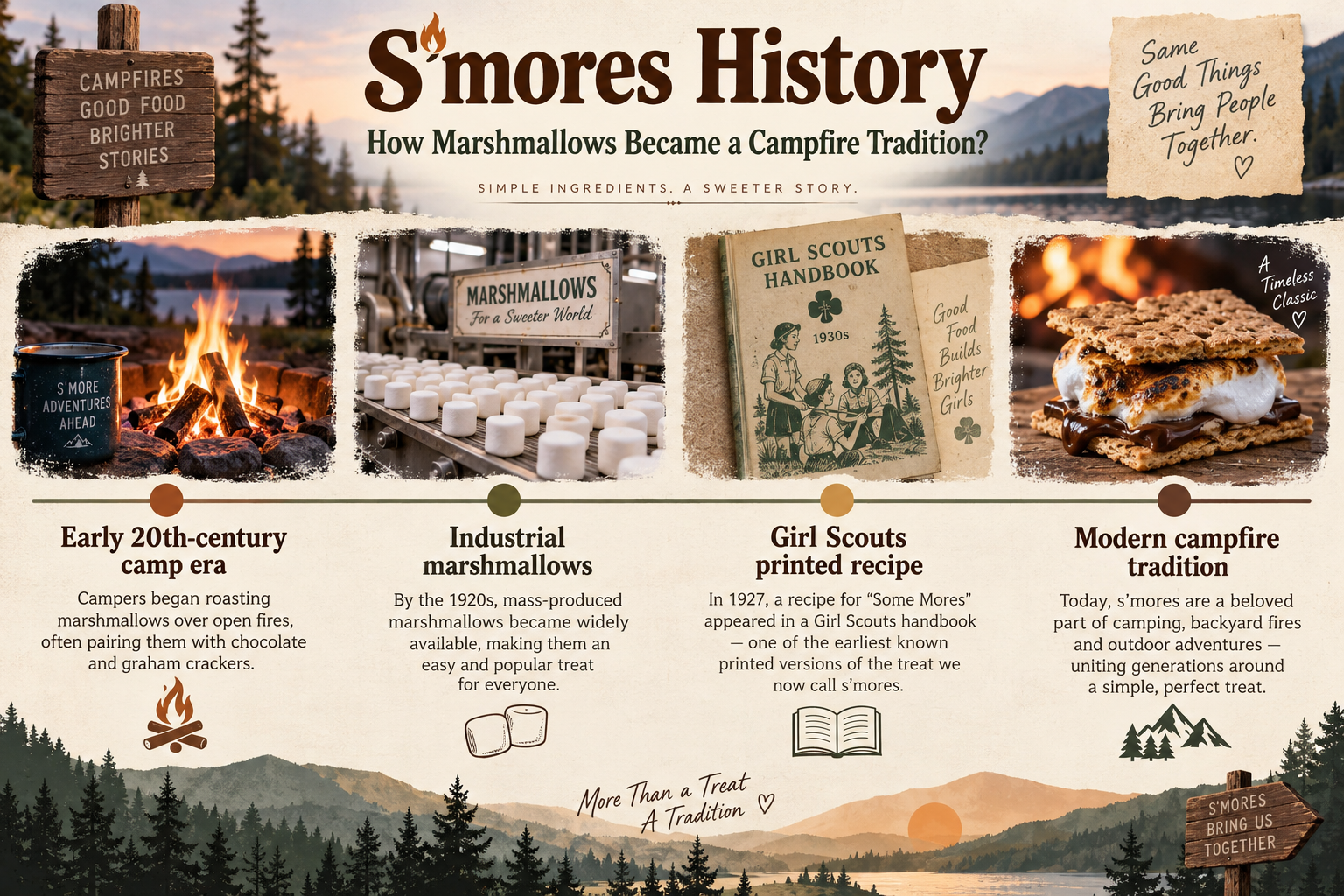
S’mores became a campfire tradition when industrial marshmallows met early 20th-century camp culture, and organizations like the Girl Scouts documented a recipe rather than invented it1 [to be verified]. The practical takeaway: treat s’mores as a modern, usage-driven format. Select marshmallow shapes, densities, and packs for real scenarios, not myths.
If you lead a seasonal program, a private label line, or a beverage menu, the next sections translate s’mores history into concrete SKU choices. I will share the questions buyers ask me each camp season and how we build factory-ready specs that toast well, travel well, and merchandise cleanly.
What does s’mores history actually tell us about the origin?
We all love a good origin story. The problem is that romantic stories can send teams chasing “authentic” specs that never existed. The agitation shows up in returns and messy demos. The solution is to separate roasting marshmallows from the later chocolate-graham stack and let documented milestones guide our product logic.
S’mores history points to early 20th-century references [to be verified], with the Girl Scouts popularizing a printed recipe, not inventing the concept. Industrially made marshmallows made consistent toasting possible at scale. Buyers should frame s’mores as a modern camp-era format and align SKUs to those real-world conditions.
Early mentions and the Girl Scouts [to be verified]
I am not a historian, and I will not make definitive origin claims. However, trade articles and cookbooks cite early 20th-century mentions of a “some more” or similar recipe [to be verified]. Girl Scouts publications helped spread the idea nationally [to be verified], but the organization did not magically invent it. This matters because it prevents us from retrofitting Victorian-era romance onto a very practical, modern treat.
Industrial marshmallows enabled the ritual
Factory marshmallows standardized size, density, and surface finish.2 That repeatability allowed families and camps to roast without the unpredictability of earlier confections. In procurement terms, a repeatable melt and toast profile matters more than lore. When a US chain buyer once asked me for “old-world s’mores,” I explained that the camp stack is modern and suggested focusing on how the marshmallow performs over a fire and under pressure between crackers.
Buyer takeaway: modern ritual, scenario-first specs
If s’mores history shows anything, it is that consistency built the tradition. Your selection criteria should follow suit:
- Define the use environment (open campfire, backyard firepit, indoor toaster).
- Choose shapes that roast uniformly and stack neatly.
- Match packaging to travel, heat, and hygiene constraints.
- Support the story on-pack in a small sidebar rather than making it the main pitch.
How should s’mores history guide campfire kit SKUs?
Camp kits fail when marshmallows slip off skewers, weld to the bag, or ooze unevenly. The stress hits your returns and reviews. The solution is to create shape, density, and finish specs that behave predictably at a campfire and to pair them with longer sticks and resealable bags.
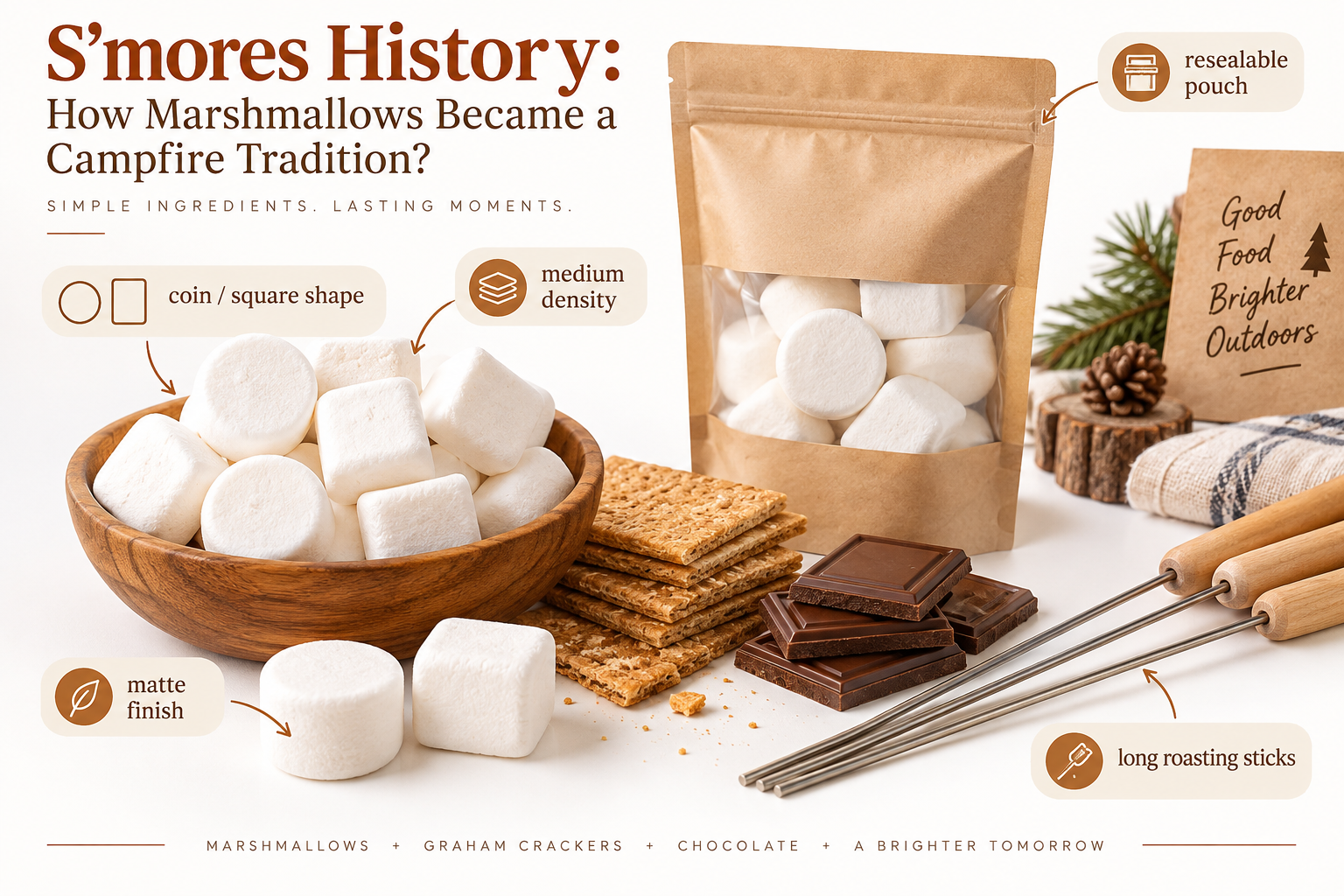
S’mores history tells us that kits should prioritize performance: flatter coins or squares that melt fast and stack cleanly, density that holds on a skewer, light anti-stick dusting to prevent mess, and resealable packs. Add longer sticks, storage guidance, and minimal, clear instructions on pack.
Shapes and densities that roast right
- Coin-like or slightly flattened squares encourage even melt and cleaner stacking.
- A medium density holds on skewers but still compresses between crackers.
- Light anti-stick dusting reduces bag weld and sticky fingers at the campsite.3
In one anonymized brief, a US outdoor retailer asked for marshmallows that “don’t roll off the graham.” We proposed a 6–8 gram coin with a matte finish. Field testing with their store staff reported cleaner assembly and fewer cracked crackers.
Sticks, packs, and on-pack instructions
- Include or cross-merch longer sticks (28–32 inches4) for safety and control.
- Use resealable pouches with internal slip liners to manage humidity and heat.
- Add micro-instructions and pairing icons (cracker + chocolate + marshmallow) to reduce friction for first-time users.
Practical checklist for camp kits
- Finish: matte, lightly dusted to release cleanly.
- Shape: coin/square; height under 15 mm for steady melt.
- Pack: resealable, travel-friendly, with internal barrier liner.
- Accessories: longer sticks or clear cross-merch signage.
- Labeling: outdoor storage guidance, and regional allergen accuracy.
We can build to these specs in OEM or ODM formats, but I always encourage buyers to validate in live-fire tests before locking the mold. We provide samples for exactly that reason.
Which shapes fit retail shelves without rewriting s’mores history?
Retail buyers juggle familiarity and novelty. The wrong novelty can slow velocity. The solution is a dual-track assortment: standard cylinders for the core and themed shapes for storytelling, both engineered to toast evenly and de-bond from packaging under store heat.
S’mores history supports a familiar core SKU and a seasonal themed SKU. Cylinders deliver reassurance, while themed shapes carry the seasonal story. Use finishes that toast evenly and avoid pack weld. Offer multi-serve formats with gentle portion cues so families pace usage.
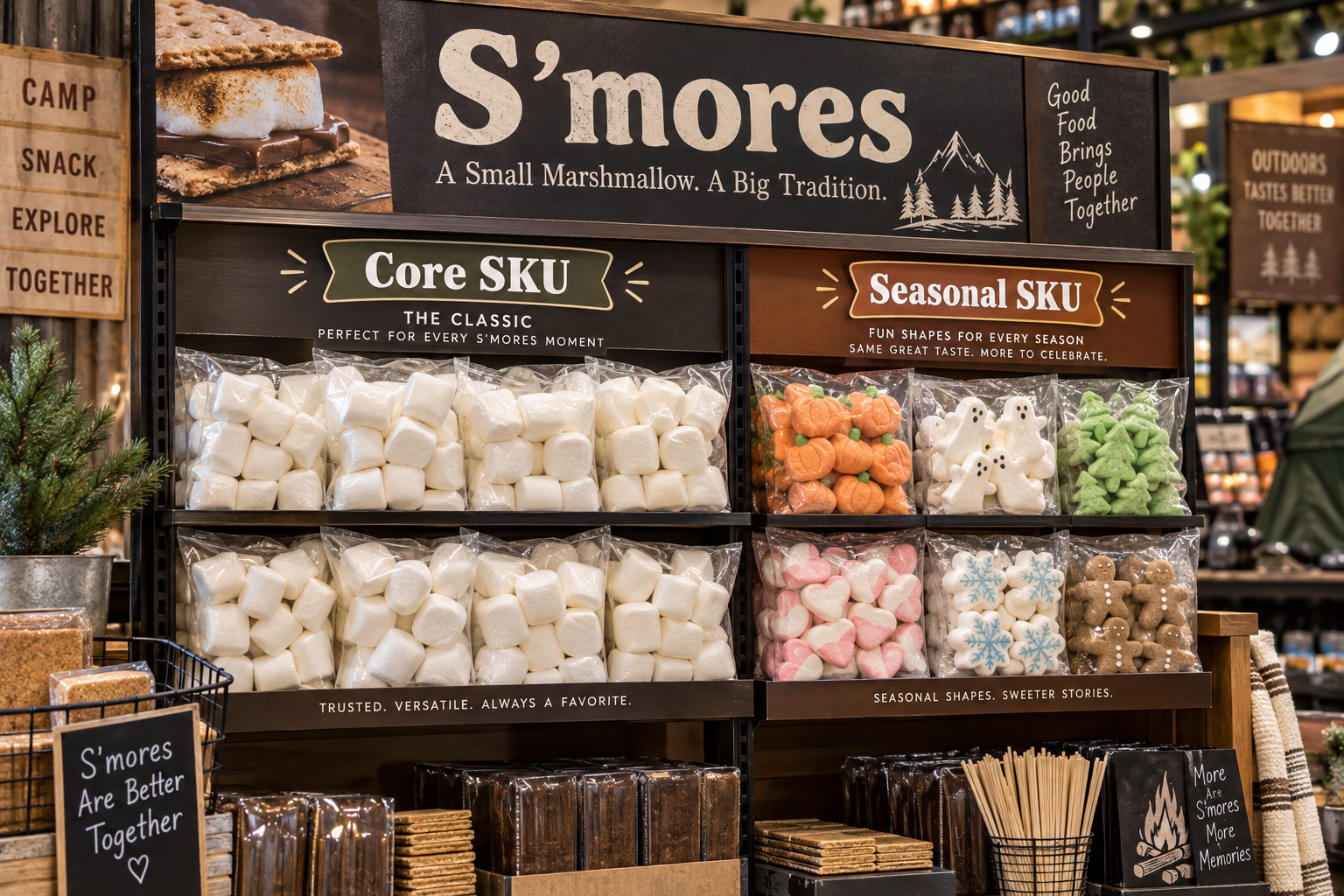
Core vs. themed: a practical comparison
| Option | Strengths | Watchouts | Best Use |
|---|---|---|---|
| Standard cylinder | Familiar, broad appeal; strong shelf velocity | Can roll off grahams if too tall; uneven browning if glossy | Everyday core SKU |
| Coin/square | Stack cleanly; faster melt; cleaner bite | Less familiar; requires illustration | Camp kits; educator SKUs |
| Themed shapes (seasonal) | Storytelling; giftable; social-friendly | Must toast evenly; avoid thin tips | Seasonal endcaps; kids’ promos |
Finish and portioning
A lightly matte surface toasts more evenly than a slick gloss, based on in-store demos we conduct with category managers. For family packs, subtle portion cues (e.g., score lines on coins or grouped minis) help parents manage portions without scolding. One EU buyer asked for “Halloween bats that don’t scorch.” We thickened the wings, added a matte finish, and included an on-pack “rotate while toasting” icon.
Packaging to suit shelves
- Heat-aware design: films with anti-block coatings to prevent sticking at 25–30°C store conditions.5
- Structural support: avoid window boxes that deform without internal tray support.
- Multi-serve reseal: maintain freshness after the first backyard session.
Label a small sidebar with a brief s’mores history note to support storytelling, but keep the hero message about usage and taste. The history should complement, not dominate.
How do events and gifting packs bring s’mores history to life?
Event planners need portion control and hygiene. Gifts need a neat unboxing. The pain shows up when marshmallows smudge packaging or stick in warm venues. The solution is individually wrapped or duo-packs, clear micro-instructions, and well-chosen films to release cleanly.
S’mores history fits events when packs are tidy and intuitive. Use individually wrapped or duo marshmallows for hygiene, add pairing icons to speed assembly, and specify films and liners that reduce heat stickiness. Include clear allergen statements and regional compliance for EU/US gifting markets.
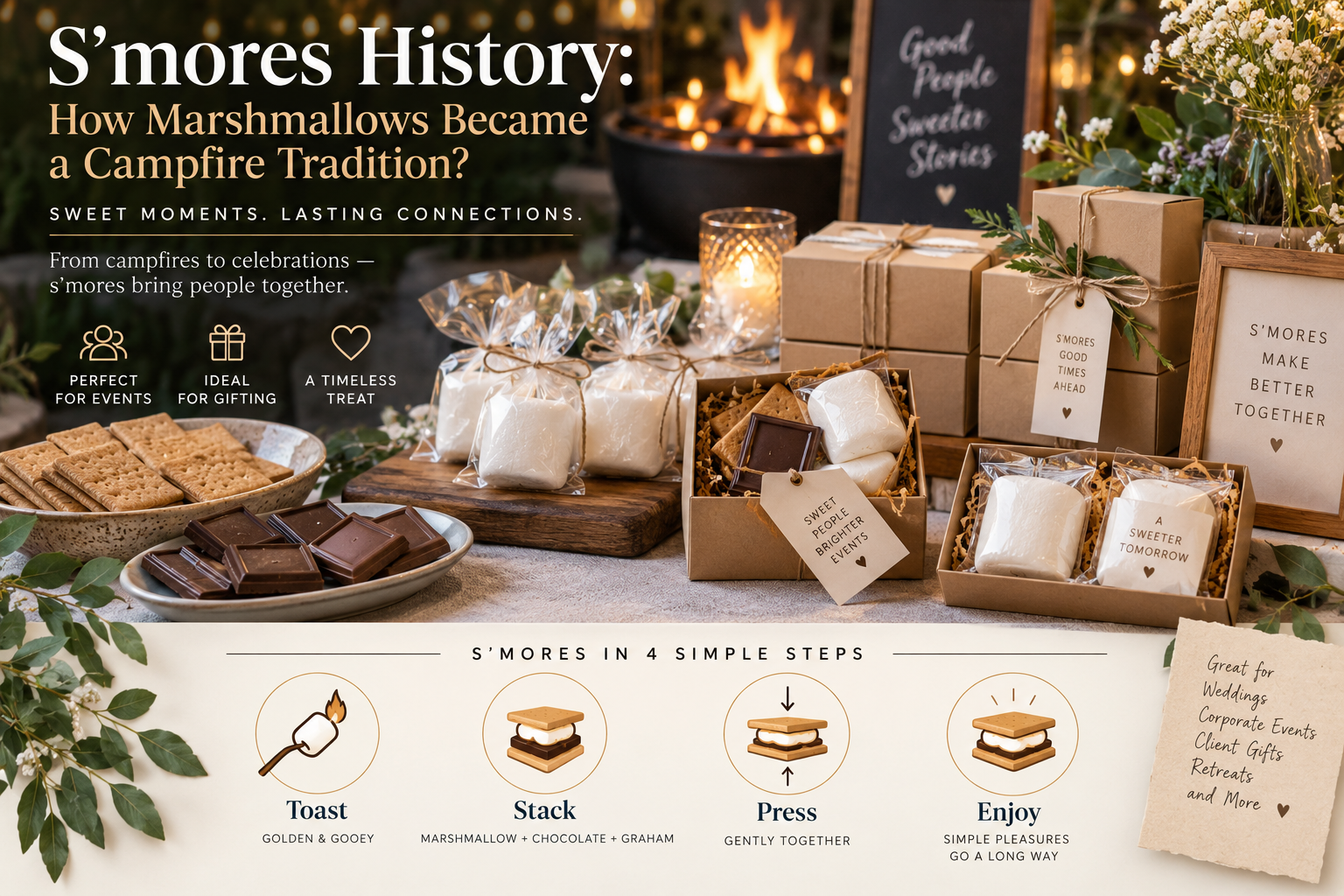
Portion, hygiene, and micro-instructions
- Individually wrapped or duo-packs minimize touchpoints.
- Include simple steps: toast, stack, press, and enjoy.
- Pairing icons and QR video links help hosts manage large groups.
An anonymized corporate client requested “logo s’mores favors” for 2,000 attendees. We recommended duo-packs with a short QR tutorial. The client reported faster lines and less waste because guests knew exactly how to assemble.
Films, liners, and heat
- Select low-blocking films with a light internal dusting or liner sheet.
- Avoid bare-window cartons without trays; the product deforms under event lighting.
- For EU winter markets, specify anti-condensation liners to prevent clumping when moving from cold to warm rooms.6
Compliance and claims
- Keep regional allergen labeling precise. Graham crackers may contain wheat; chocolate may include milk derivatives.7
- Place storage/use guidance on-pack: “Store cool and dry; avoid direct sun; reseal after use.”
- For private labels, buyers should verify documents such as BRC, ISO 22000, HACCP8, FDA facility registration9, and SMETA audits. We hold these certifications, and I encourage verification during vendor onboarding.
Can beverage programs honor s’mores history without messy mugs?
Cafes want the s’mores vibe without sink-clogging marshmallow sludge. The agitation is real: sticky finishes clump and collapse foam. The solution is small shapes or cut-outs that soften quickly, balanced density, and non-tacky finishes that behave in warm environments.
S’mores history in beverage programs calls for minis or thin cut-outs that melt gracefully. Choose finishes that do not stick or clump, pack in moisture-safe formats, and provide café-friendly portion cues. Avoid sticky gloss finishes that weld together in warm back-of-house conditions.
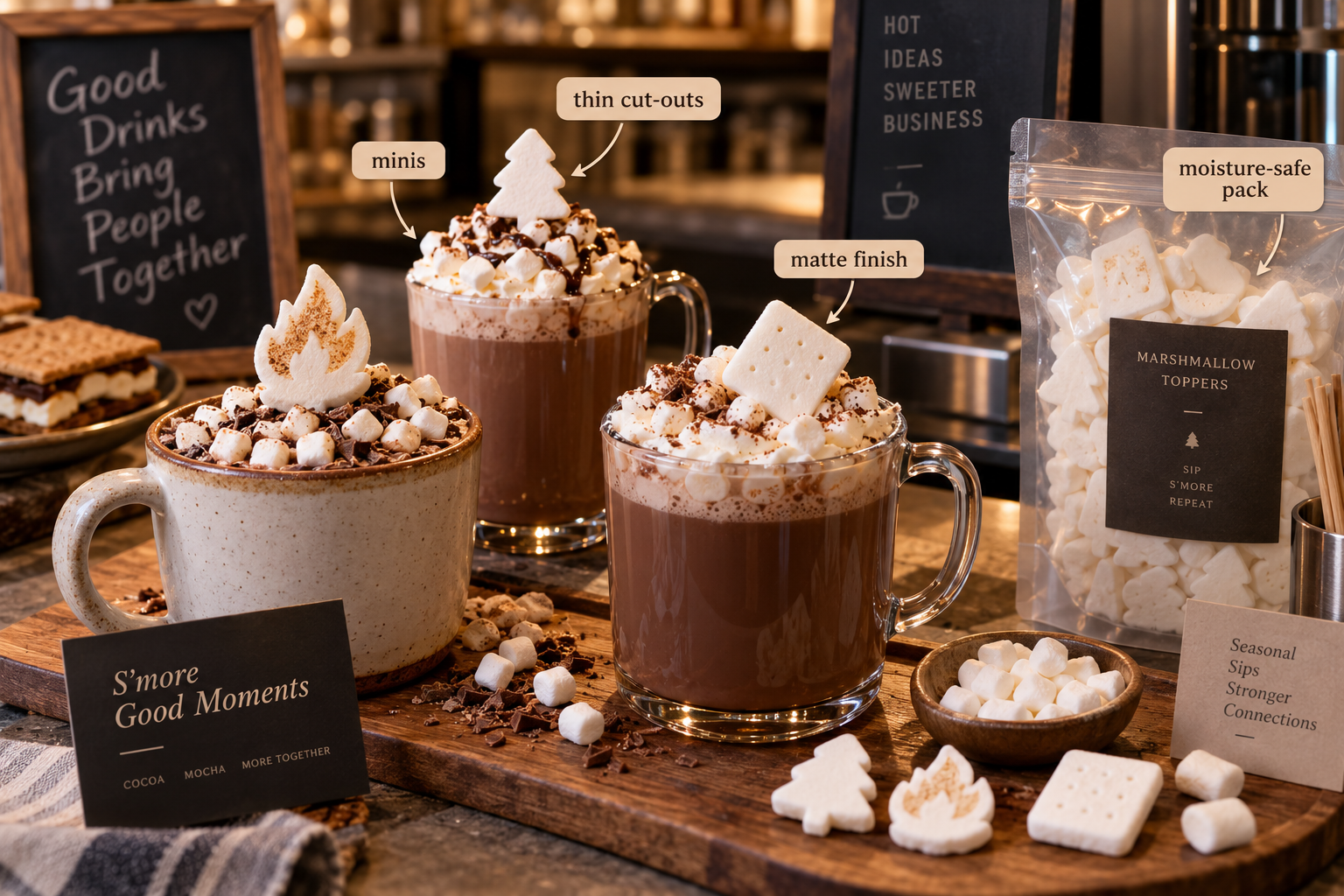
Cocoa toppers and size choices
- Mini coins or small cut-outs sit on foam, soften, and release flavor without collapsing the drink.
- Keep weight consistent so baristas can standardize topping quickly.
I had a beverage manager in Germany ask how to stop “sticky snow” in their cocoa jar. We switched to a matte finish mini with a desiccant sachet per tub and moved to a narrower jar that reduced headspace humidity. Clumping dropped dramatically.
Packaging for warm bars
- Use jars or pouches with a moisture barrier; include clear “seal after each use” guidance.
- Avoid shiny finishes; matte surfaces separate more easily.
- Offer duo-portion sachets for high-traffic events to speed service and maintain hygiene.
Menu storytelling
A brief nod to s’mores history on the menu—“inspired by camp-era s’mores”—adds warmth without overpromising authenticity. Keep the story short; let the texture and melt do the talking.
What packaging and merchandising guardrails matter beyond s’mores history?
Heat, humidity, and display choices can undercut even the best shapes. The pain point is predictable: stuck product, misshapen displays, and weak basket sizes. The solution is clear: anti-stick measures, supportive structures, and bundling strategies that lift the entire category.
S’mores history suggests performance-first choices: anti-stick dusting or liners, films that release under heat, and robust inner supports. Bundle crackers and chocolate to grow baskets, and keep the history note as a sidebar. Label storage/use guidance prominently for outdoor and travel scenarios.
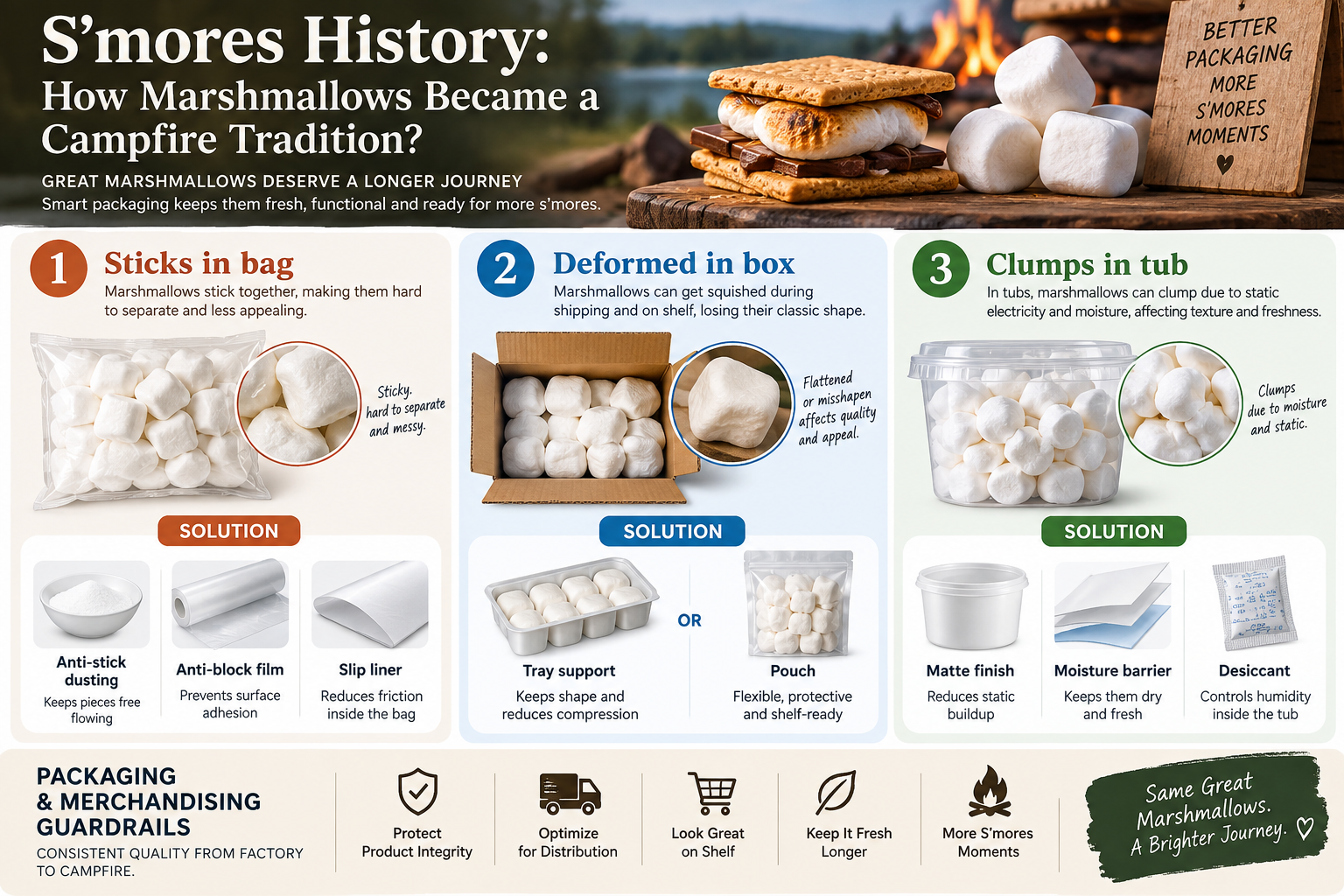
Heat and stickiness countermeasures
| Problem | Likely Cause | Countermeasure |
|---|---|---|
| Product sticks inside bag | High gloss finish; no liner; warm shelf | Add light dusting; use anti-block films; insert slip liner |
| Deformed shapes in window box | No internal tray; high ambient heat | Add tray; switch to pouch; reduce window or add support |
| Clumping in tubs | Warm, humid back-of-house | Matte finish; moisture barrier; desiccant; staff re-seal training |
Display and bundling
- Camp-ready kits: bundle crackers and chocolate to increase basket size.
- Travel-friendly formats: resealable, carry-loop pouches for campground shoppers.
- Secondary placement: cross-merch near firewood or outdoor sections to signal use cases.
Labeling and guidance
- Outdoor storage guidance on the back panel.
- Regional allergen, additive, and claim compliance with EU/US differences noted in a small box.
- QR links to brief safety tips for young roasters.
We structure these guardrails into our OEM specs. Buyers should review supplier QA controls and verify certifications. We share our BRC, FDA registration, SMETA, ISO 22000, HACCP, and GMP documents upon request.
How should seasonality and timelines map from s’mores history to your calendar?
S’mores are not only a summer niche. Teams miss fall bonfires and winter cocoa bars when they plan late. The pain is lost shelf weeks. The solution is to map stories and SKUs to seasonal windows and work backward from on-shelf dates through design, samples, packaging, production, and transit.
S’mores history aligns with multiple seasons: summer camp/backyard, fall bonfires/back-to-school, and winter cocoa bars/holiday gifting. Work backward from on-shelf dates. Lead times depend on customization and route; lock molds, proofs, and compliance reviews early to protect launch windows.
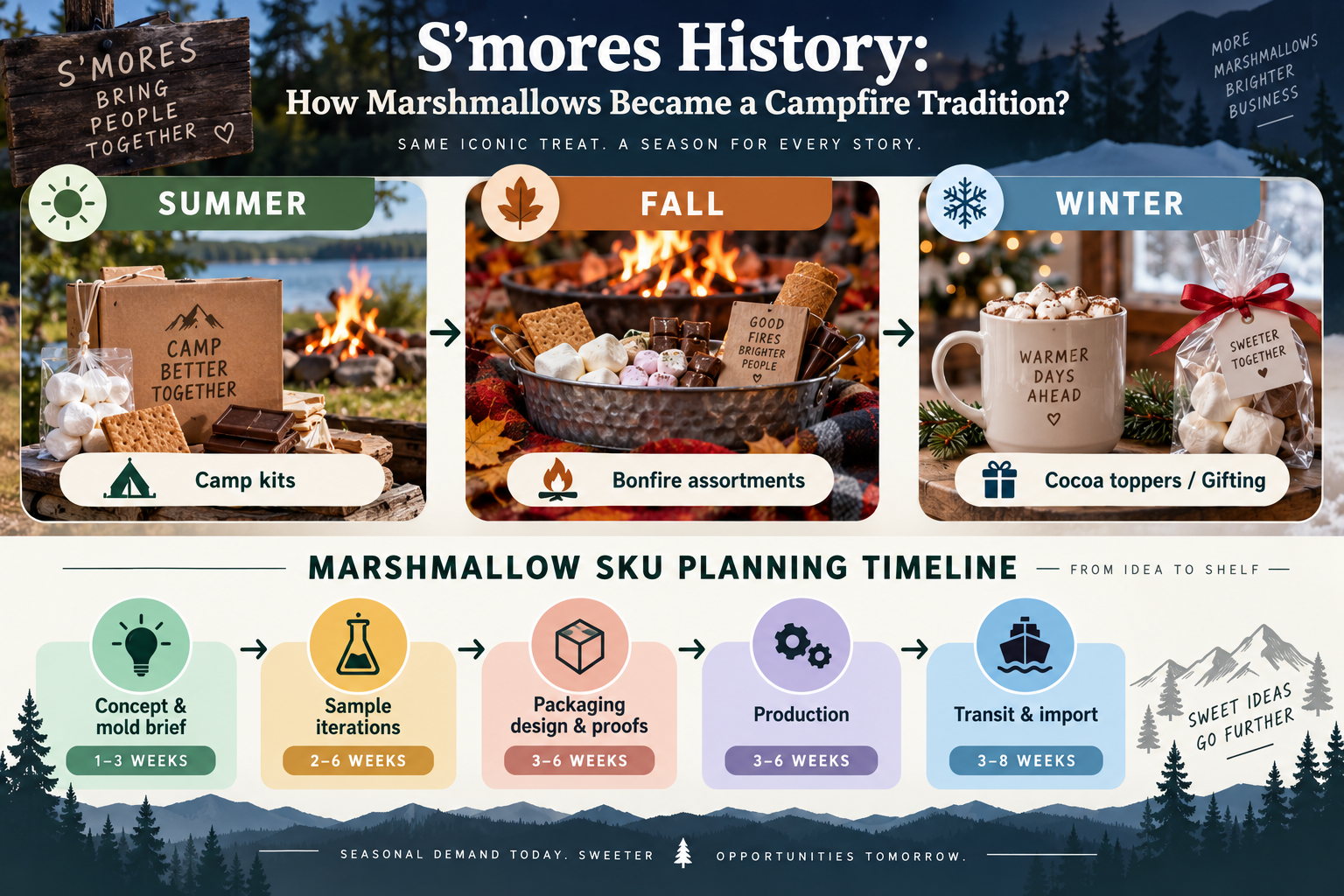
Seasonal windows and narratives
- Summer: camp kits, travel pouches, kid-friendly themes.
- Fall: bonfire assortments, back-to-school lunchbox minis.
- Winter: cocoa toppers, gifting boxes, holiday shapes.
Typical planning stages and ranges
Note: ranges are indicative; actuals depend on customization complexity and shipping routes.
| Stage | Typical Range | Notes |
|---|---|---|
| Concept & mold brief | 1–3 weeks | Align on shapes, density, finish |
| Sample iterations | 2–6 weeks | Live-fire or in-mug tests recommended |
| Packaging design & proofs | 3–6 weeks | Include liners, supports, and compliance text |
| Production window | 3–6 weeks | Depends on volume and line allocation |
| Transit & import | 3–8 weeks | Route and mode affect timing; plan buffers |
I advise buyers not to promise fixed timelines to their stakeholders. Instead, communicate dependency-based ranges and set clear approval gates. For private labels, build in time for retailer QA, artwork approvals, and third-party testing if required.
Practical planning tips
- Start winter cocoa toppers by late summer.
- Lock summer camp kits before spring to secure shelf weeks.
- For EU markets, allow extra time for multilingual labeling10 and regulatory reviews.
Frequently Asked Questions
Did the Girl Scouts invent s’mores?
No definitive evidence says they invented s’mores. Girl Scouts publications helped popularize a recipe in the early 20th century [to be verified]. I avoid origin claims and focus on how the treat behaves in real use. That lens makes better product and packaging decisions.
What marshmallow shape is best for classic s’mores?
For clean stacking and even melt, flattened coins or squares work better than very tall cylinders. Cylinders are familiar and sell well, but coins reduce sliding and cracked crackers. The right density holds on skewers while compressing between grahams.
How do I prevent marshmallows from sticking in warm stores?
Specify a light anti-stick dusting, choose anti-block films, and add internal slip liners. Avoid high-gloss finishes that weld under heat. Include storage guidance on-pack and avoid window boxes without internal trays. These steps reduce returns and messy demos.
How far ahead should I brief a private-label s’mores kit?
Work backward from the on-shelf date and allow for mold approvals, sampling, packaging proofing, production, and transit. A cautious plan might allow 12–24 weeks total, depending on customization and shipping route. Always communicate dependency-based ranges internally.
Which certifications should I verify for a marshmallow supplier?
Ask for and verify BRC, ISO 22000, HACCP, and, for US distribution, FDA facility registration. SMETA or equivalent social audits matter for retailer onboarding. We hold these credentials, and I recommend buyers validate documents during qualification.
Conclusion
S’mores history shows a modern camp-era tradition enabled by industrial marshmallows, not a 19th-century staple. Treat that insight as a practical compass: select shapes, densities, finishes, and packs that fit real scenarios—camp kits, retail shelves, events, and beverage programs—across summer, fall, and winter. If you need an OEM/ODM partner to translate s’mores history into high-performing private-label SKUs, message me. We will co-develop molds, finishes, and packaging, share our certifications for verification, and build a calendar that protects your on-shelf dates.
"S'more", https://en.wikipedia.org/wiki/S%27more. The earliest widely cited printed s’more recipe appears in the 1927 Girl Scouts handbook Tramping and Trailing with the Girl Scouts, and reference works note the origin is unknown, implying the handbook documented and popularized the treat rather than inventing it. Evidence role: historical_context; source type: encyclopedia. Supports: That the earliest widely cited printed s’more recipe appears in a 1927 Girl Scouts handbook and that the publication popularized, rather than invented, the treat.. Scope note: Earliest-known print evidence supports documentation timing but cannot prove who first assembled the combination. ↩
"Marshmallow", https://en.wikipedia.org/wiki/Marshmallow. Descriptions of modern marshmallow production explain that extrusion yields consistent cylinders and that industrial control of formulation and aeration produces relatively uniform texture in mass-produced marshmallows. Evidence role: general_support; source type: encyclopedia. Supports: That industrial extrusion yields uniform shapes and that manufacturing controls aeration and formulation affecting texture.. Scope note: Sources describe general uniformity; they do not provide quantified tolerances for density or surface finish. ↩
"Marshmallow", https://en.wikipedia.org/wiki/Marshmallow. Reference descriptions of marshmallows note they are commonly dusted with starch or powdered sugar to limit surface tack and prevent sticking to one another or packaging. Evidence role: mechanism; source type: encyclopedia. Supports: That commercial marshmallows are dusted with starch or sugar to reduce sticking.. Scope note: General mechanism is described; it does not quantify performance under specific warm-store conditions. ↩
"Campfires (U.S. National Park Service)", https://www.nps.gov/articles/campfires.htm. Government campfire safety guidance advises using long-handled utensils and keeping distance from flames, consistent with choosing longer roasting sticks for better safety and control. Evidence role: general_support; source type: government. Supports: That official campfire safety guidance recommends long-handled tools to maintain distance from flames.. Scope note: Safety materials support using long handles but typically do not specify exact lengths like 28–32 inches. ↩
"Antiblock Agents for Polymers | Reduce Blocking & Improve ...", https://www.specialchem.com/polymer-additives/guide/antiblock-agents-selection. Materials references define blocking as the tendency of film layers to adhere and explain that anti‑block additives or coatings are used to reduce adhesion and improve film release. Evidence role: definition; source type: encyclopedia. Supports: That 'blocking' is the unwanted adhesion of film layers and that anti-block additives/coatings mitigate it.. Scope note: General definition and mechanism; does not address the exact 25–30°C range or food-contact specifics. ↩
"Strategies to Reduce Moisture Condensation in Food ...", https://extension.okstate.edu/fact-sheets/strategies-to-reduce-moisture-condensation-in-food-facilities. Technical overviews explain that anti‑fog or anti‑condensation coatings on plastic films inhibit water droplet formation, keeping surfaces clear and reducing moisture buildup when moving from cold to warm conditions. Evidence role: mechanism; source type: encyclopedia. Supports: That anti-fog/anti-condensation coatings on films inhibit water droplet formation during temperature and humidity changes.. Scope note: Explains mechanism broadly; it does not provide confectionery‑specific clumping data. ↩
"Food Allergies", https://www.fda.gov/food/nutrition-food-labeling-and-critical-foods/food-allergies. The FDA identifies milk and wheat among the major food allergens that must be declared on labels when present in foods, which commonly include wheat‑based crackers and milk‑containing chocolate products. Evidence role: definition; source type: government. Supports: That wheat and milk are major allergens under U.S. law requiring declaration when present.. Scope note: Regulations specify allergens; the actual presence depends on each product’s formulation and manufacturing. ↩
"HACCP Principles & Application Guidelines", https://www.fda.gov/food/hazard-analysis-critical-control-point-haccp/haccp-principles-application-guidelines. The Codex Alimentarius General Principles of Food Hygiene set out HACCP as an internationally recognized, preventive food safety system based on identifying hazards and establishing critical control points. Evidence role: expert_consensus; source type: institution. Supports: That HACCP is an internationally recognized system defined by Codex for identifying and controlling food safety hazards.. Scope note: Codex outlines principles; certification and audit requirements vary by jurisdiction and customer program. ↩
"Registration of Food Facilities and Other Submissions", https://www.fda.gov/food/guidance-regulation-food-and-dietary-supplements/registration-food-facilities-and-other-submissions. FDA guidance states that domestic and foreign food facilities that manufacture, process, pack, or hold food for U.S. consumption are required to register with the agency as a condition of lawful distribution. Evidence role: definition; source type: government. Supports: That U.S. FDA requires food facility registration for domestic and foreign facilities that manufacture/process/pack/hold food for U.S. consumption.. Scope note: Applicability depends on specific activities and regulatory exemptions. ↩
"Food Labelling: A Brief Analysis of European Regulation 1169 ...", https://pmc.ncbi.nlm.nih.gov/articles/PMC5076719/. EU Regulation No 1169/2011 requires mandatory food information to appear in a language easily understood by consumers in the Member States where the food is marketed, typically necessitating the official language(s) of those countries for cross‑border sales. Evidence role: definition; source type: government. Supports: That EU law requires mandatory food information in a language easily understood by consumers in the country of marketing, typically the official language(s).. Scope note: The regulation sets the requirement; timelines and operational impact vary by company and market scope. ↩