Gourmet Marshmallow Subscription Box Wholesale: How to Supply?
Gourmet marshmallow subscription box wholesale projects look simple until small-batch creativity collides with fixed costs and tight ship cutoffs. Missed deliveries cause churn and refunds. Over-customization pushes unit costs over budget. I solve this by locking cadence first with existing molds, then adding bespoke features once volumes and margins can absorb tooling and changeovers.
Gourmet marshmallow subscription box wholesale supply works best with a cadence-first plan: use existing molds plus custom color/flavor to hit ship cutoffs and protect unit economics; pilot logo tooling only when forecasted inserts can amortize the mold within target cost-per-insert. Align spec/BOM, QA, pack-out, and logistics to monthly deadlines and confirm all assumptions with your supplier.
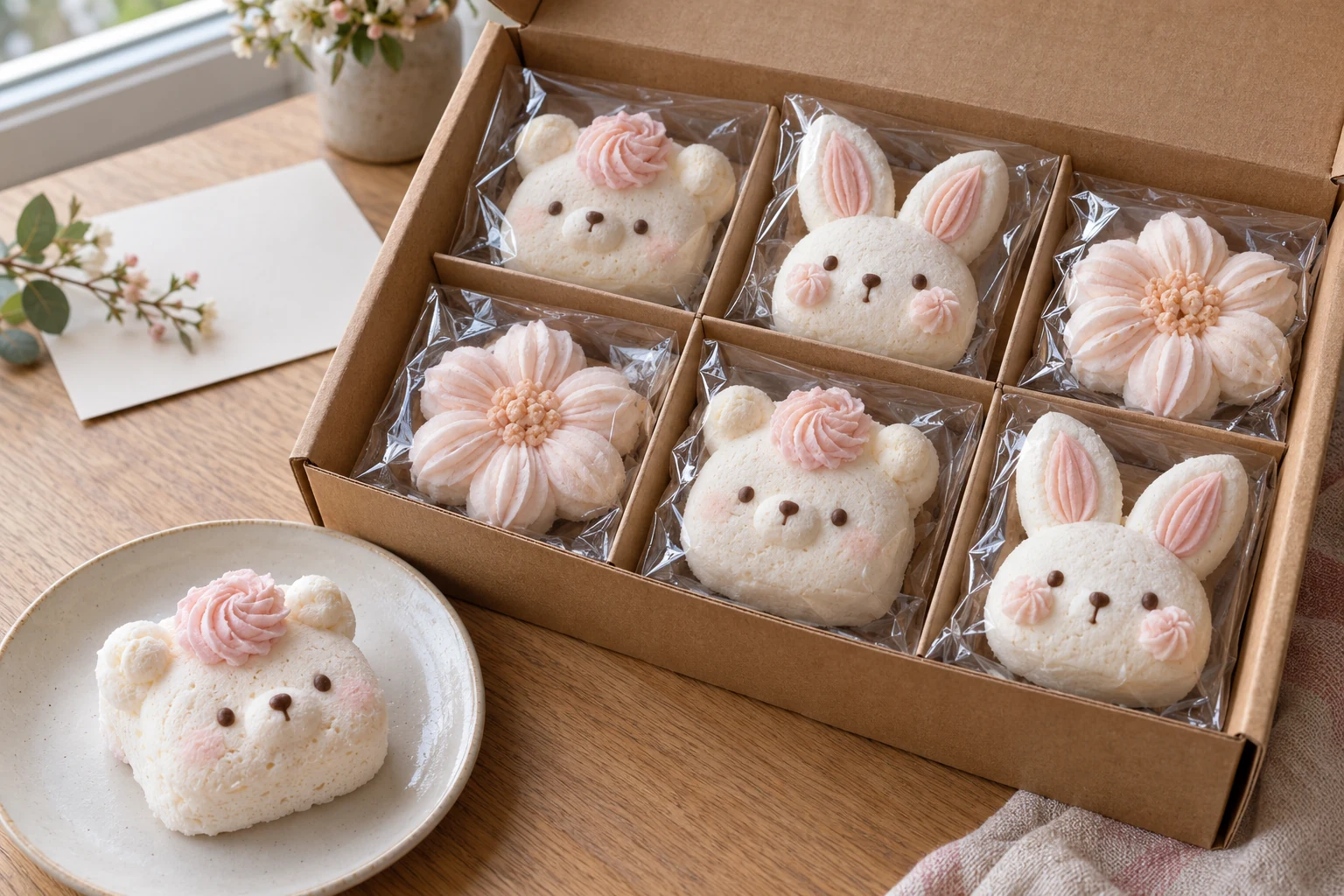
The rest of this guide breaks down the real cost stack, a reliable scheduling template, sea vs air decisions, and how to pilot new tooling without cost shock. I add an RFQ checklist and kitting pointers I use with Western subscription-box teams so you can secure approvals faster and protect margins.
What is the real cost stack in gourmet marshmallow subscription box wholesale?
Small batches feel budget-friendly until fixed costs sit on every unit. Delays and over-spec add hidden losses. The remedy is a clean unit-economics model and a “custom later” rule. I break costs into controllable blocks, then default to existing molds with color/flavor tweaks before commissioning logo tooling.
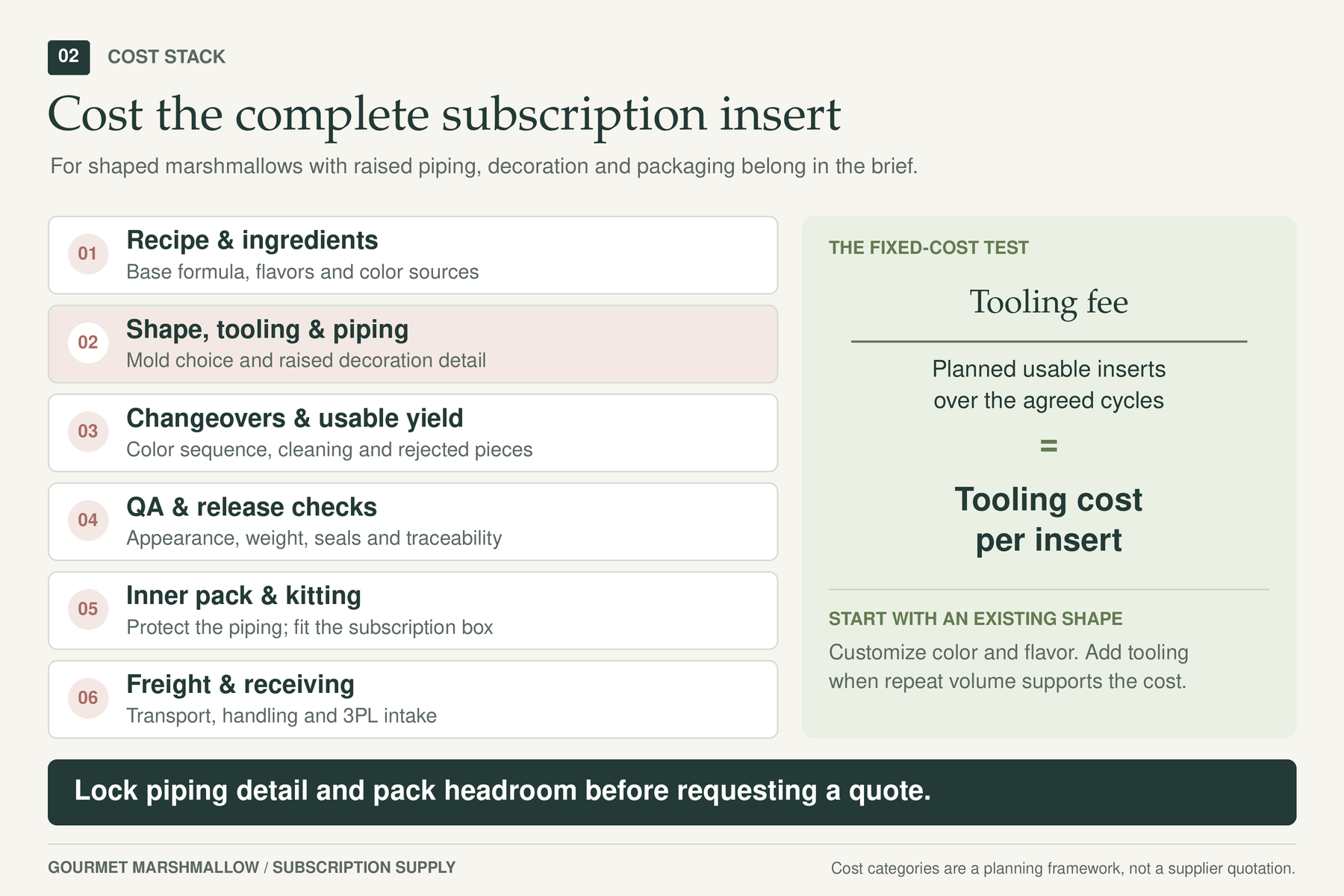
The cost stack for gourmet marshmallow subscription box wholesale includes recipe tier, tooling amortization, color/flavor changeover loss, QA controls, packaging materials, and logistics. Highly customized small runs push fixed costs into each unit. Default to existing molds + customized color/flavor; open new logo tooling only when forecasted inserts amortize the fee within the target cost-per-insert.
Dive deeper
- Base formulation and ingredient tier: Premium vanilla, natural colors, or specific gelatin sources raise base cost. I keep two to three standard recipes that meet most needs, then quote up or down for special restrictions. “Gourmet” in practice means consistent formulation and controlled texture, not marketing words.
- Tooling and mold amortization: Custom logo molds typically involve dedicated tooling. In past projects, tooling fees ranged from approximately $800–$2,500, with 2–4 weeks needed for fabrication and sampling, depending on complexity (to be confirmed per spec).1 If a subscription only needs one cycle of 10–20k units, that tooling fee adds $0.04–$0.20 per insert quickly.
- Changeover loss: Each color or flavor change introduces cleaning, purging, and yield loss. On small runs, I see 3–8% loss depending on sequence and setup.2 That loss inflates cost per usable unit, especially with multiple colors in the same batch.
- QA and consistency controls: Subscription inserts must repeat well. Extra checks—texture testing, weight checks, and color tolerances—add labor. If you add tight RGB/hex color tolerances or micro-lot tracking, we plan for more in-line checks and documentation time.
- Inner-pack and outer-pack materials: Units per inner, bag film spec, label languages, and carton dimensions all change cost. Inner packs with individual wraps raise labor and materials. I cost these upfront and advise a standard pack spec unless retail channels require multi-language labels3.
- Logistics: Air for pilots, sea for rotations. Air is faster and pricier; sea is efficient if time allows.4 We provide EXW/FOB/CIF quotes with clear Incoterms5, never implying to-door coverage6; you should align with your 3PL. Transit times and surcharges change seasonally.
Decision rule I use with buyers:
- Start with existing molds and a custom color/flavor, unless a logo is mission-critical.
- Open new tooling only when you forecast enough inserts across a defined horizon to amortize the tooling fee within your target cost-per-insert.
- Confirm the forecast, margins, and timing before authorizing tooling. If the pilot misses cost or timing, revert to existing molds to hit the cutoff.
As one example, a European holiday box planned a logo marshmallow for a 25k-unit insertion. Tooling would have added $0.06 per unit for just one cycle. We instead used an existing star shape, nailed the brand color with a natural hue, and hit their per-insert budget. We reserved the logo mold for the following year’s larger run when the amortization penciled out.
Why does cadence-first planning beat creativity-first in gourmet marshmallow subscription box wholesale?
Creativity without scheduling discipline breaks deadlines. Subscription calendars keep moving, but sampling, changeovers, and factory closures are real bottlenecks. I plan backward from ship cutoff dates, lock the spec and BOM early, and build buffers so product ships on time, consistently.
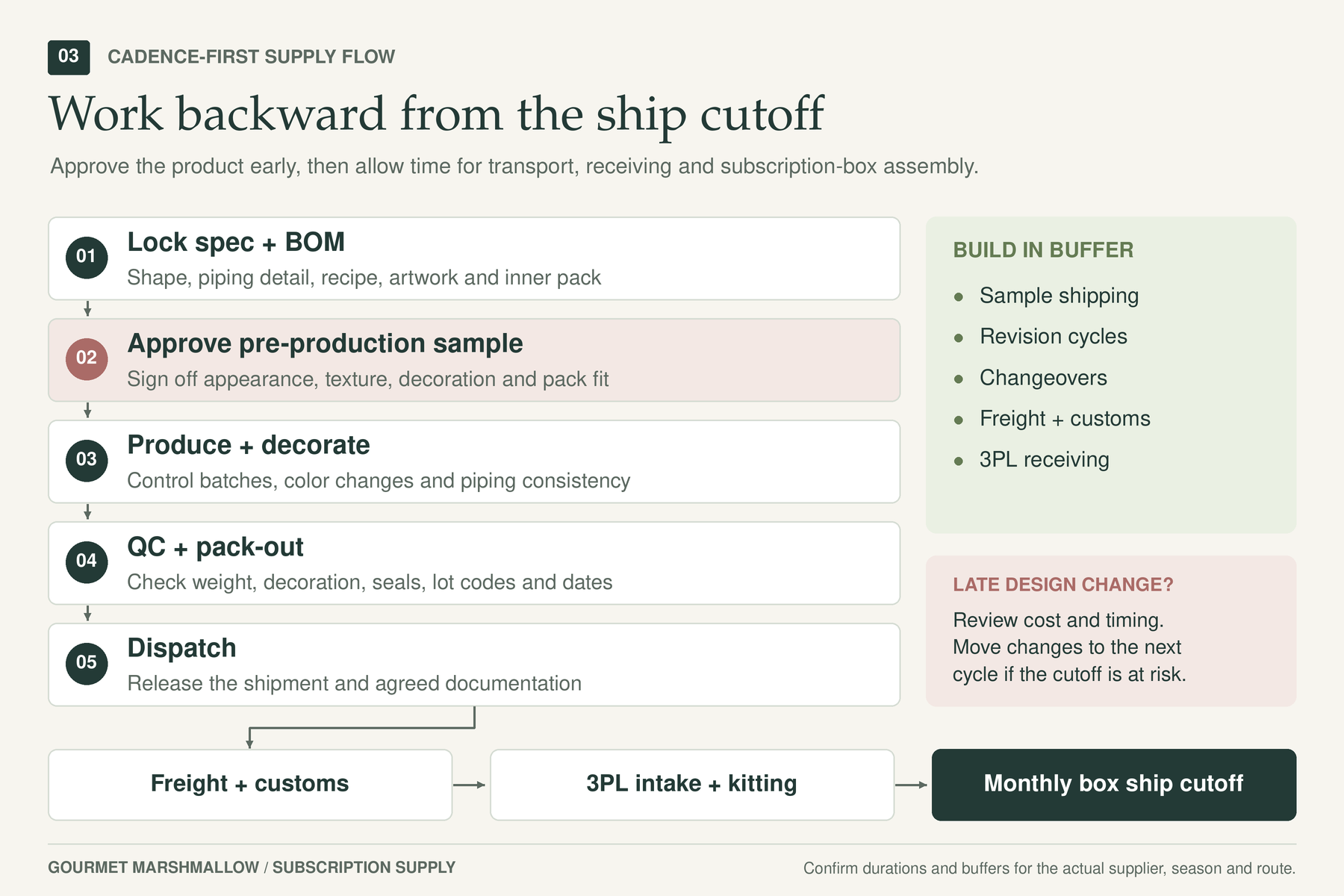
Cadence-first planning for gourmet marshmallow subscription box wholesale sets a repeatable template: spec/BOM lock → pre-production sample signoff → mass production → QC and pack-out → dispatch. Align every step to the monthly cutoff, build buffers around sampling and changeovers, and prioritize repeatability over last-minute customization.
Dive deeper
I use a standard cadence template that buyers can map to their box timeline. The exact durations must be confirmed per spec and seasonality, but the sequence remains consistent:
- Spec and BOM lock: 1–2 weeks
- Finalize mold (existing vs logo pilot), color and flavor, recipe tier, and inner-pack format. Provide any retailer or channel requirements early. Lock artwork and barcode rules.
- Pre-production sample (PPS) signoff: 1–3 weeks
- We produce color-accurate and flavor-accurate PPS. International courier times vary; I recommend planning a 3–5 day shipping buffer. Signoff starts the production clock.
- Mass production window: 2–4 weeks (factory- and spec-dependent)
- Duration depends on total volume, color variations, and changeover constraints. Fewer color switches usually mean faster throughput and lower loss.
- QC and pack-out: 3–7 days
- We run checks on weight, moisture, and color tolerance per agreed limits. Pack-out follows your inner/outer pack specs with lot coding and date marks.
- Dispatch aligned to ship mode:
I anchor this cadence to the buyer’s monthly ship cutoff. For one North American subscription client, the 3rd-week cutoff meant we had to dispatch no later than the 1st week of the month by sea. We kept a 2-week buffer for unexpected sampling revisions. When a creative tweak appeared late, we parked it for the next cycle rather than risking the month’s dispatch.
Reorder logic matters. I recommend a simple trigger tied to subscriber count and churn:
- Maintain at least 1.5 cycles of on-hand coverage at the 3PL plus pipeline inventory for sea shipments.
- Increase coverage to two cycles during peak seasons or when holiday closures are imminent.
- For pilots, consider air shipments with smaller wave releases before switching to sea for steady rotations.
Cadence-first planning reduces surprises. It assures your customer experience stays intact even if one flavor or color iteration waits for the next cycle.
Sea or air: how should you ship gourmet marshmallow subscription box wholesale pilots and rotations?
Pilots need time certainty; rotations need cost control. Air freight often wins for pilots. Sea freight wins when the cadence is predictable. I choose modes based on timing risk, volume, and per-insert budget, and I buffer for customs and 3PL intake.
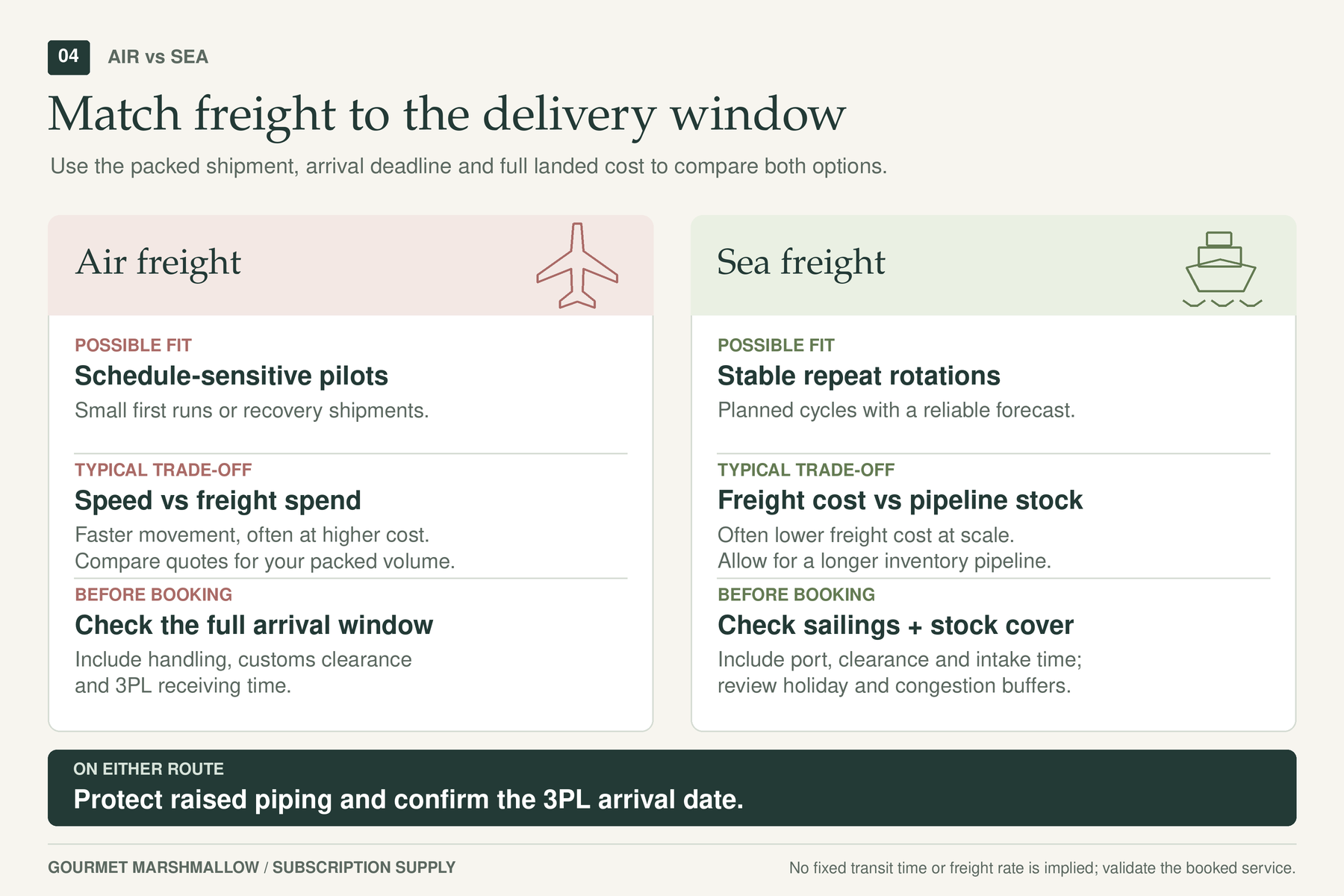
Use air for time-certain pilots and sea for predictable rotations in gourmet marshmallow subscription box wholesale. Air secures schedule confidence at higher cost; sea protects unit economics once cadence stabilizes. Build realistic buffers for customs, holidays, and 3PL intake to avoid missing monthly cutoffs.
Dive deeper
I frame the trade-off using a simple view:
- Air freight
- Pros: Reliable transit time, lower inventory in transit, flexible for pilots and last-minute changes.
- Cons: Higher per-kilo cost, potential to blow per-insert budgets if used beyond pilot phases.
- Typical use: First insertion or brand-critical re-launch, or when sampling timelines slip and you still must meet a cutoff.
- Sea freight
- Pros: Lowest freight cost at scale, predictable for well-planned cycles.
- Cons: Longer lead time, sensitive to port congestion or holiday shutters.
- Typical use: Established monthly or quarterly rotations with stable forecasts.
Example history from my schedule book: A DTC microbrand launched a Valentine’s pilot at 8k inserts. We shipped air to guarantee arrival before the 3rd-week cutoff. Two cycles later, they locked a 24k run and moved to sea with 1.5 cycles of coverage in the 3PL. Their per-insert logistics cost dropped by roughly 60%, while the buffer absorbed a week-long customs delay without missing deliveries.
I include logistics planning in every quote as clear Incoterms:
- EXW/FOB: you arrange main freight; we prepare goods per spec. Buyers with existing consolidations and strong forwarders prefer this.
- CIF/CFR: we include ocean freight to your port; you handle destination charges and last-mile. Many subscription teams use their 3PL’s brokers at destination.
I never promise to-door outcomes. Customs, taxes, and last-mile are your logistics partners’ scope. What I own is a dispatch-ready schedule, compliant packaging and documentation, and clear lot coding so your 3PL can receive, kit, and track inserts without friction.
How to run a brand/logo new-tooling pilot without cost shock in gourmet marshmallow subscription box wholesale?
New tooling is exciting and expensive. A loose scope, too many colors, or changing pack specs mid-way will expand cost and time. I scope logo pilots tightly, set expectations for fees and timelines, and agree on success criteria upfront to protect your monthly cutoff.
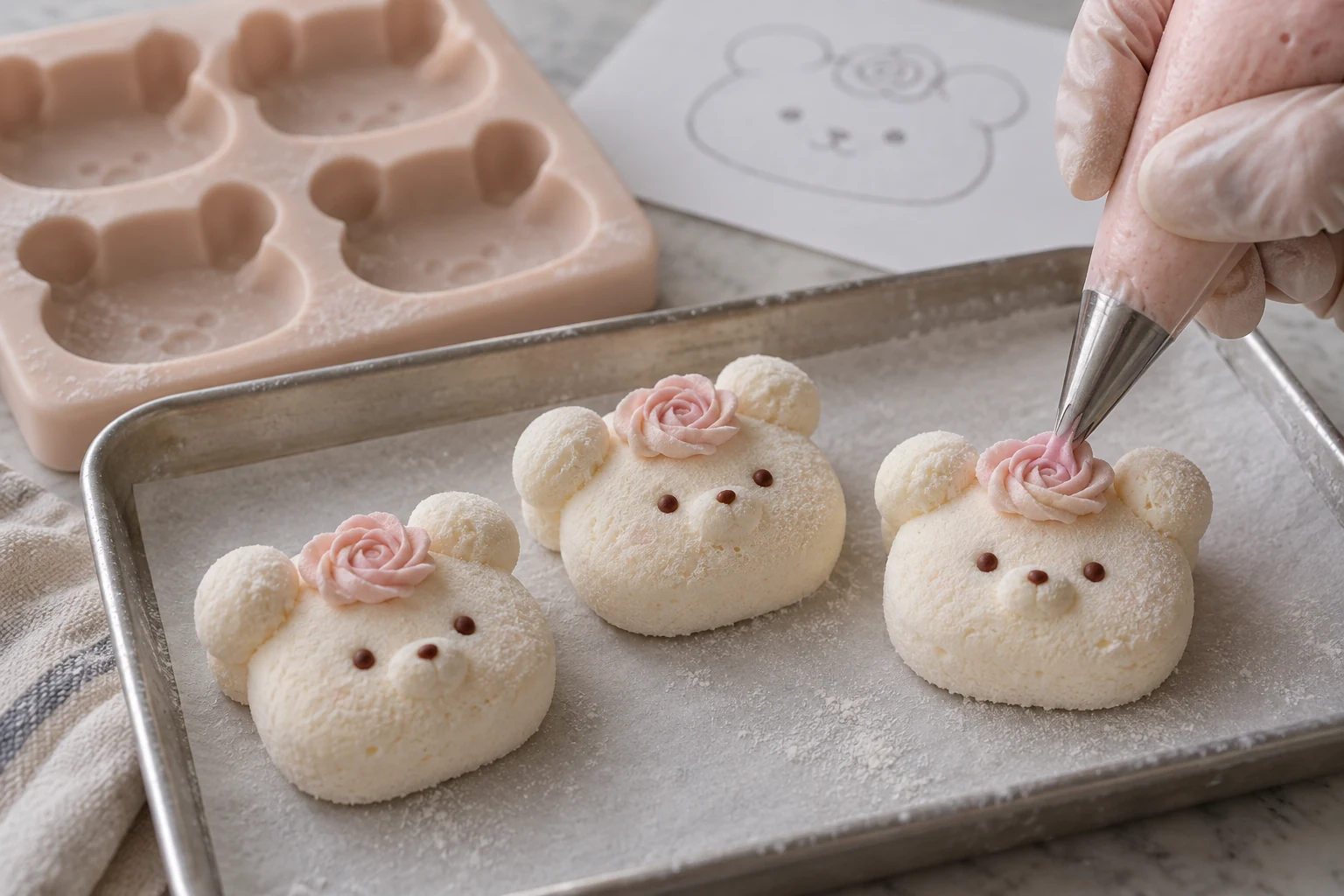
Run a tightly scoped pilot for gourmet marshmallow subscription box wholesale: one shape, 1–2 colors, one flavor, independent inner packs, and a fixed insert count. Expect a tooling fee, higher first-batch unit cost, and several weeks for tooling and samples. Pre-agree success criteria and a fallback to an existing mold if thresholds slip.
Dive deeper
A practical pilot plan I use:
- Scope definition
- One logo shape
- One flavor (e.g., vanilla) that meets your ingredient expectations
- 1–2 colors max to minimize changeovers
- Fixed insert count per inner pack
- Independent inner packs for easy kitting
- Expectations
- Tooling fee: often $800–$2,500 depending on complexity and cavity count (to be confirmed per spec)
- Timeline: tooling 2–4 weeks, then PPS, then mass production
- First batch unit cost: higher than steady-state due to amortization and pilot-scale inefficiencies
- Success criteria
- Complaint/defect threshold: set a per-10k unit limit for visible defects, damage rate, and off-color variance
- Cost-per-insert target: the pilot may exceed target by a known amount; the decision is whether rotation volumes amortize within your margin
- Feedback/NPS: collect from subscribers and internal QA
- Go/no-go rule: if cost or timing misses thresholds, switch to an existing-mold variant immediately
One anonymized example: A North American brand wanted a debossed logo shape for a spring cycle. We aligned on one color, accepted a moderate shade variance within delta-E limits, and shipped PPS for signoff. After tooling, the cost-per-insert was $0.05 above target for the pilot at 12k units. We still greenlit the pilot with a documented plan to amortize over three future insertions. If we had missed tooling timing by a week, we would have shipped the same flavor in an existing heart mold to preserve the cutoff.
The pilot’s aim is not perfection. It is a controlled test of design, process, and economics that either graduates to rotation or yields a fast fallback without sinking cost.
How to align kitting and packaging with gourmet marshmallow subscription box wholesale workflows?
Kitting lines do not forgive awkward packs. Inner packs that do not match box real estate cause rework. Flavor mixing harms traceability. I align inner-pack counts, barcodes, and carton dimensions with your 3PL’s standards to keep receiving and kitting frictionless.
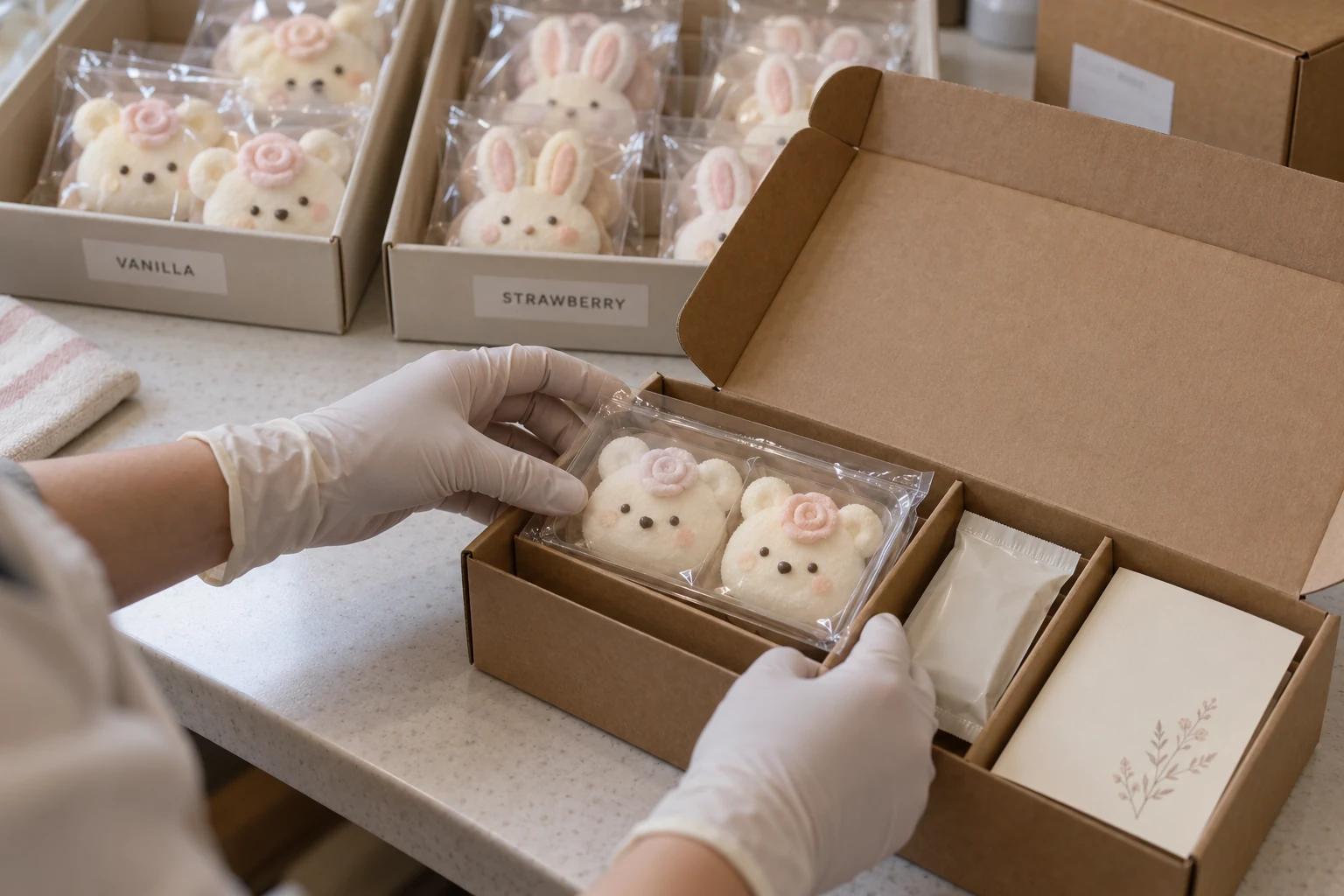
Align gourmet marshmallow subscription box wholesale pack specs with 3PL workflows: set inner-pack counts and sizes that fit box real estate, keep flavors separated, and establish barcodes, lot codes, and date marks in the required languages. Consistent carton dimensions speed receiving and reduce kitting errors.
Dive deeper
I ask early for your 3PL’s receiving and kitting SOP. Then we tailor pack-outs:
- Inner-pack format
- Standard options: individual wraps inside a small pillow bag, or multi-unit inner bags with a fixed insert count (e.g., 2–6 pieces).
- Choose counts that match your box real estate and packing speed. For example, a 2-piece inner may nest better beside a beverage sachet than a 3-piece inner.
- Barcodes and lot coding9
- If your kitting line scans every insert, we apply unit barcodes. If only inners are scanned, we reserve barcodes for inners.
- Lot codes and date marks use your language and format. We support multi-language labels but recommend limiting to essential markets unless retail requires more.
- Flavor separation and traceability
- Keep flavors or recipes separate by inner packs for traceability.10 Mixed-flavor inners complicate recalls and freshness control.
- We label outer cartons with flavor and lot codes prominently for 3PL receiving.
- Carton dimensions and palletization
- I conform carton sizes to common 3PL racking profiles to improve put-away speed. Stable pallet patterns reduce crushing risk and speed inbound checks.
A real scheduling note: One buyer changed an inner-pack count late, forcing repack. The kitting line added two touches to every box, multiplying cost. After that, we locked an inner-pack spec tied to the box bill of materials (BOM), and their rework dropped to near zero. Kitting-aligned packaging makes the difference between a smooth month and a panicked one.
What RFQ details speed a “yes” for gourmet marshmallow subscription box wholesale?
Back-and-forth emails waste days. An RFQ that includes volume, budget, ship window, and spec path unlocks accurate pricing on the first pass. I share a standard checklist that shortens time-to-quote and reduces surprises later.
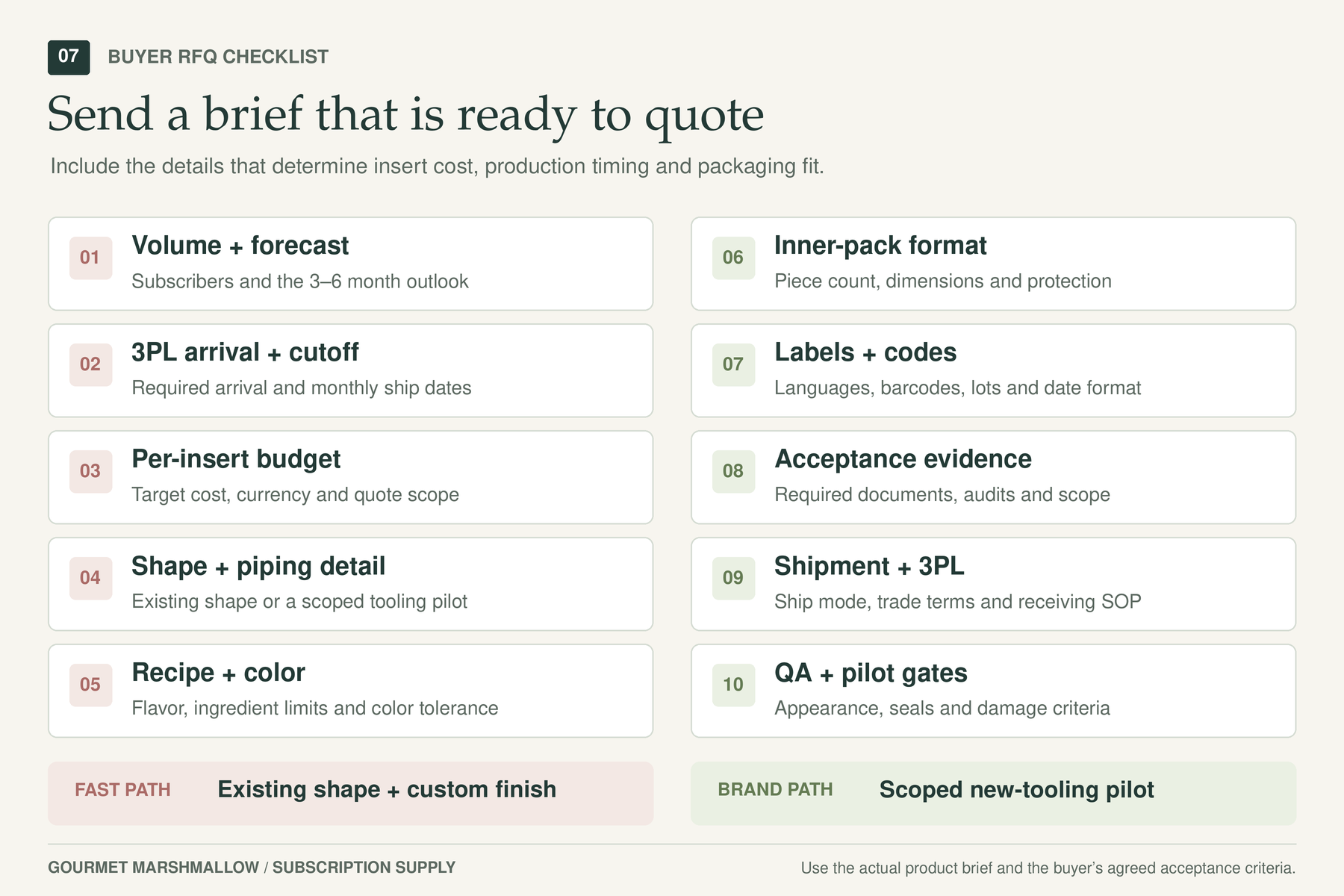
Include in your RFQ for gourmet marshmallow subscription box wholesale: subscriber volume and forecast horizon, delivery window and ship mode, per-insert budget, shape path (existing vs logo tooling), flavor/color constraints, inner-pack format, labeling languages, and channel requirements. This speeds precise costing and scheduling.
Dive deeper
Here is the RFQ checklist I send to buyers. Include as much as you can in your first email:
- Subscriber volume and forecast horizon
- Current subscribers and expected range for 3–6 months; note seasonality. I use this to model mold amortization and reorder triggers.
- Delivery window and ship mode preference
- Desired arrival window at your 3PL and openness to air for a pilot versus sea for rotations.
- Per-insert budget and target cost range
- Your target cost-insert helps me propose the fastest viable path.
- Shape path
- Existing mold versus new logo tooling. If logo, share artwork and acceptable timelines.
- Flavor and color constraints
- Gelatin source requirements, natural color mandates, allergen limits, and acceptable color tolerances.
- Inner-pack format
- Units per inner, individual wraps yes/no, target dimensions, and barcode strategy (unit vs inner).
- Labeling and languages
- Ingredient panel and languages required; note any retailer or channel-specific requirements I should consider.
- Certifications and retailer acceptance
- If a retailer requires BRC, SMETA, or specific audits, flag them. We hold BRC, FDA registration, SMETA, ISO 22000, HACCP, and GMP; you should request and verify our documents for your files.
- Incoterms and 3PL info
- Preferred Incoterms (EXW/FOB/CIF) and 3PL intake SOPs that affect pack-out or paperwork.
- QA thresholds and success criteria
- Complaint thresholds, damage rate limits, and test protocols that we should build into QC plans.
With a complete RFQ, I can offer two clear paths:
- Fast path: Existing molds + custom color/flavor. Best for immediate insertions with tight budgets and deadlines.
- Brand path: Logo pilot with defined amortization over future cycles. Good when branding matters and forecast volumes support tooling.
In my experience, this structure halves quote turnaround and prevents “late surprises” in both cost and schedule.
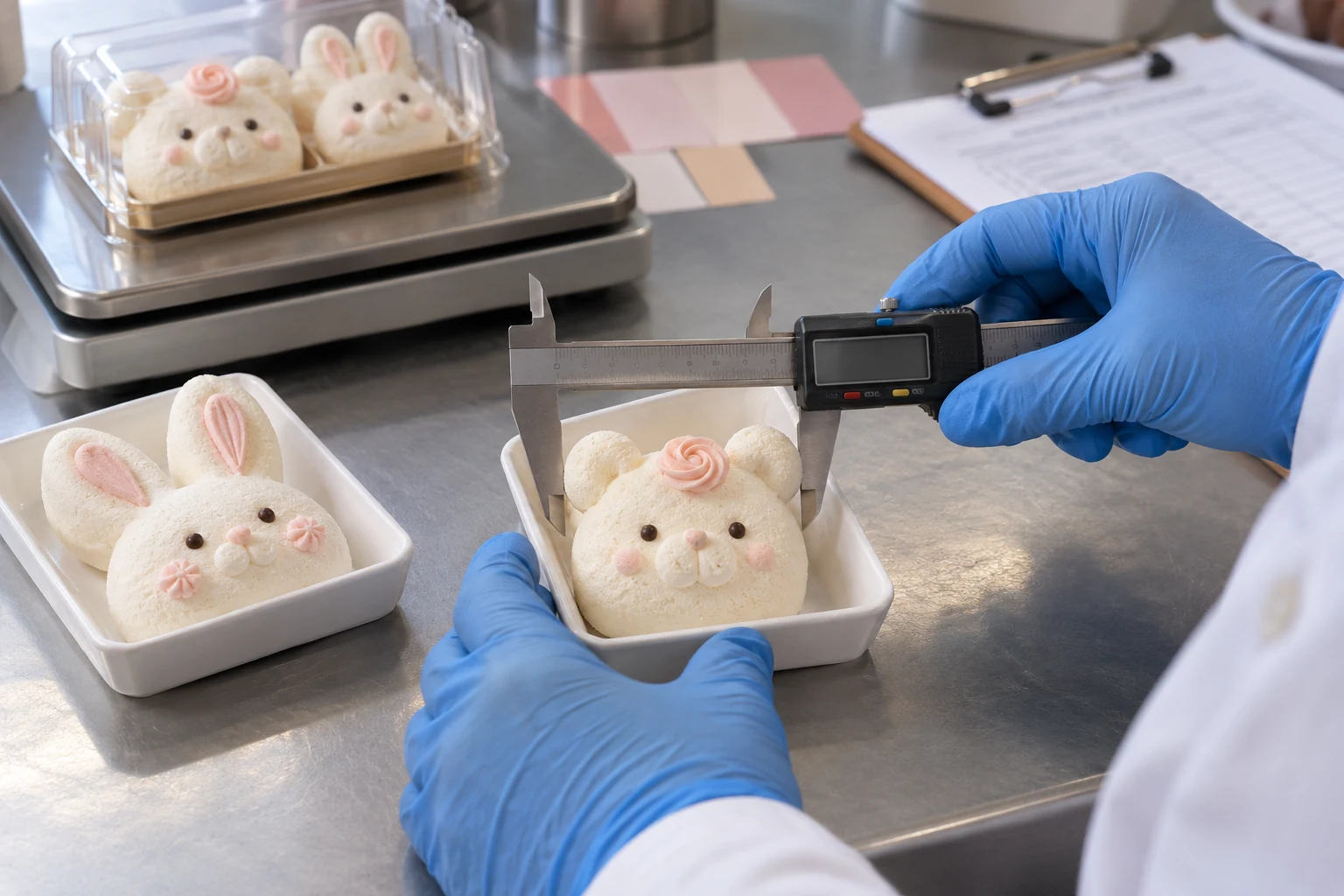
How do you evaluate a supplier’s QA and certifications for gourmet marshmallow subscription box wholesale?
A supplier can make or break your cycle. Evaluate their QA process, changeover discipline, and scheduling stability. Check certifications, but verify documents and scope. You want a partner who understands subscription cadence and communicates early when scopes shift.
For gourmet marshmallow subscription box wholesale, evaluate supplier QA, changeover controls, and cadence experience. Verify certifications like BRC, FDA registration, SMETA, ISO 22000, HACCP, and GMP. Ask for sample timelines, yield data, and corrective-action processes. Choose partners who plan buffers and escalate risks early.
Dive deeper
When buyers visit or audit us, I suggest focusing on:
- QA program and documentation
- Ask for SOPs covering ingredient checks, moisture/texture tests, color tolerance limits, and batch release criteria.
- Review how nonconformities are recorded and closed.
- Changeover controls
- Observe cleaning, line clearance, and color purging procedures. Ask about typical yield loss ranges and mitigation.
- Sampling and PPS discipline
- Review how pre-production samples are produced and approved. Confirm how we lock the spec to prevent late changes entering mass production.
- Scheduling transparency
- Ask for a sample monthly schedule showing how multiple SKUs share the line. Confirm peak-season plans and holiday closures.
- Certifications and audits
- Our factory holds BRC, is FDA registered, and has SMETA, ISO 22000, HACCP, and GMP. These are relevant for many retailers. You should request the latest certificates and audit summaries and verify scope and validity dates. Certifications support, but do not replace, your own QA evaluation.
- Traceability and recall readiness
- Inspect lot coding, raw-to-finished traceability, and mock recall procedures.
One subscription buyer asked for a changeover loss estimate upfront. We shared historical ranges for two-color runs and then built their spec to run the most complex color first. The yield improved, and we hit their per-insert budget. Suppliers who can cite anonymized history and suggest mitigations are the ones who will keep your schedule safe.
Frequently Asked Questions
What is a realistic lead time for gourmet marshmallow subscription box wholesale?
Lead times depend on spec and season. A typical sequence is 1–2 weeks for spec lock, 1–3 weeks for PPS, 2–4 weeks for production, plus logistics (air ~5–10 days; sea ~4–6 weeks). Always confirm per project and build buffers around holidays and 3PL capacity.
When should I invest in logo tooling for a subscription insert?
Invest when your forecast supports amortizing the tooling fee within your per-insert target over a defined number of cycles. If you lack volume certainty, start with an existing mold and custom color/flavor. Pilot tooling later with a tightly scoped trial and clear go/no-go criteria.
How do I prevent stockouts with monthly boxes?
Tie reorders to subscriber count and churn. Maintain at least 1.5 cycles of on-hand coverage, rising to two cycles during peak seasons. Use air for pilots or recovery, then move to sea for steady rotations. Align safety stock with known factory closures and port slowdowns.
Can I mix flavors in one inner pack?
It is possible, but I advise against it for traceability and freshness control. Separate flavors by inner pack to simplify recalls, date controls, and kitting. If marketing needs a multi-flavor experience, we can explore distinct inners in the same outer box.
What certifications matter for Western retail channels?
BRC is widely recognized in European retail.11 FDA facility registration is foundational for the U.S. market.12 SMETA, ISO 22000, HACCP, and GMP support food safety and social responsibility. Always request and verify the supplier’s documents and confirm retailer-specific requirements.
Conclusion
Gourmet marshmallow subscription box wholesale succeeds when you prioritize cadence over creativity and protect unit economics. Start with existing molds and custom color/flavor, lock a repeatable supply cadence, and add logo tooling only when volumes can amortize the cost. If you want a fast start, email us your RFQ using the checklist above. We will propose a Fast path for immediate inserts and a Brand path for scoped logo pilots, backed by our OEM/ODM experience and verified certifications.
"Injection moulding", https://en.wikipedia.org/wiki/Injection_moulding. General manufacturing overviews explain that custom molds require specialized tooling with substantial upfront costs and nontrivial lead times, supporting the statement that dedicated logo molds involve a tooling fee and a multi‑week fabrication period. Evidence role: general_support; source type: encyclopedia. Supports: That commissioning a custom mold entails significant tooling cost and a fabrication period measured in weeks.. Scope note: Provides general context on mold tooling rather than confectionery‑specific dollar ranges; actual costs vary by material, complexity, and supplier. ↩
"Eliminating production losses in changeover operations", https://www.tandfonline.com/doi/full/10.1080/09537287.2022.2136041. Peer‑reviewed studies on changeovers in food and process industries document scrap and yield losses during cleaning and line restart, supporting the claim that frequent changeovers on small runs inflate cost per usable unit. Evidence role: mechanism; source type: research. Supports: That product changeovers involve cleaning and startup effects that reduce usable yield and increase scrap on short runs.. Scope note: Research supports the mechanism but does not establish a universal 3–8% loss rate for marshmallow production. ↩
"Food Labelling: A Brief Analysis of European Regulation 1169 ...", https://pmc.ncbi.nlm.nih.gov/articles/PMC5076719/. EU Regulation No 1169/2011 requires that mandatory food information appear in the language(s) of the member state where the product is marketed, supporting the need for multi‑language labels when selling across multiple EU countries. Evidence role: definition; source type: government. Supports: That EU law requires mandatory food information to be provided in a language easily understood by consumers in the member state of sale.. Scope note: This requirement is EU‑specific and may differ in non‑EU markets or non‑retail contexts. ↩
"Air Freight: A Market Study with Implications for Landlocked ...", https://www.worldbank.org/en/topic/transport/publication/air-freight-study. Analyses by international transport institutions describe air cargo as much faster but substantially more expensive than maritime shipping, while ocean freight is the low‑cost mode where timing allows, consistent with the planning rule cited. Evidence role: general_support; source type: institution. Supports: That air freight is significantly faster but costlier than maritime transport, whereas ocean shipping minimizes unit cost when schedules are flexible.. Scope note: Comparative figures are lane‑ and season‑dependent. ↩
"Know Your Incoterms", https://www.trade.gov/know-your-incoterms. The International Chamber of Commerce’s Incoterms 2020 defines EXW, FOB, and CIF and sets out respective obligations for transport, risk, and insurance, directly supporting the terminology used for quotes. Evidence role: definition; source type: institution. Supports: That EXW, FOB, and CIF are standardized Incoterms rules specifying obligations and risk transfer points.. ↩
"Know Your Incoterms", https://www.trade.gov/know-your-incoterms. ICC guidance clarifies that Incoterms define delivery to a named place and allocate responsibilities; door‑to‑door obligations are not assumed under EXW, FOB, or CIF, which supports avoiding any implication of to‑door coverage when using these terms. Evidence role: definition; source type: institution. Supports: That door‑to‑door delivery is not implied by EXW, FOB, or CIF under Incoterms and must be specified using appropriate terms.. Scope note: Exact obligations depend on the specific Incoterm and the named place of delivery. ↩
"Cargo", https://www.iata.org/en/programs/cargo/. Industry guidance indicates international air cargo often moves within several days to about a week when accounting for airport handling and linehaul, supporting the cited 5–10 day planning figure before customs and last‑mile. Evidence role: general_support; source type: institution. Supports: That a planning window of roughly a week for international air cargo to reach regional hubs is reasonable prior to customs and final delivery.. Scope note: Actual timing varies by route, service level, consolidations, and clearance performance. ↩
"Time to import (days) - Glossary | DataBank - World Bank", https://databank.worldbank.org/metadataglossary/world-development-indicators/series/IC.IMP.DURS. Trade logistics datasets report ocean freight lead times on major lanes measured in weeks, which supports using a 4–6 week door‑to‑port estimate for planning; congestion and seasonality can extend these times. Evidence role: general_support; source type: institution. Supports: That intercontinental ocean freight lead times are measured in weeks, aligning with a 4–6 week door‑to‑port planning estimate.. Scope note: Transit durations are lane‑specific and can vary with carrier schedules, ports, and seasonal effects. ↩
"Packaging Levels in Data Hub", https://www.help.gs1us.org/packaging-level. GS1 specifications state that every trade item intended to be scanned at any point in the supply chain requires a unique GTIN and an appropriate barcode at that packaging level, supporting the suggested unit‑versus‑inner barcode strategy. Evidence role: definition; source type: institution. Supports: That each trade item and packaging level intended for scanning should have an appropriate GTIN and barcode.. Scope note: Retailer or 3PL requirements may specify particular data carriers or symbologies. ↩
"FSMA Final Rule on Requirements for Additional ...", https://www.fda.gov/food/food-safety-modernization-act-fsma/fsma-final-rule-requirements-additional-traceability-records-certain-foods. FDA traceability and recall guidance emphasizes preserving lot identity and adequate records to enable rapid product tracing, supporting the practice of keeping different products separated at the inner‑pack level. Evidence role: general_support; source type: government. Supports: That maintaining clear lot identification and separation improves traceability and facilitates effective recalls.. Scope note: Specific Food Traceability Rule obligations apply to designated foods; principles of lot control are broadly recommended but may not be mandated for all products. ↩
"Global Food Safety Initiative", https://en.wikipedia.org/wiki/Global_Food_Safety_Initiative. Background references describe BRCGS as a widely used food safety certification program developed by UK retailers and applied broadly in European retail supply chains, supporting the stated recognition. Evidence role: general_support; source type: encyclopedia. Supports: That BRCGS is a widely adopted food safety certification scheme originating with UK retailers and recognized across European retail supply chains.. Scope note: Acceptance criteria can vary by retailer, and some may prefer alternative schemes or specific audit scopes. ↩
"Guidance for Industry: Registration of Food Facilities: What ...", https://www.fda.gov/media/85098/download. FDA regulations require domestic and foreign food facilities that manufacture, process, pack, or hold food for consumption in the United States to register with the agency, supporting the assertion that facility registration is foundational for U.S. market access. Evidence role: definition; source type: government. Supports: That FDA requires domestic and foreign food facilities to register as a condition of supplying the U.S. market.. Scope note: Registration is necessary but not sufficient; additional U.S. food safety, labeling, and import requirements may apply. ↩