How Marshmallow Manufacturing Changed Over 100 Years?
Marshmallow Manufacturing has changed more in control, compliance, and consistency than in nostalgia and recipes. The old problem was uneven texture and short shelf life. The risk felt bigger as buyers scaled up. The modern answer is industrialized repeatability, audited quality systems, and process routes tailored to shape, yield, and regulatory constraints.
Marshmallow Manufacturing shifted from craft variability to audited, process-driven consistency. Over the last century, factories standardized overrun, moisture, and gelatin systems; added traceability and HACCP; and aligned ingredients with Halal/Kosher and natural-color rules.1 For buyers, the big change is how to evaluate risk, cost, and supplier fit—not chasing “traditional” formulas.
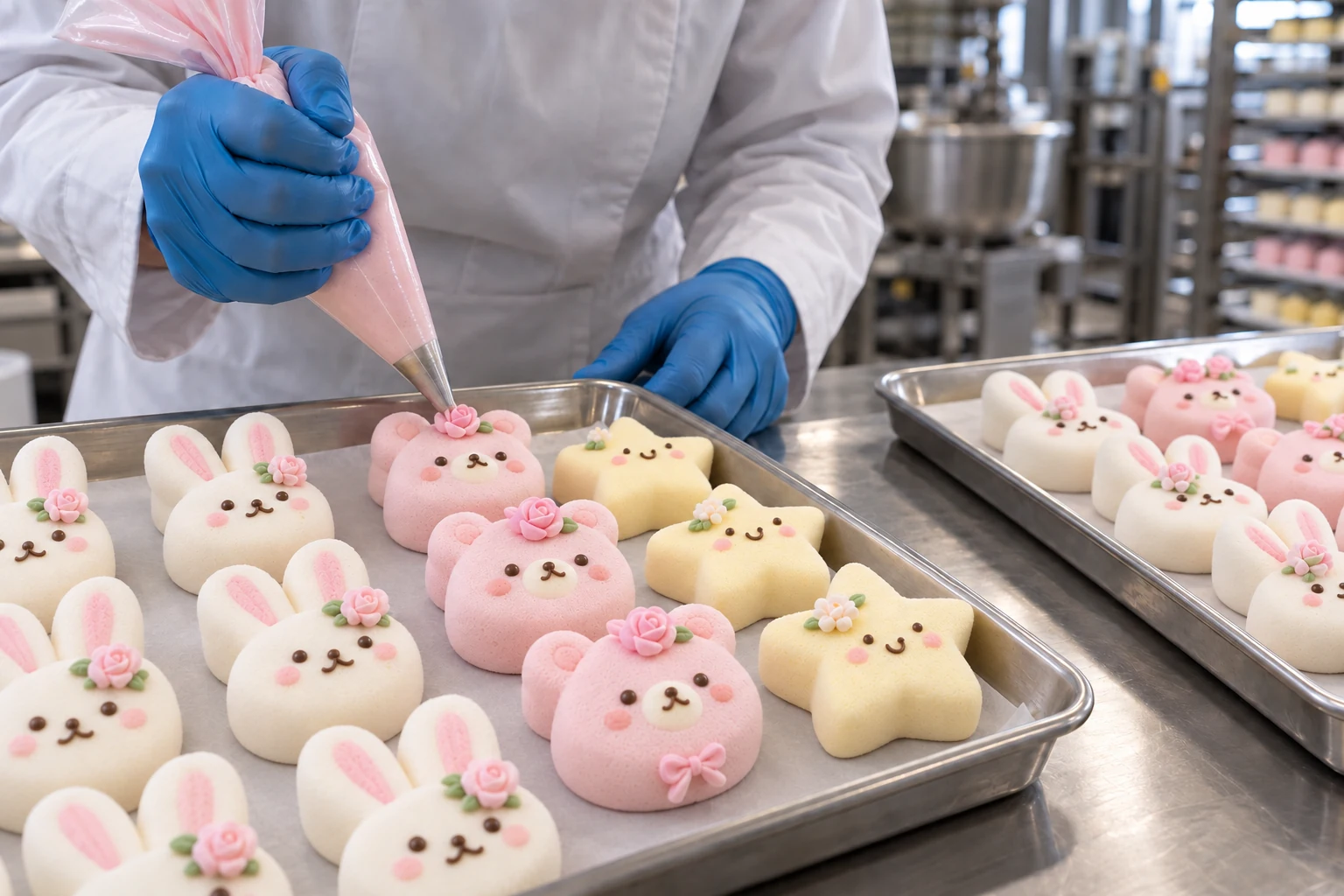
The short answer is simple. The details decide your cost, yield, and timelines. Below, I map how process routes, compliance, and quality systems shape outcomes for shaped marshmallows. I also share the buyer framework I use with US/EU customers to align claims, MOQ, and launch windows.
Which process routes define Marshmallow Manufacturing outcomes today?
There is a gap between creative shapes and line reality. Buyers want cute animals and holiday themes. Engineers worry about bubbles, stickiness, and yield. The route you pick decides feasibility, cost, and defect modes.
Process choice defines Marshmallow Manufacturing outcomes. Starch-mogul deposition suits delicate cavities but needs longer drying and risks sticking; extrusion-and-knife excels for cylinders and ropes; silicone-mold casting balances detail with manageable MOQs.2 Each route trades bubble structure, tooling cost, and lead time—especially for complex shapes.
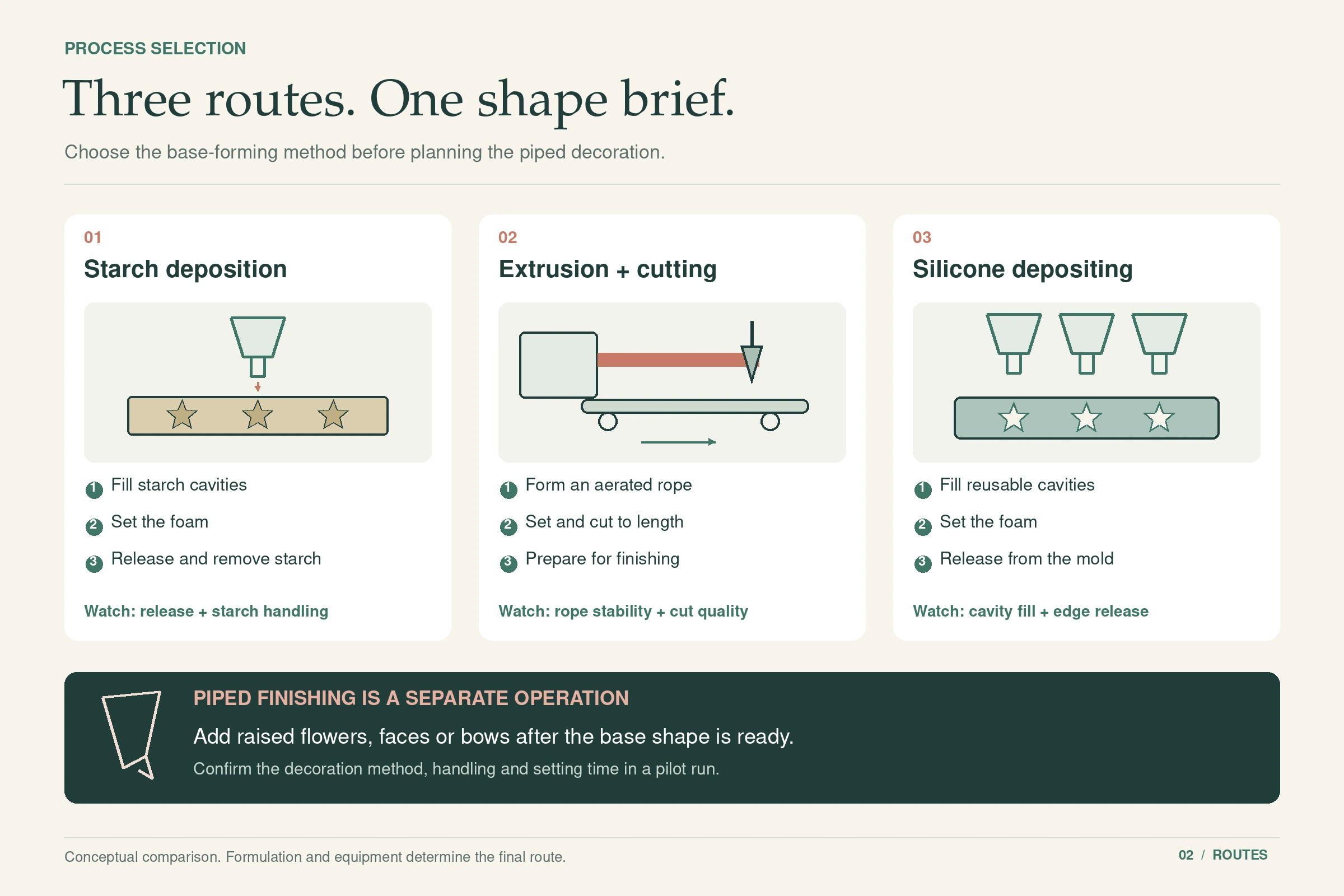
The three main routes and why they matter
In my shop, we match the process to the shape, not the other way around. When I press for a Mickey-style silhouette or a snowflake with deep recesses, the process route is the first decision. The choice determines overrun control, cavity release, and how aggressively we must dry a batch.
- Starch-mogul deposition
- Extrusion and knife-cut
- Silicone-mold casting/depositing
I first learned these trade-offs from veteran technicians who ran lines in the 1990s and early 2000s. I now verify them daily with trial yields and defect logs.
Quick comparison
| Criterion | Starch-mogul deposition | Extrusion & knife-cut | Silicone-mold depositing |
|---|---|---|---|
| Shape complexity | High detail feasible | Best for simple cylinders/ropes | High detail with smooth surfaces |
| Bubble structure | Fine, but risk of surface imprint | Uniform rope aeration | Fine to medium; smooth faces |
| Drying needs | Longer, starch pull-out time | Shorter; surface drying | Moderate; depends on cavity depth |
| Defect modes | Sticking, cavity tear, starch speck | Deformation, ovality, knife burrs | Sink marks, edge collapse, oil release |
| Tooling cost | High (tray sets) | Low (no mold) | Medium (silicone mold fabrication) |
| Tooling lead time | 4–8 weeks | 1–2 weeks | 2–4 weeks |
| MOQ tendencies | Higher due to tray sets | Lower to medium | Medium; batch-size flexible |
| Color/stripe control | Layered deposit possible | Stripes via co-extrusion | Multi-color via multi-deposit |
A few specific notes:
- Starch-mogul deposition is more common in jellies than in marshmallows,3 but it remains an option for certain foam systems when you need deep relief or concave features. It adds starch dust risk and longer turnaround for tray conditioning. We only recommend it for high volumes and complex shapes that cannot demold from silicone without distortion.
- Extrusion and knife-cut are the undisputed workhorses for classic cylinders, mini marshmallows, and ropes.4 Overrun and rope temperature must be stable within very tight bands. The defect we watch is ovality or rope sag before cutting.
- Silicone-mold depositing is our default for branded shapes, seasonal icons, and logo-themed pieces. We can open new molds in 2–4 weeks and hold MOQs lower than starch-mogul runs. The common failure is collapse on edges when the foam overrun and cavity venting are misaligned.
From a buyer’s view, the process route sets hidden constraints:
- Yield risk: Delicate edges on silicone may cause 2–5% extra waste without fine-tuned demold oils.
- Lead times: New molds add 2–4 weeks; starch sets add more.
- Cost: Small-batch trials cost less in silicone; high-volume plain cylinders are cheaper in extrusion.
- Texture: Extrusion gives slightly coarser bubbles; silicone and deposition can produce finer pores.
I still keep a notebook from a 2001 line trial where we chased a star-shaped edge in silicone. The cure was not “more gelatin.” It was reducing overrun by 5% and switching to a lower-viscosity demold oil. That changes your launch plan more than any romantic idea of “traditional.”
How does compliance reshape Marshmallow Manufacturing formulations?
The label promises buyers make now drive formulation choices first. We see “Halal,” “Kosher,” “no TiO2,” and “natural colors” on briefs more than flavor descriptions. This pressure affects cost, shelf life, and even release oils.
Compliance drives Marshmallow Manufacturing decisions. Halal/Kosher gelatin shifts sourcing and bloom strength; natural color systems demand light-stable options; retailer bans on TiO2 push alternative whiteners and coatings. “Traditional = healthier” is a myth. Modern stabilizers and controls reduce risk and keep labels compliant.
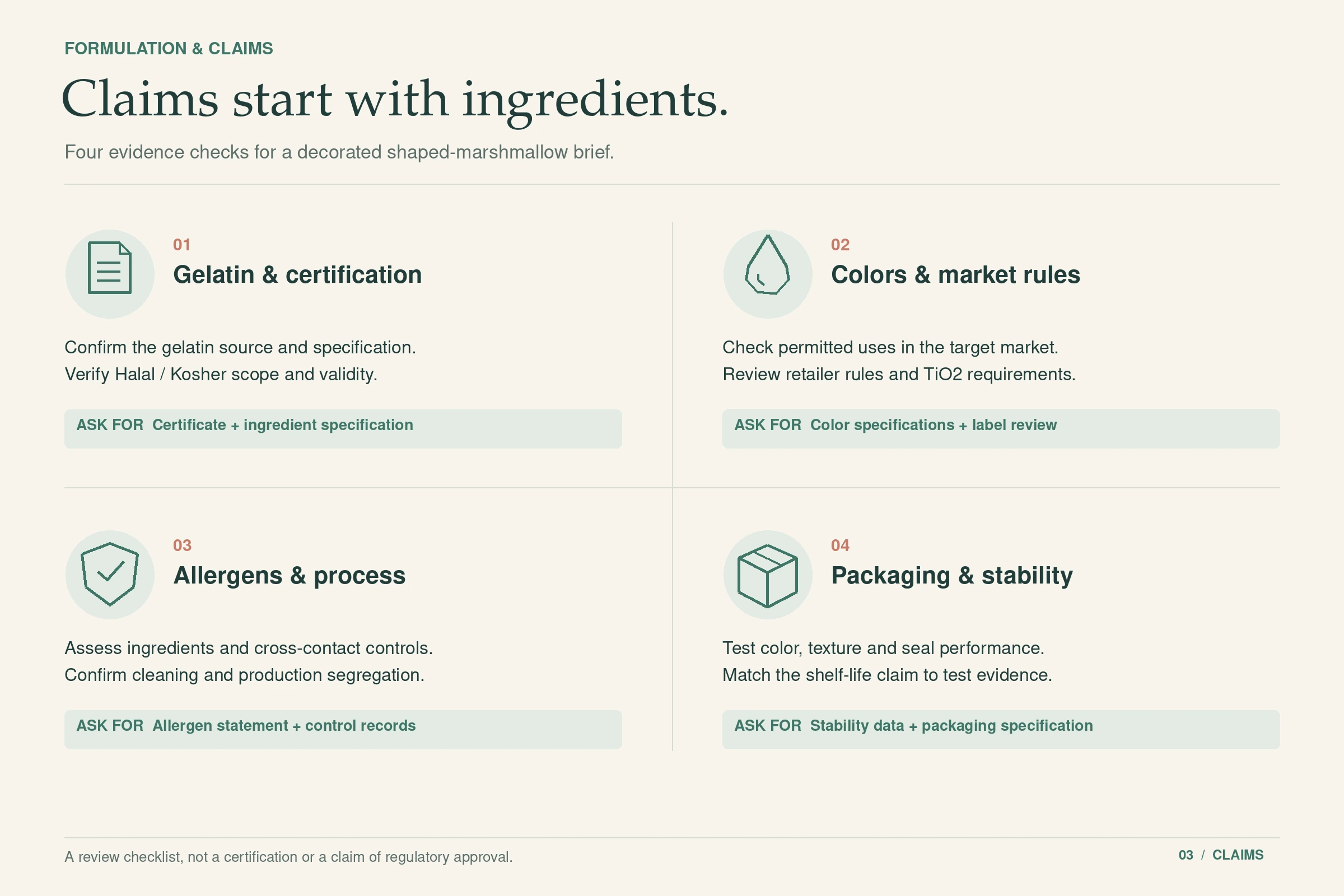
What changes in the ingredient deck and why
I operate within customer claims and retailer policies. We always recommend buyers verify documents. We provide CoAs, Halal/Kosher certificates, and ingredient specifications in advance of trials. Here is what actually changes in the formula and why.
Gelatin systems and religious requirements
- Halal and Kosher-compliant gelatin primarily means bovine or fish sources, with specific slaughter and processing controls.
- Bloom strength affects texture and demold. We see 200–250 bloom as common ranges for marshmallows5; shifting bloom plus overrun can replicate many textures without eggs.
- Many retailers and importers require certificates from specified bodies. Buyers should verify document validity and scope. We never expect acceptance without cross-checks.
A notable benefit of modern lines is allergen control. Historically, some hand-whipped recipes used egg whites.6 We rarely use egg today, which lowers allergen labeling and cross-contact risks. If a client insists on an egg-white foam, we move the run into segregated spaces and adjust sanitation windows—cost and lead time step up.
Natural colors and TiO2 restrictions
- Natural blues: Spirulina extracts are heat and light sensitive.7 We adopt opaque packaging or lower exposure on the line. Expect some fade over 6–9 months. This is the trade-off for “natural” claims.
- Reds/pinks: Beet and anthocyanins shift with pH.8 Marshmallows run near neutral; we stabilize with buffering. Stack tests under retailer lighting are critical.
- Whites: Where retailers reject TiO2 (common in EU since 20229 and increasingly in private retail specs), we switch to alternative opacifiers or rely on foam overrun for whiteness. Coating systems (e.g., rice starch blends) may be adjusted.
We do not promise cost parity for fully natural palettes. The realistic impact is 5–15% higher material cost and tighter shelf-life claims. Buyers who communicate that reality to their finance teams reduce surprises.
Labeling and micro
- Corn syrup vs. glucose syrup naming varies by market.10 We align with local norms; US labels tend to prefer corn syrup naming.
- Water activity and pH sit within narrow bands. HACCP keeps micro risk low. The myth that “traditional” is safer is false. Modern marshmallow relies on controlled aw, sugar matrices, and audited sanitation to reduce microbial growth.
A practical note: I advise buyers to require line trials that mimic retail lighting and time. Natural colors may look perfect on day one and drift by month five. Set review gates. Your compliance claim is only as strong as your first 12 months on shelf.
Why did QA evolve from craft to audited Marshmallow Manufacturing?
Retailers now audit factories more than they sample products. The shift from “tasting” to “tracing” happened because supply chains got longer. Risk migrated from kitchen variability to logistics, labeling, and foreign body control. Buyers demanded proof.
Audited systems now anchor Marshmallow Manufacturing. BRC/ISO 22000/HACCP frameworks, traceability, allergen control, metal detection, and in-line checks cut recall risk and stabilize texture and shape.11 This matters more than nostalgia for hand-whipped batches because it impacts returns, fines, and customer trust.
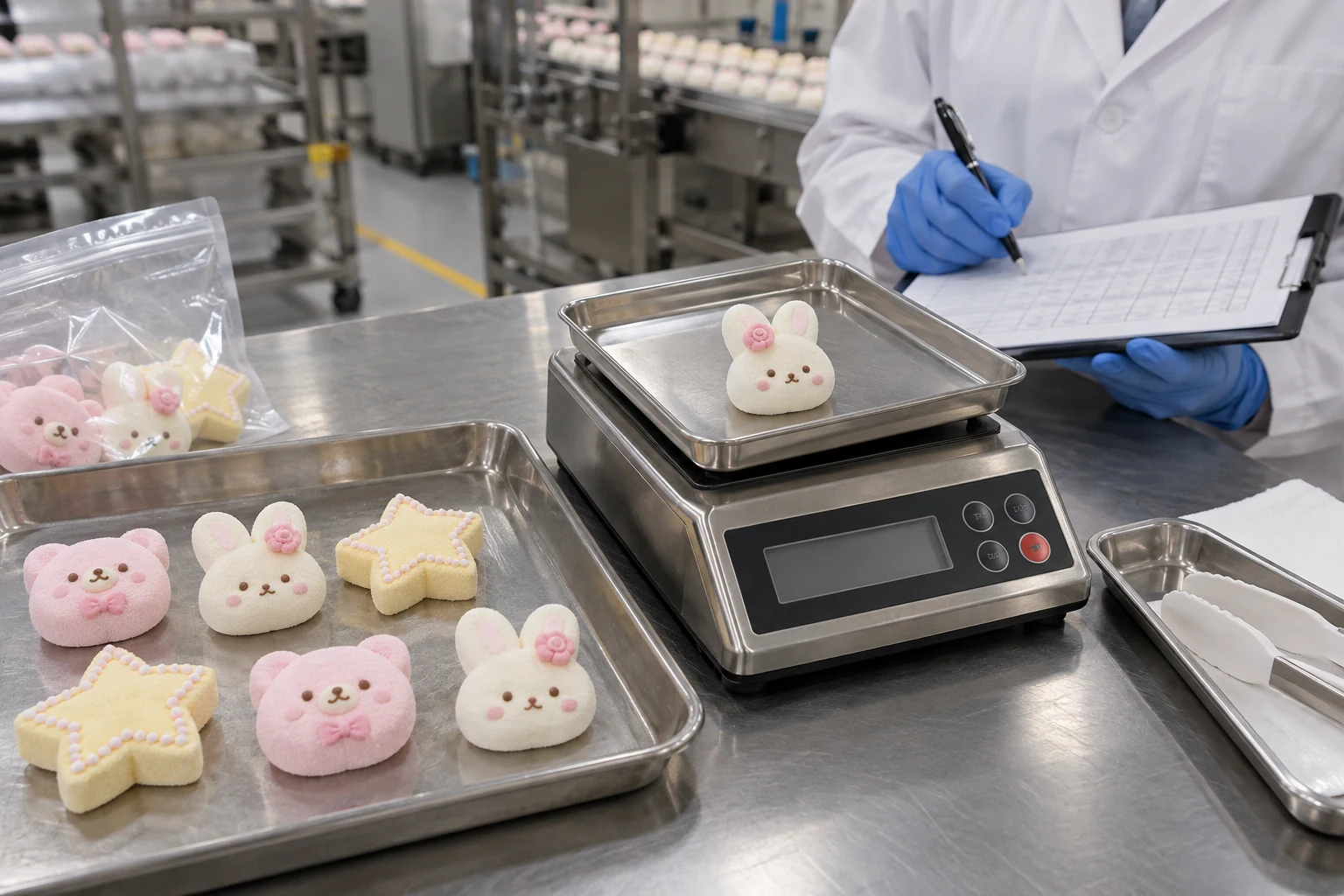
From craft stories to documented controls
Our factory runs under BRC, ISO 22000, HACCP, SMETA, and GMP. We register with FDA for US shipments. We invite buyers to audit, but we always suggest you verify documents directly with issuing bodies. This is not about logos; it is about controls.
What we control in-line
- Overrun: We measure air incorporation as a percentage. We hold a tight band, often ±2–3%. This is the core of texture control.
- Temperature: Cook and aeration temperatures are logged. Deviations trigger holds. Temperature swings cause bubble collapse or sugar crystallization.
- Density and water activity: We log every batch. Marshmallows sit in ranges that deter microbial growth.12 Hardening or stickiness often points to deviations here.
- Metal detection and X-ray: Our standard is metal detection on finished goods. For certain pack formats, we add X-ray. Buyers can set thresholds and verify challenge tests.
- Weight and portion control: Checkweighers prevent underfills and cut waste on overfills.
Traceability and allergen segregation
- Lot coding: Ingredient lots tie to finished batches through digital records. We can trace forward and backward within hours.
- Allergen policy: We run allergen-controlled lines and cleaning validation. If a buyer requires egg-free claims, we verify that no egg-based runs occur on the same shift.
Documentation and buyer evidence
- CoAs: We supply Certificates of Analysis for gelatin, colors, and sugar syrups.
- Trial yields: We share defect logs from pilot runs. Buyers who require first-pass yield data make better MOQ choices.
- Audit pass records: We keep pass reports and corrective-action closures. Buyers should ask for scope—does the certificate cover the building and product category they need?
One of my favorite moments is watching a retail auditor test our metal detector with a seeded pack. The machine rejects it, and their shoulders relax. It is not about theatrics; it is about making risk visible. This is where modern Marshmallow Manufacturing beats nostalgia every time.
What buyer decision framework fits modern Marshmallow Manufacturing timelines?
Buyers do not need a lecture on marshmallow lore. Buyers need a way to launch on time with claims intact and yields predictable. The framework below is the checklist I use in kick-off calls with private-label and brand-import clients in the US and EU.
Use a risk-and-timeline framework for Marshmallow Manufacturing. Lock compliance gates first (Halal/Kosher, natural colors, TiO2). Choose process route by shape complexity and yield risk. Align MOQ/tooling/lead time with launch windows. Demand verifiable evidence: certificates, trial yields, and CoAs—not brand lore.
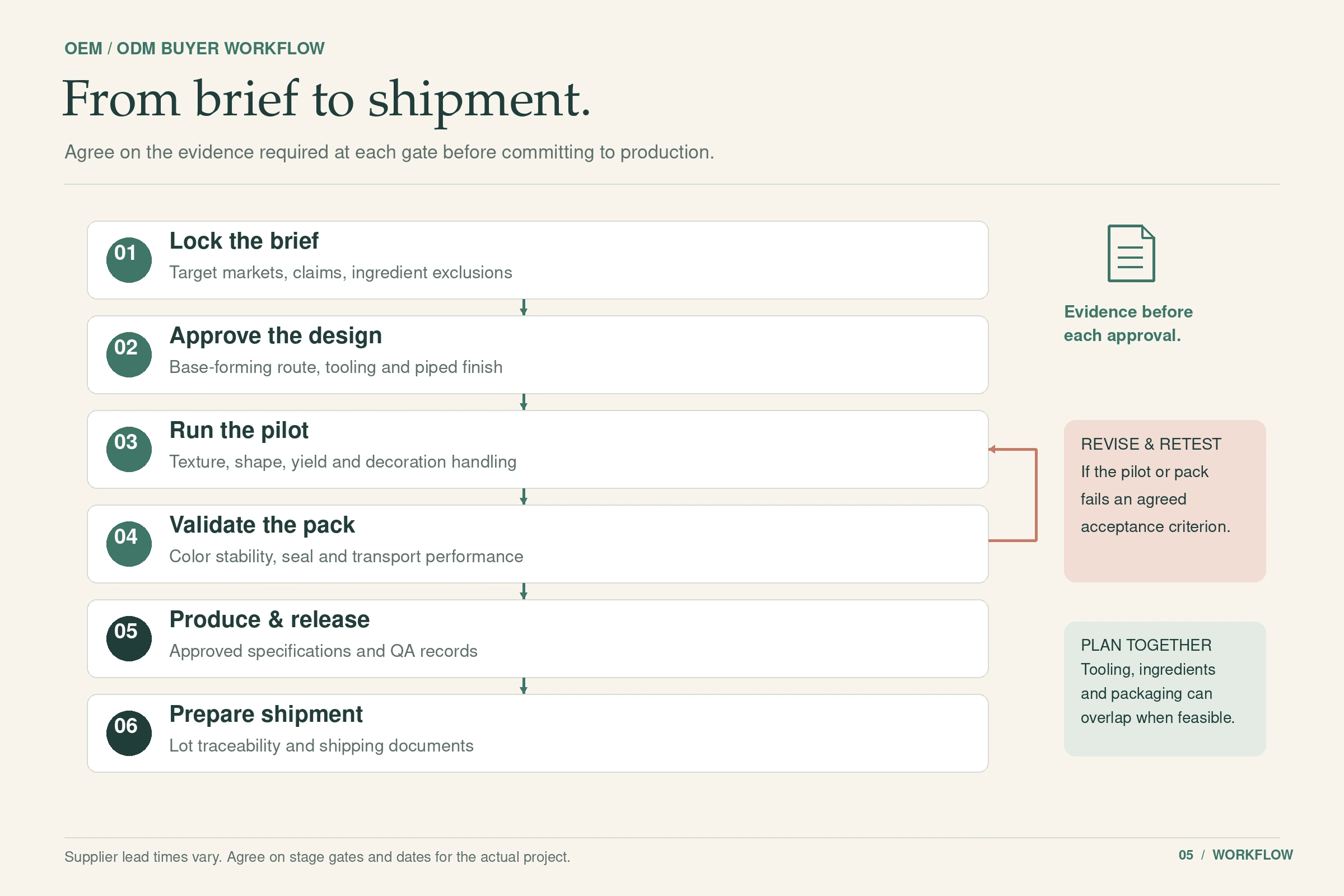
A step-by-step path from brief to shelf
I see the same traps repeat: buyers select a cute shape, then later discover the claim set forces a different gelatin or color that changes texture or lead time. Start with gates, then locks.
1) Define non-negotiable claims and target markets
- Religious certification: Halal and/or Kosher? Decide first. It affects gelatin sourcing and lead time for document checks.
- Natural color set and TiO2: Confirm retailer policies. EU buyers often forbid TiO2; US retailers vary.
- Allergen position: Egg-free? Dairy-free? These align line scheduling and sanitation gaps.
Deliverables:
- Certificate requirements list
- Ingredient no-go list
- Label claim draft
2) Select process route by shape complexity
- Simple cylinders and minis: Extrusion and knife-cut. Fastest and lowest MOQ.
- Highly detailed or branded shapes: Silicone-mold depositing. Medium tooling cost and lead time.
- Deep concave features or very soft foams: Consider starch-mogul deposition, but expect higher MOQs and longer cycles.
Tooling and lead-time ranges we commonly see:
- Silicone molds: 2–4 weeks; $1,000–$3,000 depending on cavity count and complexity.
- Starch sets: 4–8 weeks; capital ties up; viable at high volumes only.
These numbers are typical in my plant; other factories can differ. Always verify quotations and timelines.
3) Plan MOQs and trials around yields
- First-pass yield: For complex shapes, plan a pilot run. Target FPY above 95%. Accept 1–3% tuning waste in early runs.
- MOQ guidance (illustrative):
- Extruded minis/cylinders: 1–3 metric tons per SKU
- Silicone shaped pieces: 2–5 metric tons per SKU
- Starch deposition shapes: 5+ metric tons per SKU
Again, verify with your supplier; your packaging and logistics will influence workable MOQs.
4) Packaging and stability alignment
- Natural colors: Use opaque or high-barrier films. Confirm shelf-life claims under retailer lighting.
- Coatings: Adjust anti-stick powder blends for TI02-free specs.
- Drop tests and transit simulations: Avoid shape crush and clumping. We perform ISTA-style tests when buyers request them.
5) Evidence before commitment
Ask for:
- Halal/Kosher, BRC/ISO 22000, HACCP, SMETA, GMP documentation—verify authenticity.
- Ingredient CoAs and allergen statements.
- Trial yield and defect logs.
- Metal detector or X-ray challenge records.
- Retention sample plan.
A realistic timeline
A typical critical path looks like this:
- Week 0–2: Claims lock, ingredient alignment, documentation review.
- Week 2–4: Mold design and approval (if silicone). Packaging dielines.
- Week 4–6: Mold fabrication; ingredient lead-time kickoff.
- Week 6–8: Pilot runs; yield tuning; color stability checks.
- Week 8–10: First production; QA verification; packaging QA.
- Week 10–12+: Shipping and import clearance.
In one Western Europe program last year, we compressed the path to 10 weeks by running parallel packaging and mold steps. The trade-off was higher tooling rush fees. That is the kind of decision buyers should make with data in hand, not after a missed holiday slot.
Frequently Asked Questions
What is the difference between extrusion and depositing for marshmallows?
Extrusion pushes an aerated rope through a die and cuts it, which suits cylinders and ropes with low tooling cost and fast cycles. Depositing fills cavities—silicone or starch—to achieve detailed shapes. Depositing supports branding and complex geometry but adds tooling and longer lead times.
Do Halal or Kosher gelatins change texture or cost?
Yes, they can. Bovine or fish gelatin with certified handling can alter bloom strength ranges and demold behavior. We usually match target texture by adjusting overrun and bloom. Cost often increases due to certified sourcing and documentation, and lead times may extend for verification.
Can I get bright whites and pastels without TiO2?
Yes, but expect trade-offs. Without TiO2, we lean on foam overrun, alternative opacifiers, and coating adjustments. Whites may be less opaque, and pastels rely on natural colors that can fade under light. Packaging and display conditions become part of the solution. Verify performance with shelf-life tests.
What MOQs should I expect for shaped marshmallow OEM orders?
It depends on the process. Extruded cylinders can start around 1–3 metric tons per SKU. Silicone-mold shapes typically sit around 2–5 metric tons due to set-up costs. Starch-deposited shapes often require higher volumes. Always confirm with your supplier as packaging and claims impact MOQs.
Do I need X-ray if I already have metal detection?
Most buyers rely on metal detection for marshmallows. X-ray adds coverage for certain dense foreign bodies and for packages with foil or complex assemblies. Some retailers mandate X-ray for private label. We recommend aligning with retailer policies and verifying with challenge tests.
Conclusion
Over a century, Marshmallow Manufacturing evolved into audited, traceable, and compliance-led production. Process routes now decide shape feasibility and yields, while certifications and natural-color choices shape cost and shelf life. If you want lower risk and on-time launches, start with claims, choose the right route, and demand evidence. Contact our China-based OEM/ODM team to review your brief, verify certificates, and schedule a shaped marshmallow trial under your target claims.
"HACCP Principles & Application Guidelines", https://www.fda.gov/food/hazard-analysis-critical-control-point-haccp/haccp-principles-application-guidelines. Codex Alimentarius’ General Principles of Food Hygiene (CXC 1) set out HACCP-based food safety management that has been widely adopted across the food industry, supporting the claim that contemporary confectionery manufacturers operate within audited, traceable systems. Evidence role: historical_context; source type: institution. Supports: That modern food manufacturing broadly implements HACCP-based, audited controls as part of traceability and risk management.. Scope note: The Codex standard establishes industry-wide practice but does not specifically document marshmallow factories or the timeline of adoption for this product category. ↩
"Marshmallow", https://en.wikipedia.org/wiki/Marshmallow. Encyclopedic treatments of marshmallow manufacture describe extrusion and depositing as standard industrial methods used to produce various shapes, consistent with the claim that process selection drives feasible outcomes. Evidence role: general_support; source type: encyclopedia. Supports: That industrial marshmallows are commonly made by extrusion and depositing to achieve different shapes.. Scope note: Such overviews generally do not compare silicone molds to other routes or quantify drying time and sticking risks across processes. ↩
"Starch mogul", https://en.wikipedia.org/wiki/Starch_mogul. Reference descriptions of the starch-mogul system identify it as a process used predominantly for gummy and jelly candies, supporting the assertion that it is more common there than in marshmallow production. Evidence role: definition; source type: encyclopedia. Supports: That the starch-mogul system is chiefly associated with depositing jelly/gummy confections.. Scope note: These sources typically do not enumerate marshmallow usage frequencies or provide comparative production data. ↩
"How Marshmallows Are Made",
. General encyclopedic accounts of marshmallow production explain that extrusion is widely used to form ropes and cut pieces, aligning with the statement that extrusion and knife-cutting dominate classic formats. Evidence role: general_support; source type: encyclopedia. Supports: That extrusion is a standard industrial method for forming marshmallows into cylindrical pieces and ropes.. Scope note: Such accounts do not quantify market share by process or brand-specific practices. ↩"Gelatin Bloom Strength - Understanding the Types and Uses", https://customcollagen.com/gelatin-bloom-strength-types-and-uses/. Encyclopedic descriptions of marshmallow formulations note the use of medium‑to‑high Bloom gelatin for setting the aerated foam, consistent with a typical range around 200 Bloom. Evidence role: general_support; source type: encyclopedia. Supports: That marshmallow production generally uses medium-to-high Bloom gelatin, commonly around 200 Bloom or higher.. Scope note: Specific numeric ranges vary by source and product specification, and not all references narrow the range to 200–250 Bloom. ↩
"Marshmallow - Wikipedia", https://en.wikipedia.org/wiki/Marshmallow. Historical overviews of marshmallows recount the use of egg whites in earlier recipes prior to the modern gelatin‑set, aerated formulations adopted in industrial production. Evidence role: historical_context; source type: encyclopedia. Supports: That earlier marshmallow recipes incorporated egg whites, later supplanted by gelatin in industrial production.. Scope note: Accounts summarize culinary history and may not document specific dates or prevalence across regions. ↩
"Physicochemical degradation of phycocyanin and means to ...", https://pmc.ncbi.nlm.nih.gov/articles/PMC9257648/. Peer‑reviewed studies report that phycocyanin exhibits significant degradation under heat and light, supporting the assertion that spirulina‑based blue colors are sensitive to processing and storage conditions. Evidence role: mechanism; source type: paper. Supports: That phycocyanin, the blue pigment in spirulina extracts, degrades with exposure to heat and light.. Scope note: Findings pertain to model systems and various matrices; stability in marshmallow specifically and over a 6–9 month shelf life is not directly measured. ↩
"Anthocyanidins and anthocyanins: colored pigments as food ...", https://pmc.ncbi.nlm.nih.gov/articles/PMC5613902/. Authoritative overviews of anthocyanins describe their molecular forms shifting with pH, producing characteristic color changes that explain pH sensitivity in red/pink natural color systems. Evidence role: mechanism; source type: encyclopedia. Supports: That anthocyanin pigments exhibit pH-dependent color changes.. Scope note: The source explains the pigment mechanism but does not specify marshmallow formulation pH or buffering practices. ↩
"The implications of the EU ban on titanium dioxide", https://pubmed.ncbi.nlm.nih.gov/39549786/. European Commission regulatory action in 2022 removed authorization for titanium dioxide (E171) as a food additive in the EU, establishing the regional policy context referenced for retailer specifications. Evidence role: historical_context; source type: government. Supports: That the EU banned the use of titanium dioxide (E171) as a food additive in 2022.. ↩
"Understanding high fructose corn syrup in popular snacks - PMC", https://pmc.ncbi.nlm.nih.gov/articles/PMC12935215/. Encyclopedic entries on glucose syrup note that the product is a hydrolysate of starch known generically as ‘glucose syrup,’ while in the United States the term ‘corn syrup’ is used when derived from corn starch. Evidence role: definition; source type: encyclopedia. Supports: That ‘glucose syrup’ is a generic term and ‘corn syrup’ refers to glucose syrup made from corn, particularly in the U.S.. Scope note: Labeling regulations vary by jurisdiction, and the source does not address all national labeling requirements. ↩
"ISO 22000", https://en.wikipedia.org/wiki/ISO_22000. ISO 22000 defines a HACCP‑based food safety management system for organizations in the food chain, including requirements for hazard control and traceability that underpin recall risk reduction. Evidence role: general_support; source type: institution. Supports: That ISO 22000 is a HACCP-based food safety management system standard addressing hazard control and traceability in food production.. Scope note: The standard establishes management system requirements and does not mandate specific device types (e.g., metal detectors) or quantify recall risk reductions. ↩
"Water Activity and its Role in Food Preservation (March 2025)", https://ucanr.edu/program/uc-master-food-preserver-program/article/water-activity-and-its-role-food-preservation. University extension resources explain that most pathogenic bacteria require water activity near or above 0.91 and many molds above about 0.80, indicating that low‑aw confections are inhospitable to microbial growth. Evidence role: general_support; source type: education. Supports: That low water activity inhibits growth of most foodborne microbes, consistent with high-sugar confections having reduced microbial risk.. Scope note: The source outlines general aw thresholds and does not report measured aw values for marshmallows in this specific context. ↩