How Much Sugar Is in a Marshmallow? (Compared to Other Candy)
Most buyers ask one blunt question: how much sugar is in a marshmallow? The confusion comes from pieces, cups, and scoops. That makes comparisons unfair and risky on labels. If you sell or private-label marshmallows, misreading sugar data can derail claims and assortment positioning. I use one method to resolve it.
Most marshmallows contain about 55–65 g of sugar per 100 g.1 Typical labeled servings are 28–30 g (about 4 regular pieces)2, which deliver 16–20 g sugar. By weight, that’s similar to milk chocolate and many gummies but well below hard candies (95–99 g sugar per 100 g)3. Always compare by per 100 g and per labeled serving with the serving weight.
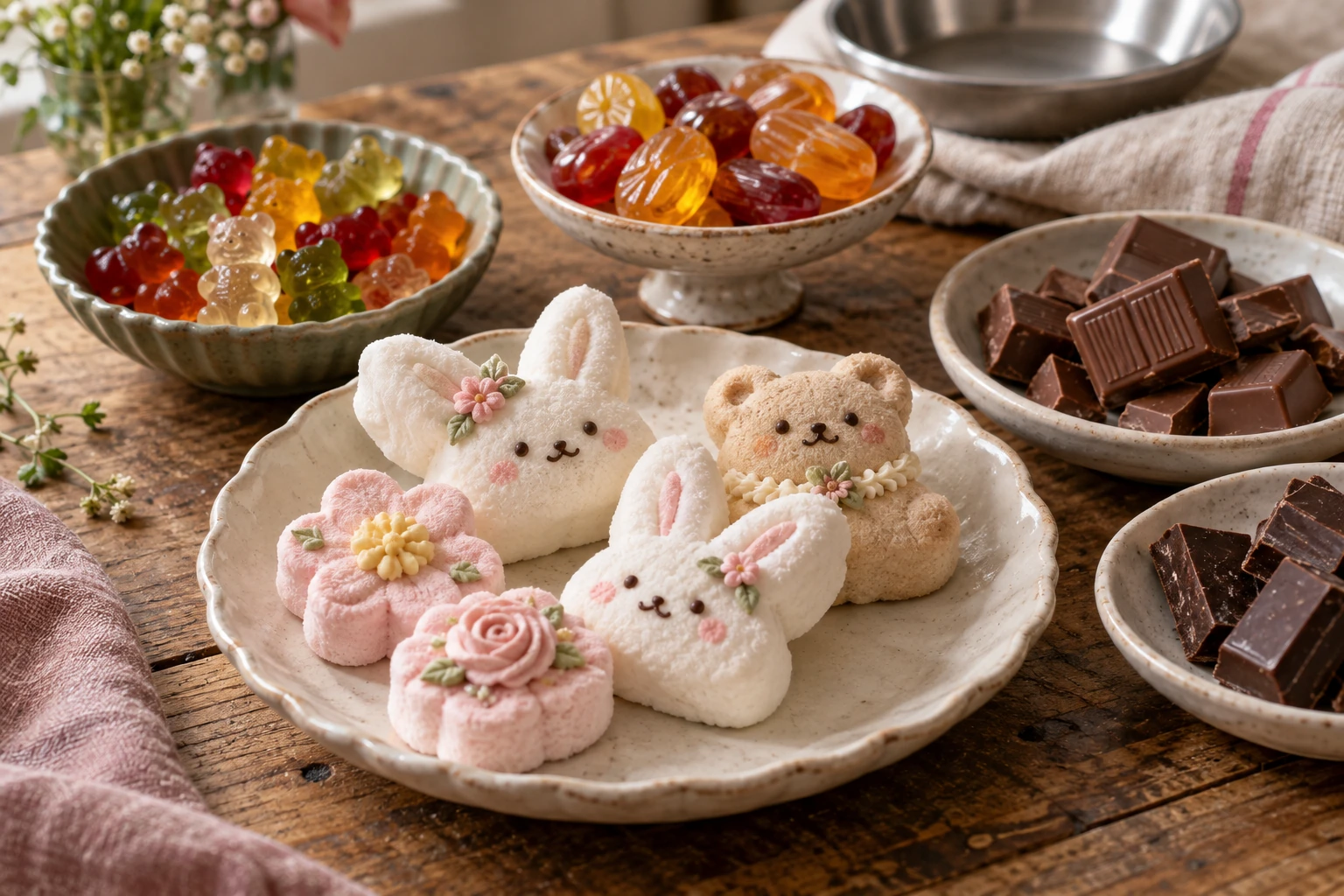
The short answer hides a lot of nuance. Aeration makes marshmallows look “light,” while hard candy is dense. Gummies carry more water than hard candy. Chocolate adds fat, which shifts calories without increasing sugar. Let’s align the units first, then read the numbers correctly.
What is the fair way to compare sugar in a marshmallow and other candy?
Buyers often juggle cups, pieces, and visuals. That leads to inconsistent claims and poor positioning. I see teams mix “per piece” for marshmallows with “per serving” for chocolate. The result is chaos. There’s a simple fix and it works across shapes, sizes, and categories.
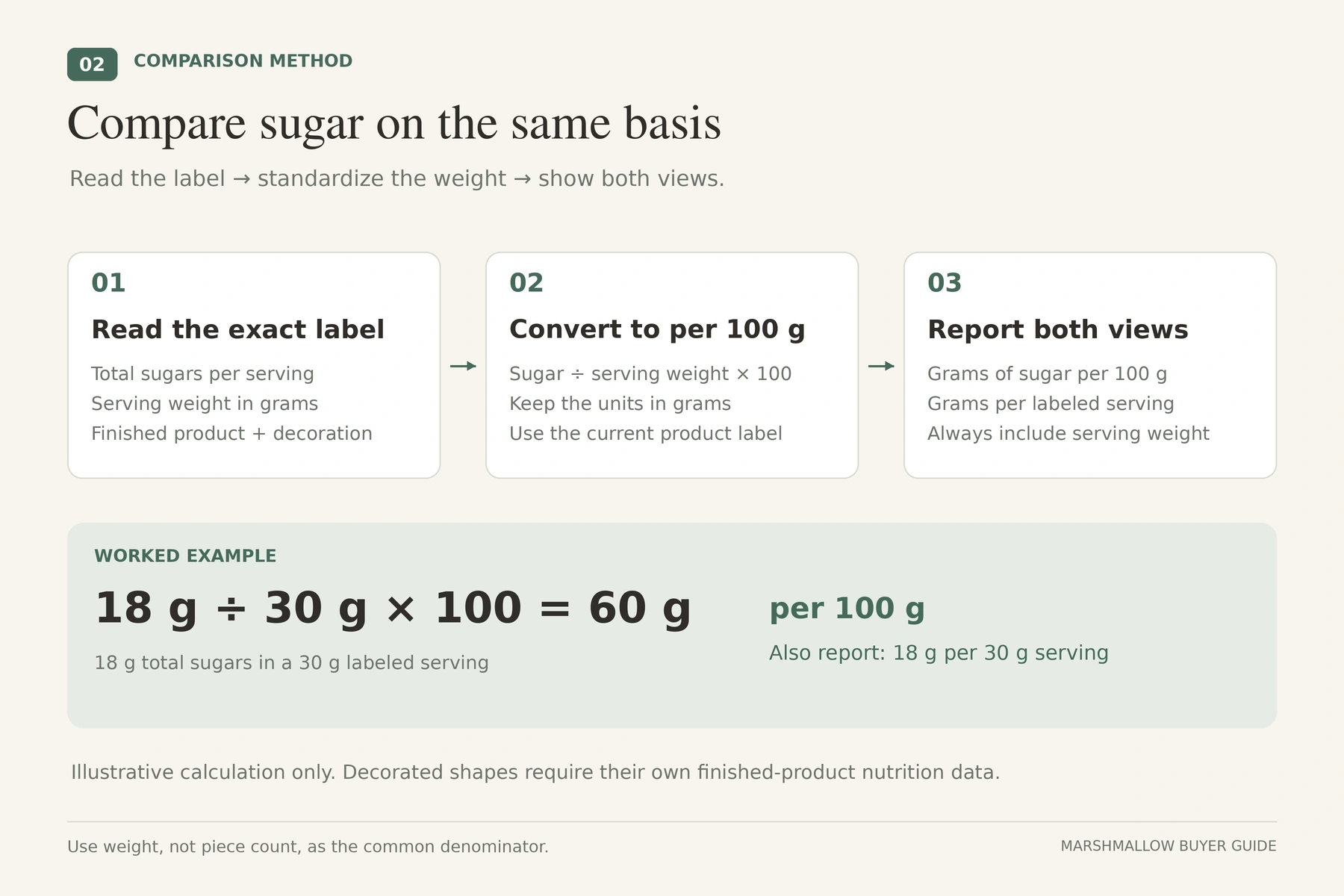
Always report sugar two ways: grams per 100 g, and grams per labeled serving with the serving weight. Use “per piece” only when you also show the exact per-piece weight. Density and air vary widely, so weight-normalized metrics are the only fair basis for comparison and on-pack claims.
Dive deeper
I contribute to formulation and nutrition-labeling for our BRC/FDA-audited marshmallow factory. I adopted a simple comparison protocol that works for retailers, private-label managers, and QA:
- Per 100 g shows the core composition. It levels the playing field across formats.
- Per labeled serving shows the consumer-facing portion and connects to your on-pack Nutrition Facts. Always include the serving weight.
- Only use per piece when you also show piece weight. A “piece” can weigh anywhere from ~0.9 g (mini) to ~8 g (regular) to 12+ g (large shaped novelty), so piece counts can mislead.
Regulatory note:
- In the US, serving sizes follow 21 CFR 101.12 (RACC categories).4 Brands then set their labeled serving weight and household measure based on how consumers customarily eat the product. You must verify your exact RACC and how it maps to your label.
- In the EU and UK, nutrition must be per 100 g/100 mL and often per portion.5 Buyers should confirm country-specific implementation.
My workflow when I benchmark categories:
- Gather labels. I use in-house Nutrition Facts for mini, regular, and shaped runs (e.g., Mini batch: 2024-05; Regular batch: 2024-08; Shaped batch: 2024-09) and curated public labels from major US brands (e.g., Jet-Puffed Regular; Campfire Minis; labels accessed 2024). Always verify the latest pack.
- Standardize units. Convert everything to per 100 g and per labeled serving with serving weight. If a label only shows per piece, calculate the per-piece weight from the serving.
- Present ranges. Candy formulations vary. I publish ranges and mark estimates “to be verified” if the brand’s current label is not in hand.
This protocol keeps your internal decks, buyer pitches, and compliance reviews consistent. It also protects you from “apples vs. oranges” comparisons that legal teams flag late in the process.
How much sugar per 100 g is in a marshmallow, really?
“Per 100 g” exposes the true solids—not the air. Claims and category maps hinge on this. I often hear “marshmallows are all sugar,” which is not precise and can backfire in copy approvals.
Most marshmallows land around 55–65 g sugar per 100 g. In our labels and major US brand panels reviewed in 2024, total sugars typically measured 56–62 g/100 g. Flavor colors and shapes rarely move sugar much; water content and overrun do.

Dive deeper
Here’s how the numbers look when you unify them by weight. All figures refer to total sugars on Nutrition Facts panels (US) or labels (EU/UK). Verification required for on-pack use.
- Our Mini Marshmallow (Batch 2024-05, export spec): 58–60 g sugar per 100 g. Variability came from slight solids differences across lots.
- Our Regular Marshmallow (Batch 2024-08): 59–61 g sugar per 100 g.
- Our Shaped Seasonal (Batch 2024-09, thicker walls): 57–60 g sugar per 100 g.
- Public label examples (accessed 2024; for benchmarking only):
- Jet-Puffed Regular: per labeled serving 28–30 g, sugars 16–18 g. That equates to roughly 57–60 g/100 g.
- Campfire Minis: per labeled serving near 30 g, sugars ~17–19 g → roughly 57–63 g/100 g.
Why the range?
- Water and solids: Marshmallows are whipped sugar syrups stabilized by gelatin or alternatives.6 Small shifts in final moisture can push total sugars up or down by a few g/100 g.
- Overrun (air incorporation): Overrun affects piece size and density. It does not change per 100 g composition, but it affects per piece impressions.
- Coatings and inclusions: Starch-dusting or cocoa-dusting barely moves total sugars. Chocolate-coated or filled marshmallows do, but those are hybrid confections with different profiles.
Practical takeaway:
- If you are a retailer or private-label manager, expect a 56–62 g/100 g band for classic white marshmallows unless the spec says otherwise. For procurement, require the current Nutrition Facts or QUID and align it with your QA documentation.
- Ask suppliers to state sugar per 100 g, not just per serving. Make “per 100 g + per serving with serving weight” a standard RFI field.
How do labeled servings change how much sugar in a marshmallow looks?
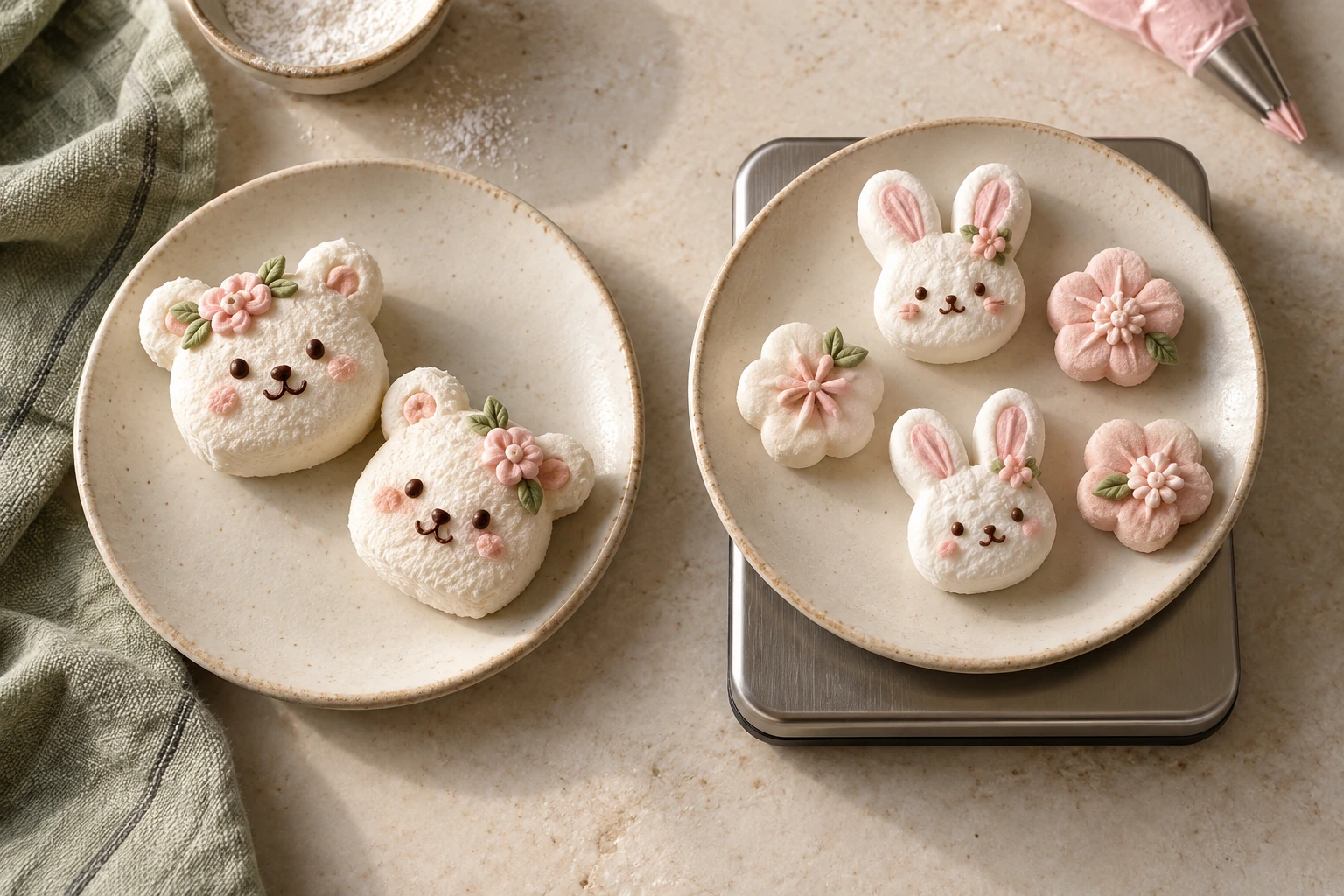
Teams get mixed up when serving weights differ across brands. I have seen product A list 30 g per serving and product B list 28 g. The per serving sugar then shifts even when the per 100 g sugar is the same.
A typical labeled serving for regular marshmallows is 28–30 g (often 4 pieces), yielding 16–20 g sugar. Mini marshmallows also cluster around 28–30 g per serving (often a fraction of a cup), again showing roughly 16–19 g sugar when normalized for weight.
Dive deeper
Serving sizes are consumer-facing and legally constrained, but brands have latitude within category norms. What matters is the serving weight. Consider these examples:
-
Regular marshmallows:
- Label A: Serving size 4 pieces (28 g), total sugars 16–18 g.
- Label B: Serving size 4 pieces (30 g), total sugars 17–19 g.
- Conclusion: The difference in per serving sugars is mostly the 2 g swing in serving weight.
-
Mini marshmallows:
- Label A: Serving size 2/3 cup (30 g), total sugars 17–19 g.
- Label B: Serving size 3/4 cup (28 g), total sugars 16–18 g.
- Conclusion: Household measures vary; weight tells the real story.
-
Shaped novelties:
- Our Batch 2024-09 used a 30 g serving because single pieces varied from 10–12 g. The panel showed 17–19 g total sugars.
Key buyer tip:
- When you build category stories or compare to gummies and chocolate, always show the serving weight next to per serving sugar. Otherwise, marketing teams may unintentionally “game” the comparison by choosing a smaller serving weight in one product and a larger one in another.
One more caution:
- Avoid blending “per piece” for one item with “per serving” for another. If you must show per piece, calculate the piece weight explicitly. For regular marshmallows, a single piece often weighs ~7 g. If the product is ~60% sugar by weight, that piece carries ~4.2 g sugar. Document your assumptions.
Why does sugar in a marshmallow seem “low” per piece?
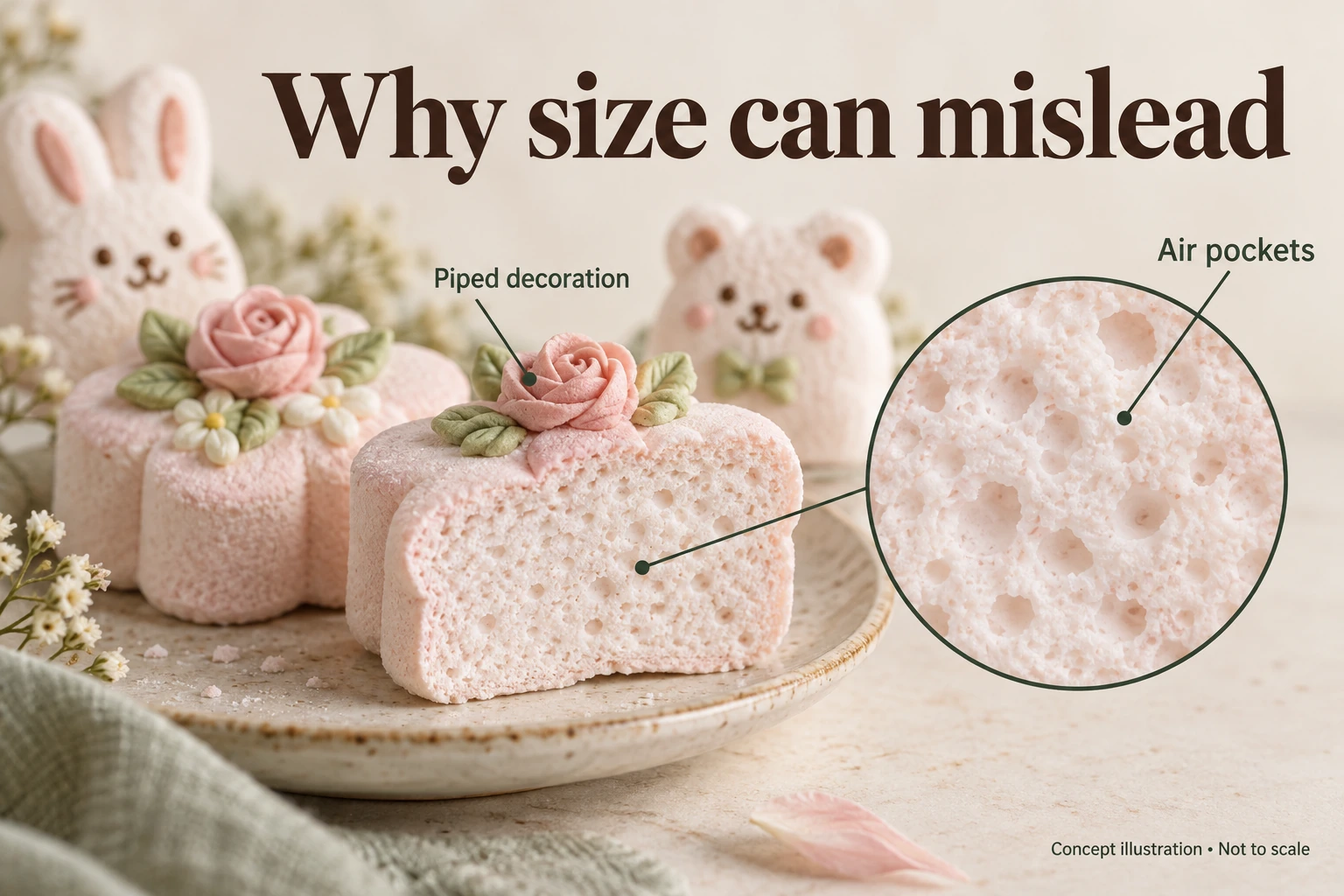
This is where density misleads. Marshmallows are foams. The air makes a piece look large for its weight. If you line up a marshmallow next to a hard candy, the marshmallow looks bigger but weighs less.
Marshmallows are highly aerated. A regular piece might weigh ~7 g but look larger than a 12 g gummy cluster or a 15 g chocolate square. Per piece sugar looks lower because the piece weighs less. Weight-normalized metrics remove that illusion.
Dive deeper
Foams break “per piece” logic. Here is what happens under the hood:
- Overrun: Marshmallow overrun (air incorporation) can exceed 200%, meaning you triple the volume without increasing solids. Typical densities range roughly 0.2–0.4 g/mL.
- Visual bias: Two pieces of equal visual size can differ in weight dramatically. A hard candy of 10 g is tiny. A marshmallow of 7 g looks bulky.
- Sweetness perception: Subjective sweetness depends on formulation and how the foam dissolves. Air and texture can make sweetness feel intense. That does not change grams of sugar.
A simple math illustration:
- Assume a regular marshmallow weighs 7 g and is 60% sugar. Sugar per piece ≈ 4.2 g.
- Compare that to a 15 g milk chocolate square at 50% sugar. Sugar per piece ≈ 7.5 g. The chocolate looks smaller but carries more sugar because it weighs more and is denser.
- If you only read “per piece,” you might conclude marshmallows are “low sugar.” That is faulty. Per 100 g, the marshmallow has ~60 g sugar and the milk chocolate ~50 g sugar. The difference is in density and fat content.
Operational advice for buyers and PMs:
- Train your teams to distrust “per piece” visuals unless piece weights are specified.
- Enforce a style guide: always present per 100 g and per serving with serving weight. Use per piece only as a secondary datapoint with explicit piece weights.
- Keep “sweetness” out of sugar claims. Labeling decisions should track the Nutrition Facts, not taste tests.
I once ran a buyer workshop where we handed out identical volume cups holding mini marshmallows, gummi bears, and boiled sweets. Everyone guessed the marshmallows had the most sugar. The labels said otherwise by 100 g. The exercise stuck because it showed how air and water confuse the eye.
How does sugar in a marshmallow compare to gummies, hard candy, and chocolate?
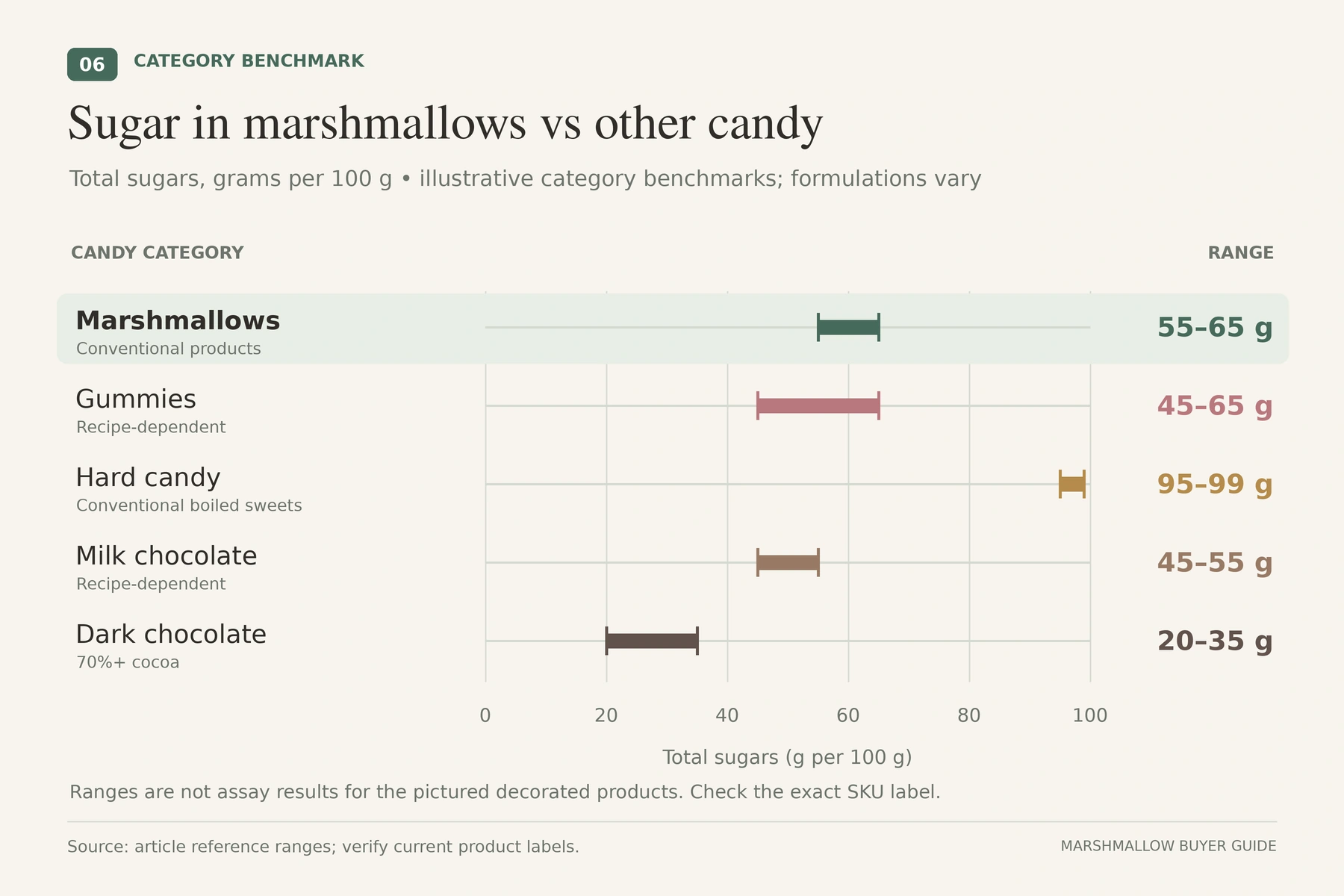
Comparisons across categories fall apart when you mix units. With weight-normalized data, patterns emerge. Hard candy is mostly sugar. Gummies carry more water. Chocolate carries fat. Marshmallows sit between gummies and hard candy by per 100 g sugar.
By weight, marshmallows typically show 55–65 g sugar per 100 g. Gummies often range 45–65 g/100 g depending on recipe.7 Hard candy is 95–99 g/100 g. Milk chocolate averages 45–55 g/100 g, while dark chocolate can be 20–35 g/100 g.8 Serving weights vary, so show them.
Dive deeper
Here is a normalized view. These figures summarize our in-house panels and curated public labels accessed in 2024. Always verify current packaging before on-pack use.
| Category/product (illustrative) | Sugar per 100 g | Typical serving weight | Sugar per serving | Notes |
|---|---|---|---|---|
| Marshmallows (regular) | 56–62 g | 28–30 g | 16–20 g | Aerated; per piece ≈ 7 g; density varies |
| Marshmallows (mini) | 56–62 g | 28–30 g | 16–19 g | Household measure often in cups; same weight = similar sugars |
| Gummies (gelatin) | 45–65 g | 30–40 g | 18–26 g | Water content drives range; pectin/starch similar |
| Hard candy/lollipops | 95–99 g | 15–20 g | 14–19 g | Nearly pure sugar; dense pieces |
| Milk chocolate | 45–55 g | 28–40 g | 14–22 g | Sugar lower than marshmallows per 100 g, but higher calories due to fat |
| Dark chocolate (70%+) | 20–35 g | 28–40 g | 6–14 g | Lower sugar, higher fat; per 100 g calories high |
Interpreting the table:
- Marshmallows vs gummies: The overlap is real. Many gummies sit in the 50–60 g/100 g sugar zone, especially gelatin-based ones with similar solids to marshmallows. Some low-sugar gummies are engineered differently; verify claims case by case.
- Marshmallows vs hard candy: Hard candy sits near the ceiling because it is mostly crystallized sugar. Per serving sugars can look comparable because serving weights are smaller. Per 100 g reveals the large gap.
- Marshmallows vs chocolate: Chocolate’s per 100 g sugar is often lower than marshmallows, but total calories per 100 g are higher because fat contributes 9 kcal/g. If your positioning focuses on sugar grams, note this distinction clearly. Do not conflate “less sugar” with “lower calories.”
Buyer guidelines:
- When building shelf sets, avoid comparing a 15 g lollipop serving to a 30 g marshmallow serving without normalizing. List serving weights next to per serving sugars.
- For private-label briefs, specify target sugar per 100 g and target serving weight. That gives suppliers a clear spec. We often receive briefs like “≤58 g/100 g sugars; serving 28 g; total sugars ≤17 g.”
Can I make low-sugar claims about sugar in a marshmallow legally?
This is where compliance risk shows up. Teams love phrases like “low sugar” or “reduced sugar,” but those are regulated claims. Use them only if you meet thresholds in the target market. Your QA/legal team must sign off.
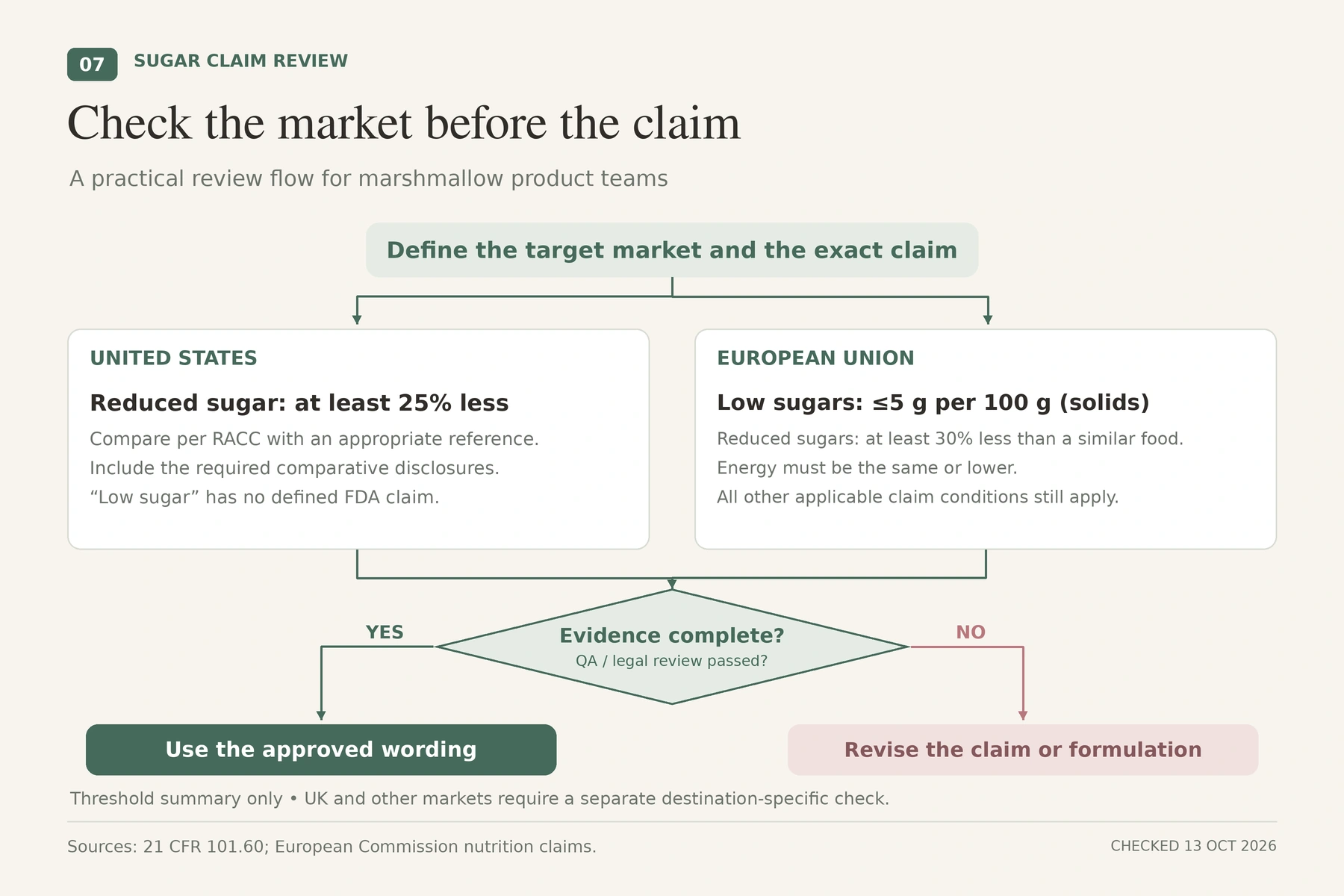
In the US, “reduced sugar” generally means at least 25% less sugars than a reference product. “Low sugar” is not a defined US claim. In the EU/UK, “low sugars” requires ≤5 g/100 g—standard marshmallows do not meet that.9 Treat any claim as conditional on jurisdiction and verification.
Dive deeper
Regulatory landscape at a glance (summarized for buyer awareness; this is not legal advice):
-
United States:
- “Reduced sugar”: Must be at least 25% less sugars than an appropriate reference food. You must identify the reference and ensure like-for-like comparisons.
- “Low sugar”: Not a defined nutrient content claim in current FDA framework. Using it can mislead unless qualified carefully, which is risky.
- “No added sugars”: Only if no sugars or ingredient sources of sugars were added and the product does not contain ingredients that functionally act as sugar. Traditional marshmallows include added sugars, so they typically do not qualify.
- Labels list “Total Sugars” and “Includes X g Added Sugars” for marshmallows. Because sugars are added, “includes” typically mirrors total sugars for these products.
-
EU/UK:
- “Low sugars”: ≤5 g sugars per 100 g for solids. Conventional marshmallows (~56–62 g/100 g) do not qualify.
- “Reduced sugars”: At least 30% reduction compared to a reference product, with no energy increase as a result. Achieving this requires reformulation with polyols or fibers and changes in texture and overrun; verify all impacts.
Practical steps for product managers:
- Decide your target claim and jurisdiction before R&D. Share the regulatory definition in the brief.
- Ask suppliers for a formulation route to meet the claim, plus sensory and texture implications. Marshmallow structure is sensitive to solids and types of sweeteners.
- Require: current Nutrition Facts, calculation basis, and any claim substantiation dossier. In our BRC system, we prepare a claim checklist for each market. Buyers should request it.
- Avoid “healthier” or glycemic claims unless you have competent legal and scientific substantiation. Most teams should stay with factual, label-derived statements.
I have walked clients away from “low sugar” headlines more than once. We preserved their timelines by pivoting to precise, jurisdiction-compliant statements like “X g sugars per serving (30 g serving size).” Shoppers respond to clarity, and legal teams sleep better.
Frequently Asked Questions
How many grams of sugar are in one regular marshmallow?
A typical regular marshmallow weighs around 7–8 g10 and is roughly 55–65% sugar by weight. That yields about 4–5 g sugar per piece. However, piece weight varies by brand and aeration. Always calculate from the serving weight and per 100 g sugar on the label to avoid errors.
Do mini marshmallows have less sugar?
Per piece, minis often have less sugar because each piece weighs less (~0.8–1.2 g). Per 100 g, minis usually land in the same 55–65 g sugar range as regular marshmallows. Serving weights for minis (for example 28–30 g) yield similar total sugars per serving to regular formats.
Are flavored or colored marshmallows higher in sugar?
Not typically. Colors and flavors contribute minimal solids. Total sugars per 100 g usually remain in the same band as plain marshmallows. Coatings, fillings, or chocolate layers can change the profile. Always read the exact label and standardize by per 100 g before concluding.
How do vegan marshmallows compare for sugar?
Vegan marshmallows often replace gelatin with plant-based gelling agents. The sugar system remains similar for structure and sweetness. As a result, sugar per 100 g is usually comparable to conventional marshmallows. Verify with the actual Nutrition Facts for the specific brand.
Why does a chocolate bar have fewer grams of sugar per 100 g but more calories?
Chocolate contains significant fat (from cocoa butter and milk). Fat contributes 9 kcal/g, while sugar contributes 4 kcal/g.11 Milk chocolate may show ~45–55 g sugar per 100 g—lower than marshmallows—but total calories per 100 g are higher due to fat content.
Conclusion
If you are asking “how much sugar is in a marshmallow,” use one lens: per 100 g and per labeled serving with the serving weight. Most marshmallows sit around 55–65 g/100 g, with 16–20 g per 28–30 g serving. That aligns fairly against gummies, hard candy, and chocolate. If you manage a private label, I can help you set specs, standardize comparisons, and review claims against BRC/FDA or EU frameworks. Contact us to align your assortment and labels with compliant, shopper-friendly sugar facts.
"USDA FoodData Central", https://fdc.nal.usda.gov/. USDA FoodData Central entries for marshmallows report total sugars commonly around 56–62 g per 100 g, aligning with the stated range. Evidence role: statistic; source type: government. Supports: That typical marshmallow products list total sugars in approximately the mid‑50s to low‑60s grams per 100 g on neutral databases.. Scope note: Values vary by brand, batch, and formulation; FoodData Central reflects specific products rather than the entire market. ↩
"USDA FoodData Central", https://fdc.nal.usda.gov/. USDA FoodData Central includes marshmallow entries with serving sizes listed as 4 pieces (28 g), supporting the claim that a ~28 g serving is typical. Evidence role: general_support; source type: government. Supports: That a commonly used labeled serving for marshmallows is 4 pieces weighing around 28 g.. Scope note: Serving sizes can vary by brand and jurisdiction; FoodData Central examples are illustrative rather than exhaustive. ↩
"USDA FoodData Central", https://fdc.nal.usda.gov/. USDA FoodData Central lists representative hard candy products with total sugars near 98 g per 100 g, indicating that these confections are almost entirely sugar. Evidence role: statistic; source type: government. Supports: That standard hard candies list total sugars close to the high 90s g per 100 g.. Scope note: Formulations with acids, fillers, or sugar‑free alternatives deviate from these values; the cited figures reflect conventional sugar‑based products. ↩
"21 CFR 101.12 -- Reference amounts customarily ...", https://www.ecfr.gov/current/title-21/chapter-I/subchapter-B/part-101/subpart-A/section-101.12. 21 CFR 101.12 defines Reference Amounts Customarily Consumed (RACCs) for food categories, which are used to set serving sizes on Nutrition Facts labels. Evidence role: definition; source type: government. Supports: That FDA regulations establish RACCs which underpin serving sizes on Nutrition Facts labels.. ↩
"Food Labelling: A Brief Analysis of European Regulation 1169 ...", https://pmc.ncbi.nlm.nih.gov/articles/PMC5076719/. Regulation (EU) No 1169/2011 on food information to consumers mandates nutrition declarations per 100 g or 100 mL; portion information may be provided in addition. Evidence role: definition; source type: government. Supports: That EU law requires nutrition declarations per 100 g or 100 mL, with optional per‑portion information.. ↩
"Marshmallow", https://en.wikipedia.org/wiki/Marshmallow. Reference works on confectionery describe marshmallows as aerated sugar syrups stabilized by gelling agents such as gelatin, with plant‑based hydrocolloids used in vegan variants. Evidence role: definition; source type: encyclopedia. Supports: That marshmallows are made by whipping a sugar syrup and stabilizing the foam with gelatin or alternative hydrocolloids.. Scope note: Encyclopedic summaries are general overviews and may not reflect all industrial formulations. ↩
"USDA FoodData Central", https://fdc.nal.usda.gov/. USDA FoodData Central entries for gelatin‑based gummy candies commonly report total sugars between roughly 45 and 60 g per 100 g, consistent with the stated range. Evidence role: statistic; source type: government. Supports: That standard gummy candies list total sugars commonly in the mid‑40s to mid‑60s g per 100 g.. Scope note: Recipe variation (e.g., reduced‑sugar or sugar‑free formulations) can fall outside this band. ↩
"USDA FoodData Central", https://fdc.nal.usda.gov/. USDA FoodData Central records for milk chocolate products typically show 45–55 g sugars per 100 g, while dark chocolate entries with higher cocoa solids often list 20–35 g sugars per 100 g. Evidence role: statistic; source type: government. Supports: That milk chocolate commonly lists ~45–55 g sugars per 100 g and dark chocolate ~20–35 g per 100 g.. Scope note: Sugar levels vary with cocoa percentage and brand; the database reflects representative products. ↩
"Consumer understanding of sugars claims on food and drink ...", https://pmc.ncbi.nlm.nih.gov/articles/PMC3437484/. Regulation (EC) No 1924/2006 on nutrition and health claims specifies that “low sugars” for solids requires no more than 5 g sugars per 100 g. Evidence role: definition; source type: government. Supports: That EU nutrition claim rules define “low sugars” for solid foods as ≤5 g sugars per 100 g.. ↩
"USDA FoodData Central", https://fdc.nal.usda.gov/. USDA FoodData Central lists a standard serving as 4 marshmallows weighing 28 g, which implies around 7 g per piece and supports the stated typical weight. Evidence role: general_support; source type: government. Supports: That a common serving of 4 regular marshmallows weighs 28 g, implying ~7 g per piece.. Scope note: Actual piece weights differ by brand, size, and aeration level; the figure is an estimate based on typical labeling. ↩
"Food and Nutrition Information Center (FNIC)", https://www.nal.usda.gov/programs/fnic. USDA/FDA nutrition guidance uses Atwater factors of 9 kcal per gram for fat and 4 kcal per gram for carbohydrate sugars, underpinning energy calculations on labels. Evidence role: definition; source type: government. Supports: That standard Atwater factors assign 9 kcal/g to fat and 4 kcal/g to carbohydrate sugars.. Scope note: Atwater factors are generalized averages; exact metabolizable energy can vary slightly by ingredient. ↩