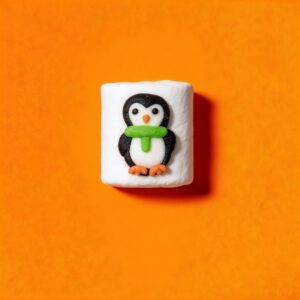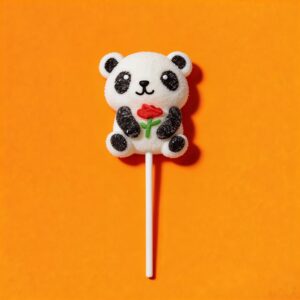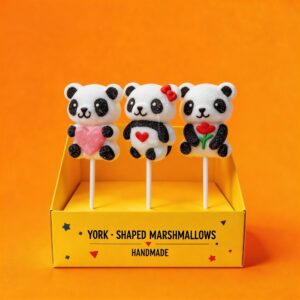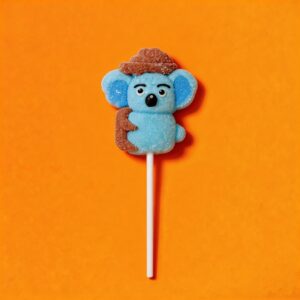
You want to launch a line of animal shaped marshmallows1 with your own unique designs, but every factory shows you the same generic bears and bunnies from their catalog. Your brand disappears into a crowd of identical products, and you lose the one thing that would make customers choose you.
The secret to custom animal marshmallows that sell is co-creating them with a factory that has in-house mold development2. This means you're not limited to catalog shapes — you can design your own characters with unique expressions, custom colors3, branded accessories, and even surprise fillings4. The process starts with your sketch, moves through 3D mold engineering, and ends with a product that no competitor can copy because the mold belongs to you.
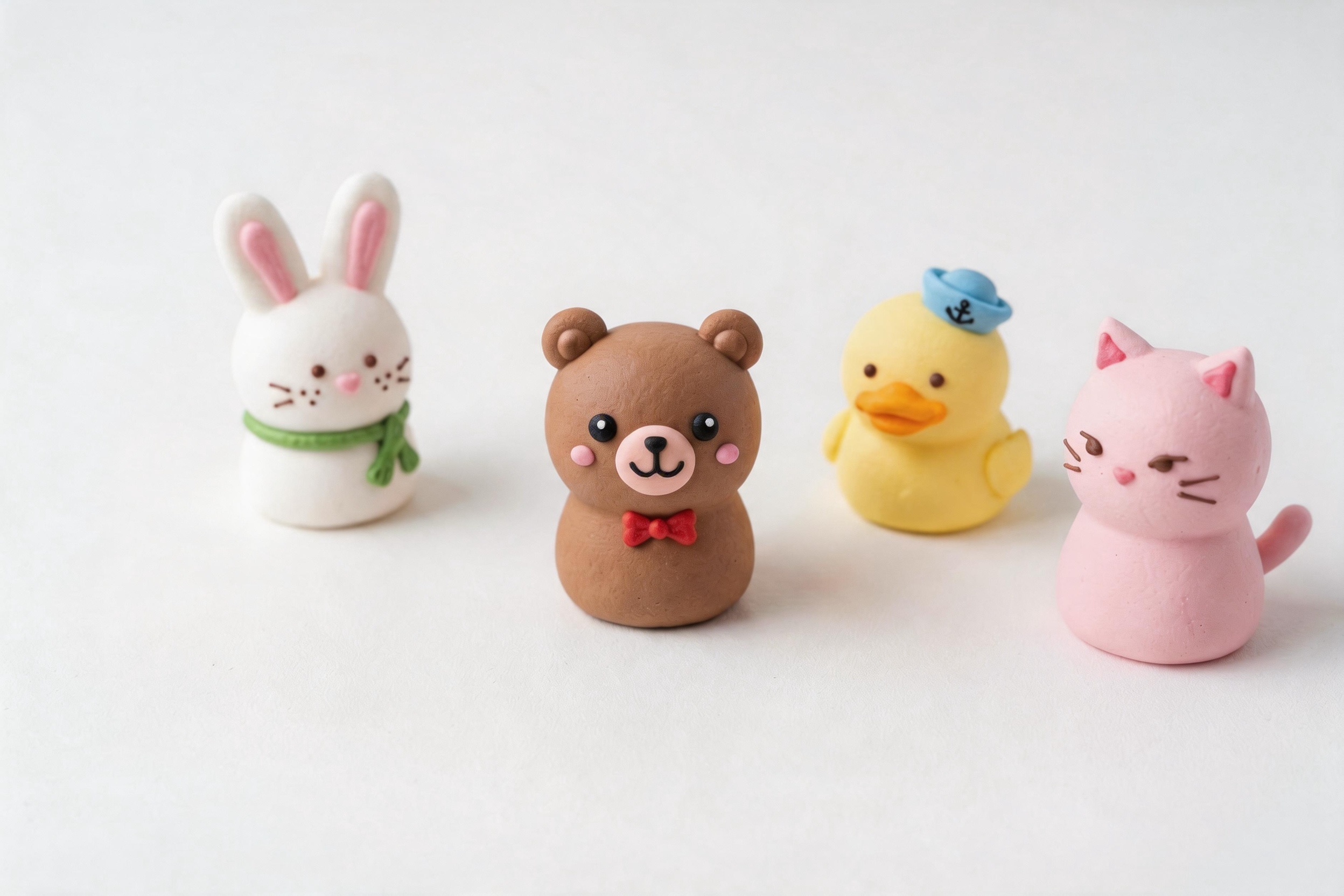
In my years of manufacturing shaped marshmallows5 for brands across the US and Europe, I've learned that the brands which grow fastest are never the ones selling generic shapes. They're the ones who invested in creating something uniquely theirs. A bear is a bear — until it's your bear, with your brand's personality, your color palette, and an expression that customers fall in love with. That's when a marshmallow stops being commodity candy and starts being a brand asset. Let me walk you through exactly how we turn a client's idea into a one-of-a-kind animal marshmallow.
Why Do Generic Animal Shapes Fail to Build Brand Loyalty?
You sell cute animal marshmallows, and customers buy them once. But they don't come back specifically for yours because they can find the exact same bear at three other stores. You have zero brand defensibility.
Generic catalog shapes fail because they create no emotional ownership. When five brands sell the same bear from the same mold supplier, the customer's purchase decision comes down to price — and that's a race to the bottom6. A custom animal character with a unique face, a signature color, and a personality becomes your brand mascot7. Customers don't just buy it — they recognize it, seek it out, and share it on social media8.
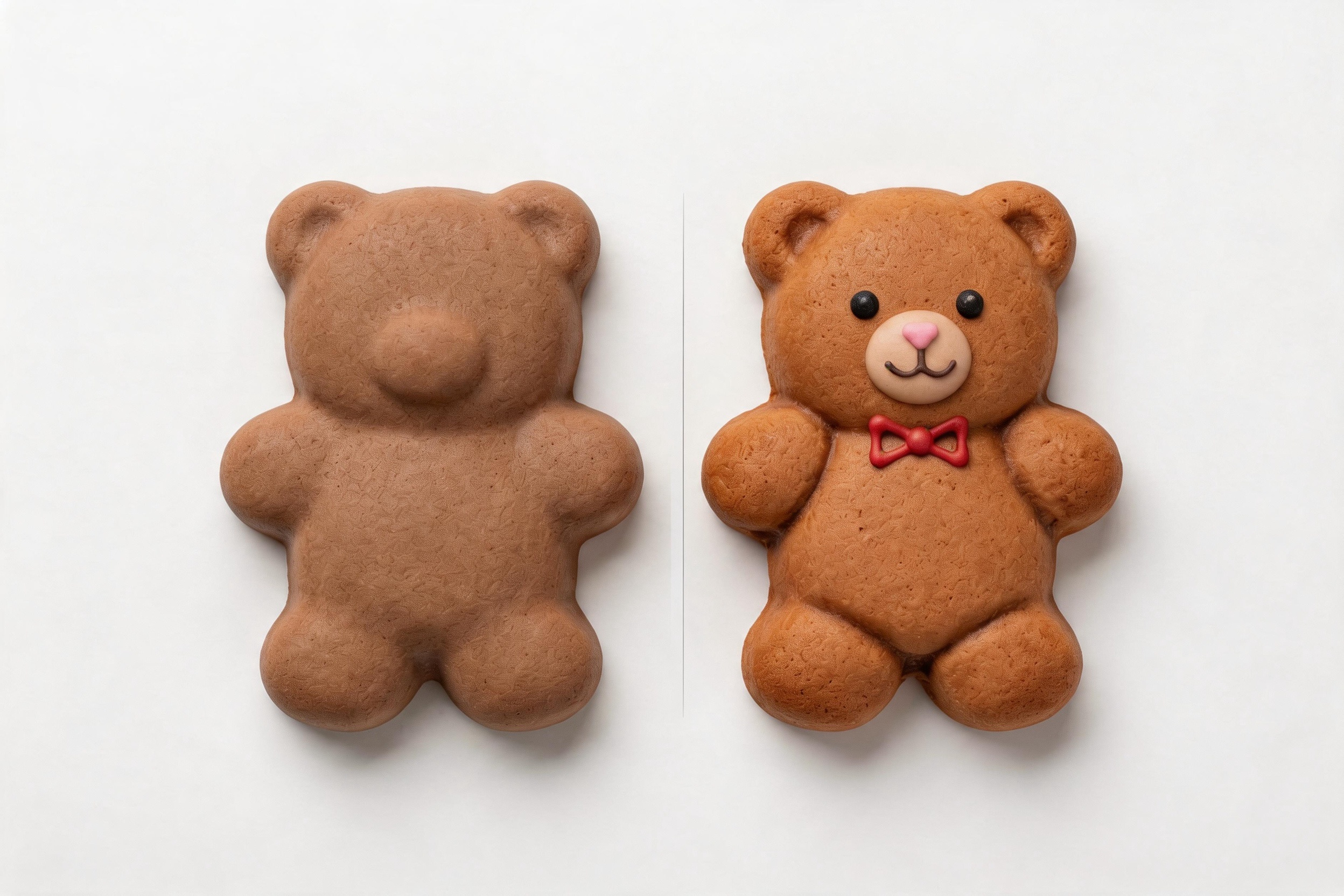
I saw this play out clearly with two of my clients who both launched animal marshmallow brands in the US market within the same year. Client A bought our standard bear, duck, and bunny from the catalog. Good shapes, decent quality, competitive price. Client B spent three months working with our design team to create their own character — a chubby bear with a winking eye, a lopsided grin, and a tiny red heart piped on its chest. They called him "Buddy." Client A competed on price from day one and struggled. Client B charged 40% more per bag, and customers didn't blink. Why? Because people weren't buying "a bear marshmallow." They were buying "Buddy." Kids asked their parents for Buddy by name. People posted photos of Buddy9 in their hot chocolate. The brand built an Instagram following around one character. That's the power of a custom animal marshmallow. It's not just candy — it's intellectual property.
Generic vs Custom: The Business Impact
| Factor | Generic Catalog Shape | Custom Character |
|---|---|---|
| Uniqueness | Identical to competitors' products | Exclusively yours — no one else has this design |
| Price Power | Competes on price — margins shrink | Commands premium — customers pay for the character |
| Brand Recognition | None — "just another bear marshmallow" | High — customers recognize and seek out your character |
| Social Media Value | Low — nothing worth photographing | High — unique characters get shared and create user content |
| Defensibility | Zero — any competitor can source the same mold | Strong — your custom mold is your proprietary asset |
What Does the Custom Animal Marshmallow Design Process Actually Look Like?
You have an idea for a character, maybe a rough sketch or even just a concept in your head. But turning that into a physical marshmallow that can be produced at scale feels like a massive, complicated leap.
The process is simpler than you think when you work with the right factory. It follows five stages: concept sketch, 3D mold engineering10, test mold production, sample approval, and mass production. A good factory partner manages the entire journey — you don't need to be a food scientist or an engineer. You just need to know what character you want, and we handle the rest.
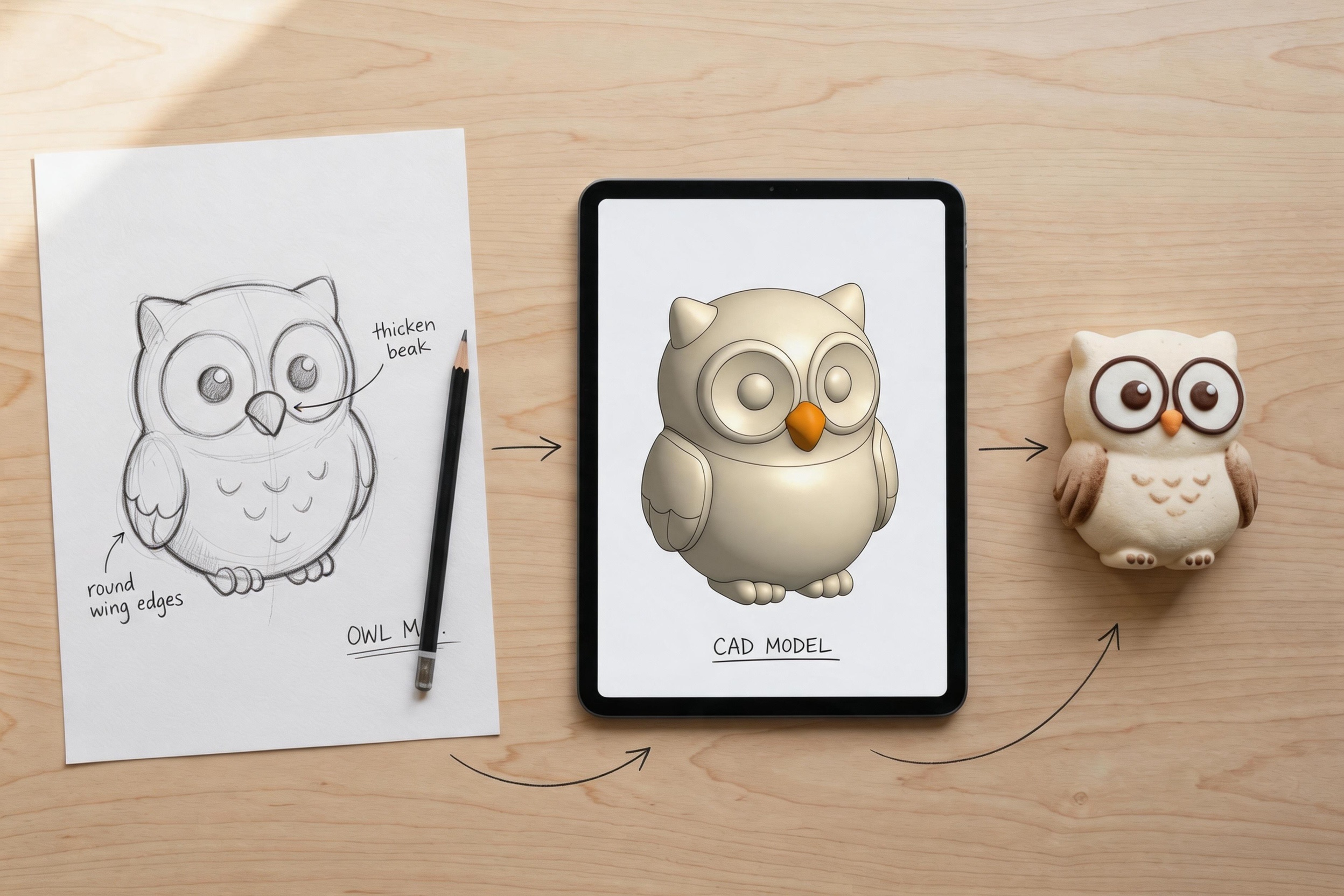
Let me walk you through how this actually works with a real example. A children's snack brand from Germany came to us with a napkin sketch. Literally — a pencil drawing on a napkin. It was a round owl with big eyes, a tiny beak, and small wing bumps on the sides. That was all they had. From there, our mold engineer took over. He redrew the owl digitally, adjusting proportions for manufacturability11 — thickening the beak so it wouldn't snap during demolding, rounding the wing edges so the marshmallow would release cleanly from the mold. He then created a 3D model and sent it to the client for approval. They loved it. We machined a test mold, ran a trial batch, and sent physical samples. The first samples were 90% perfect — the eyes needed slightly more definition. We adjusted the mold depth by 0.3mm, ran another batch, and it was spot on. From napkin sketch to approved sample took six weeks. From approval to first mass production run took three more weeks. Their owl is now their best-selling product, and no other brand can make it because we hold the mold exclusively for them.
The Five-Stage Process
| Stage | Timeline | What Happens | Your Involvement |
|---|---|---|---|
| 1. Concept | Week 1 | You provide a sketch, reference image, or description. We discuss feasibility. | You share your vision — napkin sketch is fine. |
| 2. 3D Design | Week 2-3 | Our mold engineer creates a 3D digital model10, adjusting for production realities. | You review and approve the digital model. |
| 3. Test Mold | Week 3-4 | We machine a physical test mold from the approved 3D design. | No action needed — we handle this. |
| 4. Sampling | Week 4-6 | We run test batches and send you physical marshmallow samples to taste and inspect. | You test shape, color, texture, and flavor. Request tweaks. |
| 5. Production | Week 7-9 | Final mold is approved. Mass production begins. | You confirm the order quantity and ship date. |
What Design Details Make or Break a Custom Animal Marshmallow?
Your designer created a beautiful animal character, but the factory says the thin ears will break and the tiny eyes won't show up. You don't know what's possible and what's not, so every design revision feels like a frustrating guessing game.
The key is designing for the medium. Marshmallow is a soft, aerated material — not plastic or paper. Successful animal designs follow three rules: all parts must be at least 3-4mm thick, all corners must be rounded (no sharp points), and fine details like eyes and mouths are added through hand piping12 after demolding, not built into the mold itself. Understanding this from the start saves weeks of redesigns.
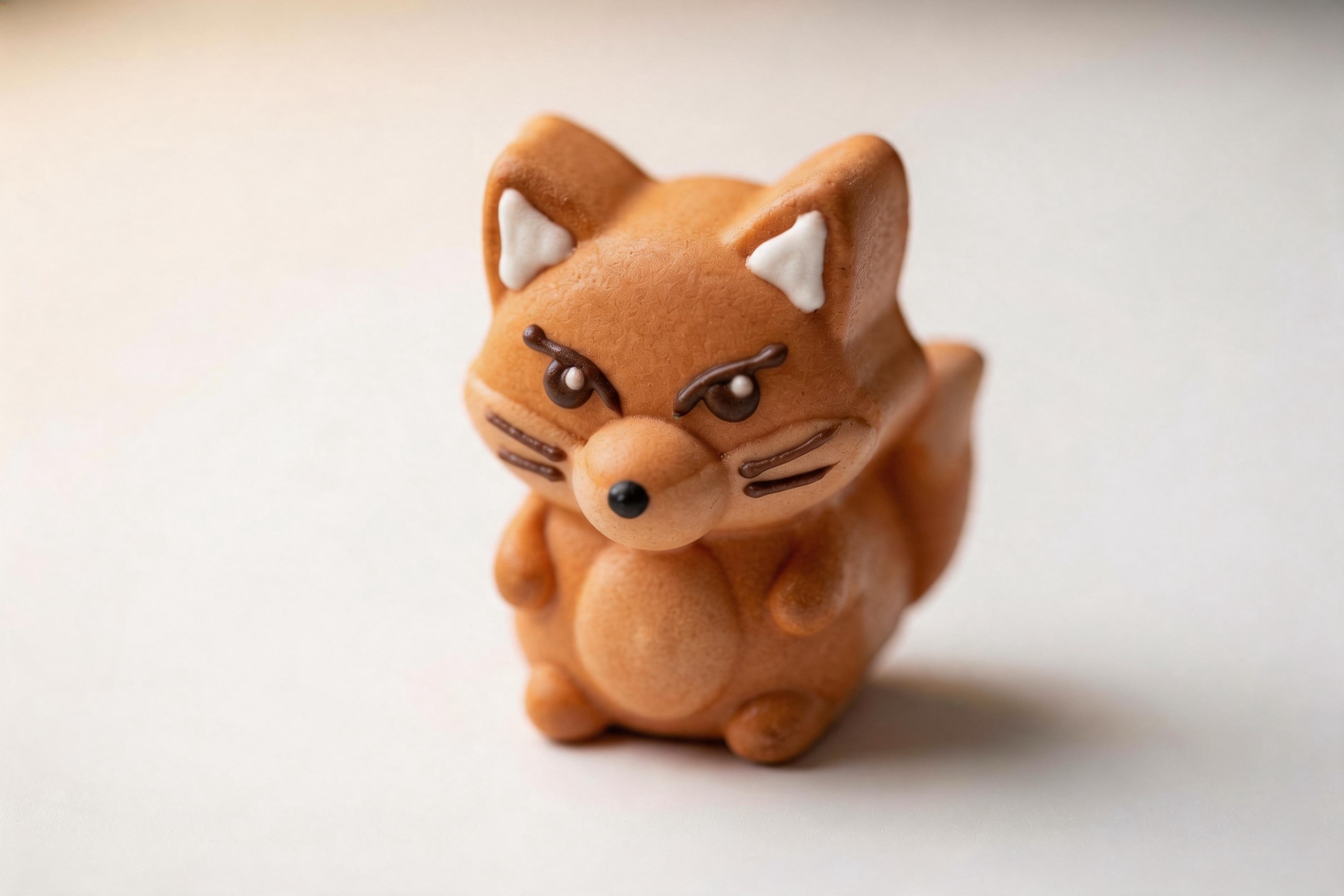
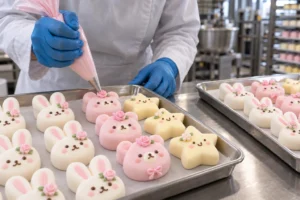
This is the most important lesson I can share. The mold creates the body. The piping creates the personality. These are two separate systems, and the best custom animal marshmallows use both strategically. The mold gives you the overall silhouette — the body shape, the ear position, the limb proportions. This needs to be bold and simple. Then our piping artisans13 add the fine details — the dot eyes, the tiny nose, the smile line, the colored scarf or bow tie. A client once sent us a design for a fox with thin, pointy ears and a long, narrow snout. Beautiful on paper. But thin pointed shapes tear during demolding14. We redesigned the fox's ears as shorter, thicker triangles — still clearly fox ears, but production-safe. The snout became a rounded bump. Then our piping team added a tiny black nose dot, two clever triangular eye shapes, and orange-brown color accents that made the fox instantly recognizable. The client said it looked better than their original drawing. That's the art of designing for marshmallow.
Design Rules for Custom Animal Marshmallows
| Design Element | The Challenge | The Solution |
|---|---|---|
| Ears / Horns | Thin projections break during demolding | Make them short and thick (≥4mm); piping can add inner-ear color detail |
| Eyes / Face | Fine details don't survive in the mold | Keep the mold face smooth; add all facial features through hand piping after |
| Tail / Limbs | Long thin extensions snap off | Integrate limbs into the body shape as bumps; piping adds definition |
| Color Accents | Multi-color molds are complex and expensive | Use a single-color mold base; add color through multi-color piping layers |
| Accessories | Separate pieces (hats, scarves) fall off | Build accessories as part of the mold silhouette; piping adds color and texture |
How Can You Use Custom Animal Marshmallows Across Multiple Product Lines?
You designed one great animal character. But you're only selling it as a standalone candy bag. You're underusing your own asset and missing revenue from other channels.
A custom animal character is a brand asset that can be deployed across multiple product formats15: standalone candy bags, hot chocolate topper16 kits, baking decoration17 sets, lunchbox snack packs, gift baskets, and even café menu items. The same mold serves all of these — you just change the packaging, the size, and the context. One character, five revenue streams.
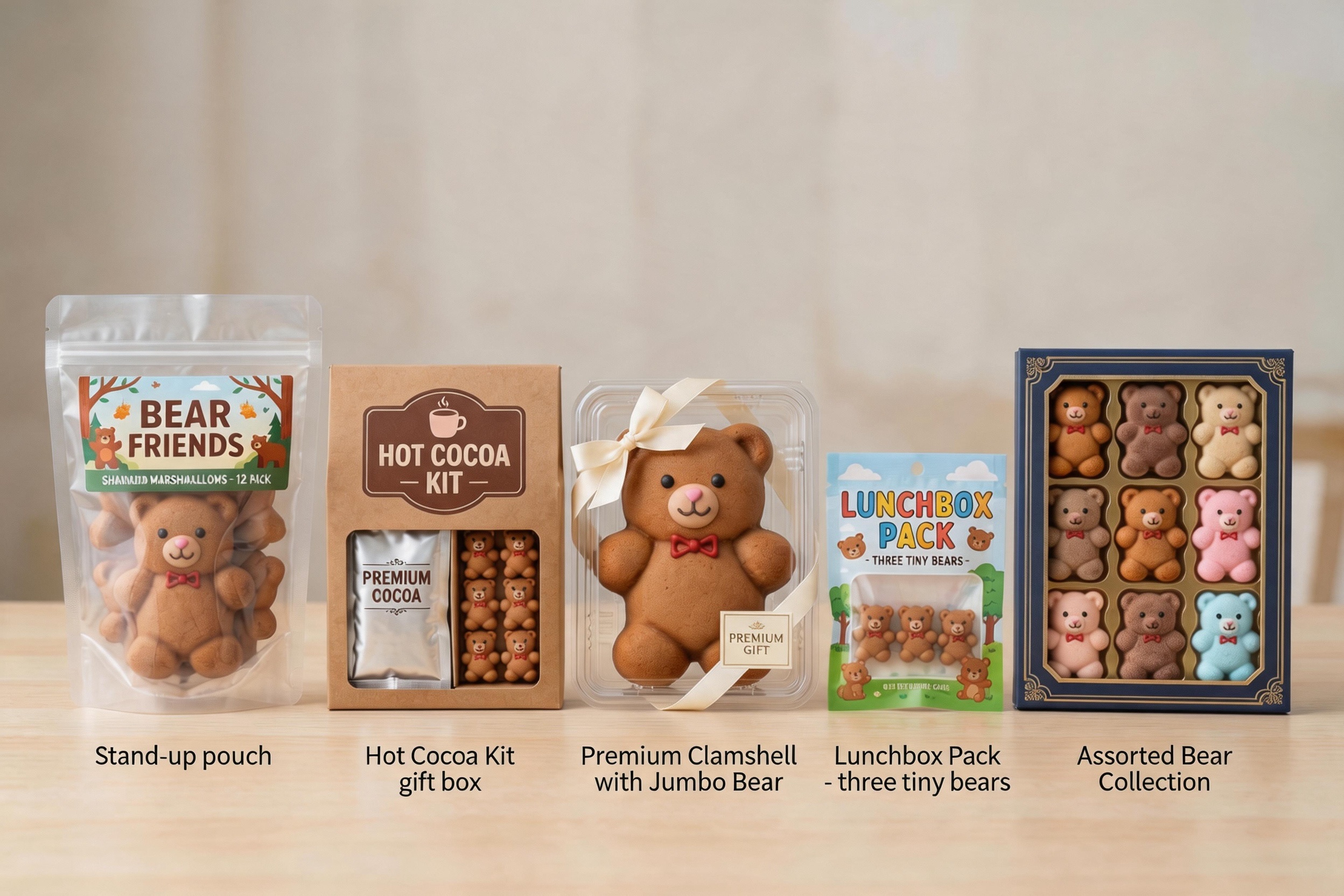
This is the strategy I always push my clients toward, because it maximizes the return on their mold investment. That German owl client I mentioned earlier? They started with a single 100g candy bag for kids. Sales were strong. Then I suggested we produce a mini version of the same owl for a "Hot Cocoa Friends" kit — a box with cocoa powder and six tiny owls. It became their winter bestseller. Next, we made a jumbo version of the owl as a premium individual gift item, shrink-wrapped with a ribbon. That sold through boutique gift shops. Then they created a "Lunchbox Owls" single-serve pack for the back-to-school18 season. Same character, same mold family (just different cavity sizes), four completely different products hitting four different sales channels. Their total revenue from the owl character is now six times what the original candy bag generated alone. The mold paid for itself on the first production run. Everything after that is pure brand leverage19.
One Character, Multiple Products
| Product Format | Size | Channel | Revenue Role |
|---|---|---|---|
| Candy Bag (100g) | Standard 3-4cm | Candy aisles, party supply20 stores | Core volume — everyday snacking and gifting |
| Hot Cocoa Kit | Mini 1-2cm | Gift sections, seasonal displays, online | High margin — sells as an experience, not just candy |
| Jumbo Gift Piece | Large 6-8cm | Boutique gift shops, specialty retail | Premium — individual gift item with highest per-unit margin |
| Lunchbox Single Pack | Small 2cm | Grocery snack aisles, school supply sections | Repeat purchase — parents buy weekly |
| Café Topper | Mini 1-2cm | Food service, cafes, dessert shops | B2B supply — recurring orders from commercial accounts |
Conclusion
Custom animal marshmallows are not just a product — they're a brand asset. Invest in a unique character designed with your factory partner, and you'll own a product that no competitor can copy and that sells across every channel year-round.
Discover the world of custom shaped marshmallows and their unique artisan production process. ↩
Learn about the importance of in-house custom molding capabilities for unique product development. ↩
Understand how color quality measurement ensures brand consistency in food product manufacturing. ↩
Find exciting marshmallow filling ideas that add surprise and delight to your products. ↩
Learn about the key elements of starting and running a marshmallow manufacturing business. ↩
Explore how product differentiation drives competitive advantage and prevents price-based competition. ↩
Gain insights on building a strong brand identity that creates lasting customer recognition. ↩
Understand how user-generated content builds authentic brand loyalty and expands organic reach. ↩
Understand the Instagrammable effect and how visual products drive organic social media sharing. ↩
Explore the role of 3D modeling in product design, visualization, and manufacturing readiness. ↩
Learn why design simplicity and manufacturability are critical for successful physical product development. ↩
Watch the hand-piping process that brings marshmallow characters to life with detailed decorations. ↩
Discover how custom shapes and craftsmanship help candy brands stand out in competitive retail. ↩
Learn about the complete marshmallow manufacturing process including molding and demolding techniques. ↩
Discover how seasonal candy momentum and format variety help retailers drive year-round sales. ↩
Discover strategies to leverage hot cocoa and marshmallows for consistent seasonal sales growth. ↩
Find creative marshmallow shape and flavor ideas for innovative baking and dessert applications. ↩
Discover party planning and back-to-school trends that drive demand for fun, kid-friendly snacks. ↩
Learn effective market research methods to understand consumer preferences and retail opportunities. ↩
Browse wholesale party supply options to understand the market for novelty candy products. ↩