You need edible cake decorations1 that look professional on every cupcake and cake you sell. But sourcing them is a nightmare — suppliers send you samples with faded colors, cracked edges, and toppers that go soft within days. Your bakery deserves better than this.
The best way to source custom sugar toppers2 in bulk is to work directly with a specialized factory that offers edible ink printing3, molded sugar paste, and wafer paper production under one roof. A real factory — not a trading company — can Pantone-match4 your exact brand colors, create designs from your artwork, produce trial batches before you commit, and guarantee shelf life of 6-12 months. This is the difference between a decoration that elevates your product and one that embarrasses it.
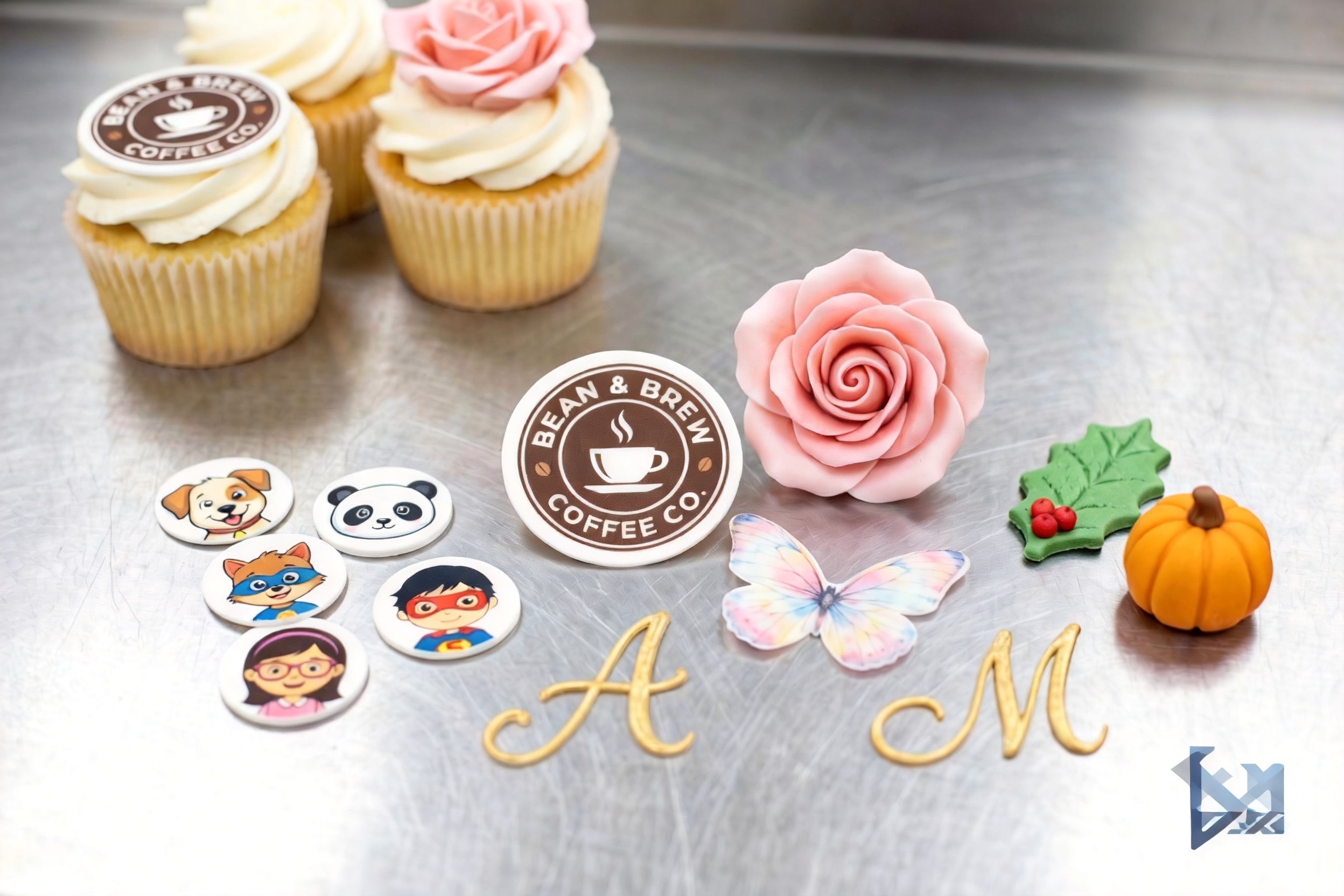
I've been manufacturing edible decorations5 for bakery brands, dessert chains, and grocery retailers across the US, UK, and Europe for years. The most common thing I hear from new clients is, "I've been burned before." They tried a supplier who promised custom toppers but delivered generic, low-quality pieces that looked nothing like the approved sample. Or the toppers arrived crisp but turned to mush within a week because the factory didn't understand humidity control6. These are solvable problems — if you know what to look for in a supplier. Let me walk you through the entire sourcing process so you can avoid the mistakes and find a partner who actually delivers.
What Types of Sugar Toppers Are Available and Which Ones Suit Your Products?
You know you want edible decorations, but the options are overwhelming — sugar sheets, wafer paper, royal icing7, fondant8 pieces, isomalt. You have no idea which material is right for your specific products and your customers.
Each sugar topper type serves a different purpose. Edible ink on sugar sheets9 is best for logos and photorealistic images. Molded sugar paste10 is best for 3D flowers and figurines. Wafer paper is best for lightweight, delicate elements like butterfly wings. The right choice depends on your design complexity, your product's surface (buttercream vs fondant vs naked), and how long the topper needs to last on the shelf.
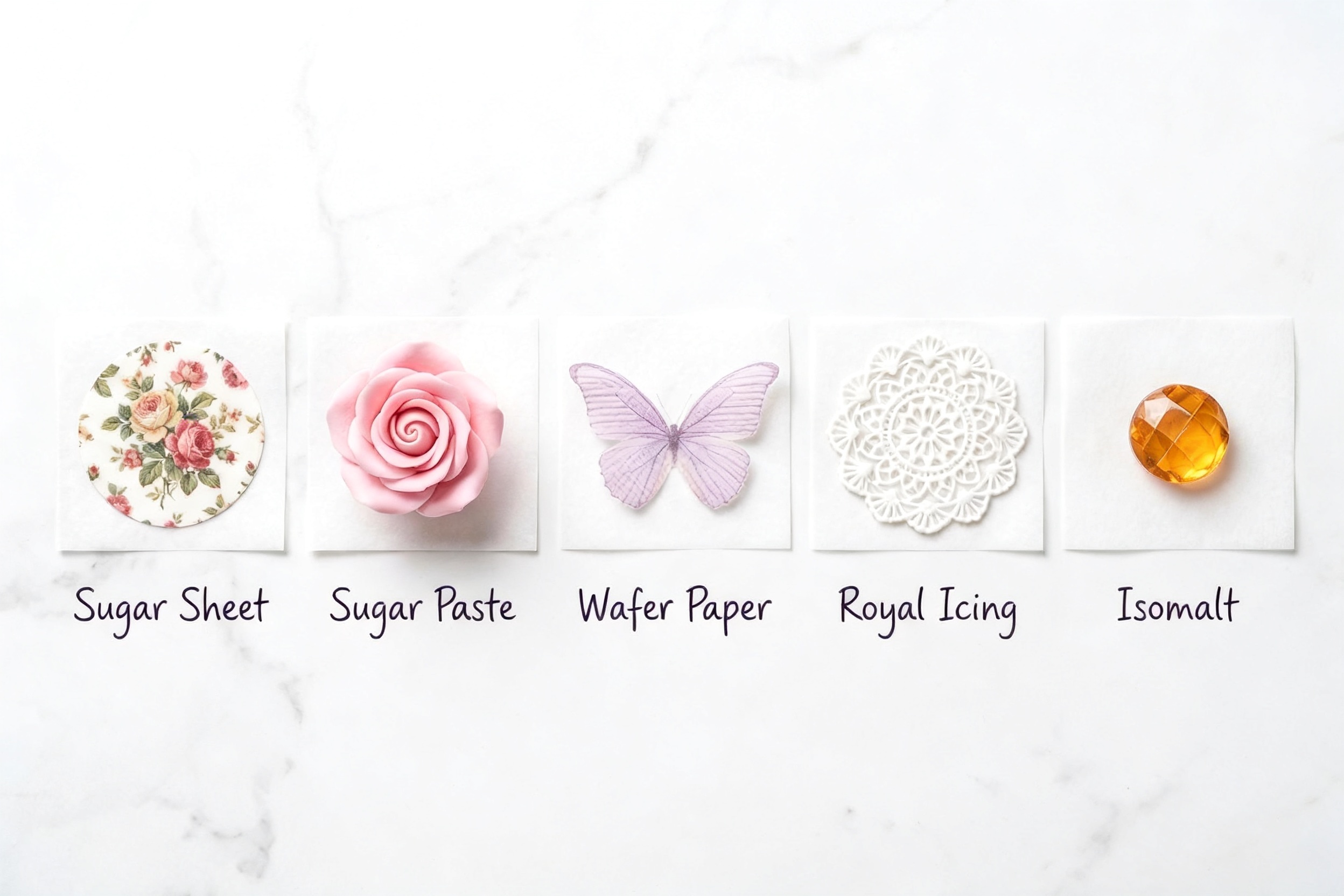
I always start a new client conversation with one question: "What are you putting this on, and how long does it need to look good?" The answer determines everything. A coffee shop11 that puts a sugar topper on a latte needs something that holds up for 3 minutes before dissolving elegantly. A grocery bakery that displays cupcakes in a refrigerated case for 48 hours needs something that won't absorb moisture from the buttercream and go limp. A home baking kit company needs toppers that survive 6 months in sealed packaging before a customer opens them. Each scenario demands a different material. One of my clients — a cupcake chain in Australia — was using wafer paper toppers on buttercream cupcakes. The problem? Wafer paper is ultra-thin and absorbs moisture fast. Within two hours in the display case, the toppers were curling and translucent. We switched them to printed sugar sheet toppers, which have a much better moisture resistance12. Problem solved. Same design, different material, completely different performance.
Sugar Topper Types Compared
| Type | Best For | Detail Level | Shelf Life | Moisture Resistance |
|---|---|---|---|---|
| Sugar Sheet (Edible Print) | Logos, photos, characters, detailed flat designs | Very high — photorealistic | 6-12 months sealed | Good — holds up on buttercream for 24-48hrs |
| Molded Sugar Paste | 3D flowers, figurines, shaped decorations | High — crisp edges with depth | 6-12 months sealed | Good — rigid, handles light moisture |
| Wafer Paper | Butterfly wings, petals, lightweight delicate elements | Medium — delicate, elegant | 3-6 months sealed | Poor — absorbs moisture quickly, curls |
| Royal Icing Transfer | Lace patterns, monograms, classic piped look | High — traditional elegance | 6+ months sealed | Medium — can soften in high humidity |
| Isomalt | Transparent gems, jewel effects, glass-like sails | Medium-high — glass finish | 3-6 months sealed | Very poor — extremely humidity-sensitive |
Why Does Color Accuracy Matter So Much for Wholesale Sugar Toppers?
Your brand's visual identity13 depends on exact colors. But every sugar topper sample you receive looks slightly different from your approved artwork. If your logo is the wrong shade of blue across 200 store locations, your brand manager14 will reject the entire order.
Color accuracy in edible printing requires professional-grade equipment5 with calibrated color profiles, not consumer-grade printers. A reliable factory uses edible ink systems that are calibrated to reproduce exact Pantone values. They will produce a color proof for your approval before any bulk run. If a supplier can't show you their color calibration process, they can't guarantee your brand colors will be right.
This is the issue that separates a real factory from a hobby operation. I once had a US coffee chain switch to us after a disastrous experience with their previous supplier. They needed their exact brand green — Pantone 349C — printed on 80,000 cupcake toppers for a national launch. The previous supplier's "green" came out closer to teal. The entire batch was rejected. That's $15,000 worth of product in the bin, plus a delayed launch. When they came to us, we ran a color calibration test first. We printed their logo at five slightly different saturation levels and sent all five to their brand team for comparison. They picked the exact match. We locked that color profile4 into our system, and every subsequent batch has been identical. This isn't just a "nice to have." For any client with brand guidelines15, it's the single most important capability your supplier must have.
What Causes Color Problems
| Problem | Cause | How a Good Factory Prevents It |
|---|---|---|
| Wrong shade | Uncalibrated printer, consumer-grade inks | Professional edible ink system with Pantone calibration profiles |
| Fading over time | Low-quality ink, exposure to light | UV-resistant edible inks, opaque packaging with light barriers |
| Inconsistent batches | No locked color profile, operator changes settings | Color profile locked in software, verified with spectrophotometer per batch |
| Bleeding / blurring | Wrong sugar sheet surface, too much ink saturation | Matched ink-to-sheet formula, controlled print density settings |
How Do You Verify a Sugar Topper Supplier Before Placing a Large Order?
A supplier's website looks great and their catalog photos are beautiful. But catalog photos aren't your custom design. You need to know that what you approve is exactly what 10,000 units will look like — and that they'll still look perfect three months from now.
Never place a bulk order without testing three things: a custom sample in your exact design (not a catalog piece), a shelf-life test (leave the sample on your counter for a week), and a documentation check (valid BRC16 or FDA17 certificates, ingredient lists, allergen declarations). A confident factory will welcome this due diligence — a bad one will make excuses.
I've adopted a rule in my business: I never sell a client's first order from a catalog sample. I insist on producing a custom sample from their actual artwork first. Why? Because a catalog piece is our best work under perfect conditions. Your design might have different colors, finer lines, or smaller text that behaves differently. I'd rather discover a problem at the sample stage — where fixing it costs nothing — than at the 10,000-unit stage where it costs everything. I encourage every buyer to test their samples aggressively. Peel one off the sheet and place it on a cupcake with buttercream. Leave another one on your kitchen counter, unsealed, for seven days. Check it at day three and day seven. Is it still crisp? Have the colors shifted? Has it warped or softened? If it passes that test, you've found a real manufacturer. If it fails, you've saved yourself from a disaster. Our factory holds BRC16, FDA registration18, ISO 2200019, HACCP, and SMETA20. These aren't just logos — they mean every ingredient, every process, and every piece of packaging has been audited against global food safety standards.
Supplier Verification Checklist
| Test | What to Do | Red Flag | Green Flag |
|---|---|---|---|
| Custom Sample | Request a sample printed from YOUR artwork, not their catalog | Only offers catalog pieces, says "it'll look the same" | Produces a custom sample sheet for your approval before quoting bulk |
| Color Check | Compare sample against your Pantone swatch under neutral light | Color is "close" but visibly off | Provides 3-5 calibration options for you to choose the exact match |
| Shelf-Life Test | Leave an unsealed sample on your counter for 7 days | Softens, warps, or changes color within 3 days | Still crisp, flat, and vibrant after 7 days in open air |
| Certifications | Ask for current BRC, FDA, ISO certificates with valid dates | Can't provide, expired, or different company name on certificate | Sends certificates proactively, invites you to verify with the issuing body |
| Allergen Info | Request full ingredient list and allergen declaration | Vague answers like "it's just sugar" | Provides detailed spec sheet listing every ingredient and allergen status |
What Packaging and Shelf-Life Factors Should You Consider When Buying in Bulk?
You order 5,000 sugar topper sheets, but by the time you use the last box three months later, the toppers have gone soft, sticky, and the colors have faded. Your investment is half wasted before it even reaches a cupcake.
Sugar toppers are hygroscopic6 — they absorb moisture from the air. Proper packaging with moisture barrier12 materials, desiccant packs, and airtight seals is what determines whether your toppers last 2 weeks or 12 months. When ordering in bulk, always ask your factory about their packaging material specs, resealable options, and recommended storage conditions21.
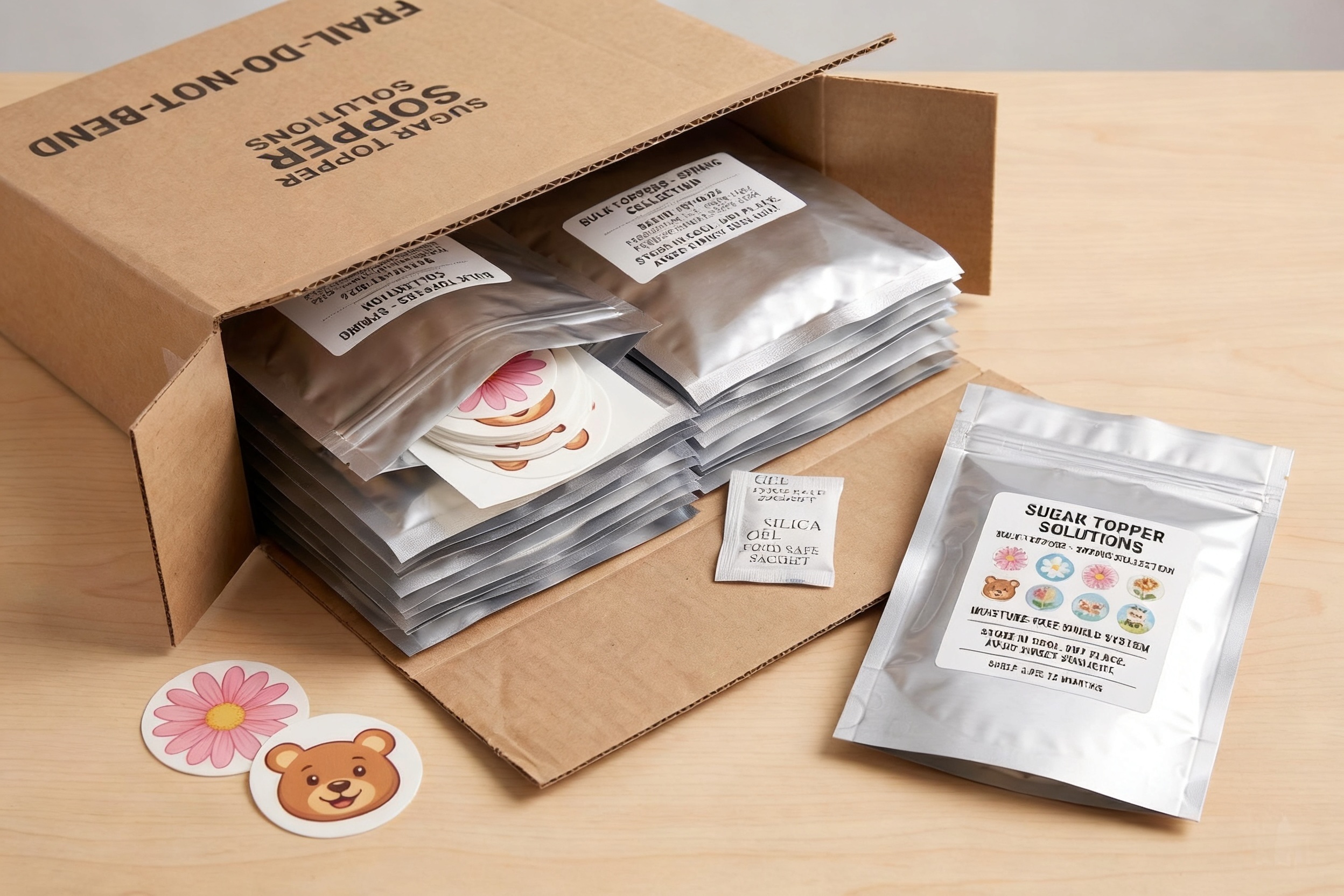
This is the hidden factor that most buyers don't think about until it's too late. A beautiful sugar topper is worthless if it turns gummy in your storage room. I had a client in the UK — a subscription box22 company — who ordered a six-month supply from another factory. The toppers arrived fine. But after two months in their warehouse, the boxes at the bottom of the pallet had softened completely. The factory had used standard poly bags with no moisture barrier and no desiccant. In a humid UK warehouse, the sugar absorbed ambient moisture right through the thin packaging. They lost nearly 40% of their inventory. When they switched to us, we packaged each sheet in a foil-laminated moisture barrier pouch6 with a food-safe desiccant sachet inside, then packed the pouches into corrugated cartons with additional moisture protection. Their toppers now stay crisp for 12 months. They order twice a year instead of monthly, which saves them a significant amount on shipping and logistics. The packaging cost is slightly higher per unit, but the waste drops to zero — and that's where the real savings are.
Packaging Factors That Protect Your Investment
| Factor | Cheap Packaging | Professional Packaging |
|---|---|---|
| Material | Standard thin poly bag | Foil-laminated moisture barrier pouch |
| Moisture Control | None | Food-safe desiccant sachets included |
| Seal Type | Simple heat seal, not resealable | Double-sealed with zip-lock resealable option |
| Shelf Life | 2-4 weeks after opening | 6-12 months sealed; 2-4 weeks after opening if stored correctly |
| Waste Rate | High — 20-40% loss to softening and warping | Near zero — product stays crisp throughout its stated shelf life |
Conclusion
Sourcing custom sugar toppers in bulk comes down to three non-negotiables: exact color accuracy, proven shelf-life performance, and a factory partner who produces a custom sample from your design before you commit a single dollar to bulk production.
Explore creative cake decorating ideas and visual trends for bakery product inspiration. ↩
Learn about sugar paste and its foundational role in edible cake decoration manufacturing. ↩
Explore the latest research on edible printing technology and its food manufacturing applications. ↩
Understand how color quality measurement and Pantone matching ensures brand consistency in food products. ↩
Watch how professional edible printing technology produces detailed sugar decorations at scale. ↩
Learn how moisture barrier packaging materials preserve sugar topper freshness and quality. ↩
Understand royal icing techniques and their traditional role in cake decoration. ↩
Learn about fondant icing and how pre-made sugar toppers compare as an alternative. ↩
Watch how ready-to-use edible decorations are applied in commercial bakery settings. ↩
Learn traditional buttercream flower piping techniques to understand the time and skill sugar toppers replace. ↩
Browse the cake topper community on Instagram to see current design trends and consumer demand. ↩
Explore food packaging and shelf life research for insights on edible product preservation. ↩
Gain insights on building a strong visual brand identity in competitive food and dessert markets. ↩
Understand how operational efficiency and brand consistency drive decisions in consumer packaged goods. ↩
Learn effective market research methods to understand bakery and food brand requirements. ↩
Learn about BRC Global Standards and their critical role in food safety certification for export markets. ↩
Explore FDA guidelines for food ingredients, additives, and colors used in edible decorations. ↩
Understand FDA registration requirements for food manufacturing facilities exporting to the US. ↩
Discover the benefits of ISO 22000 certification for food safety management in manufacturing. ↩
Learn how SMETA ethical audits ensure fair labor practices and social compliance in factories. ↩
Explore FDA guidelines on safe food storage to understand best practices for edible product preservation. ↩
Understand how unboxing experience and product quality drive retention in subscription box businesses. ↩