Marshmallow Thank-You Gifts: Corporate Appreciation Wholesale?
Marshmallow Thank-You Gifts promise a playful way to say thanks, but corporate timelines and brand standards raise the stakes. Many teams assume it is a simple “print my logo” job, then hit delays in molds, packaging, and labels. I treat these as selection and risk decisions. Locked early, they land on time and on budget.
Marshmallow Thank-You Gifts work best when you lock three decisions at the brief: the brand realization level (shape and color), the packaging workflow, and market-specific labeling. This sequence controls cost, lead time, and approval cycles. I am a China-based OEM/ODM factory, so I guide EU/US buyers through these gates with verifiable certifications and repeatable timelines.
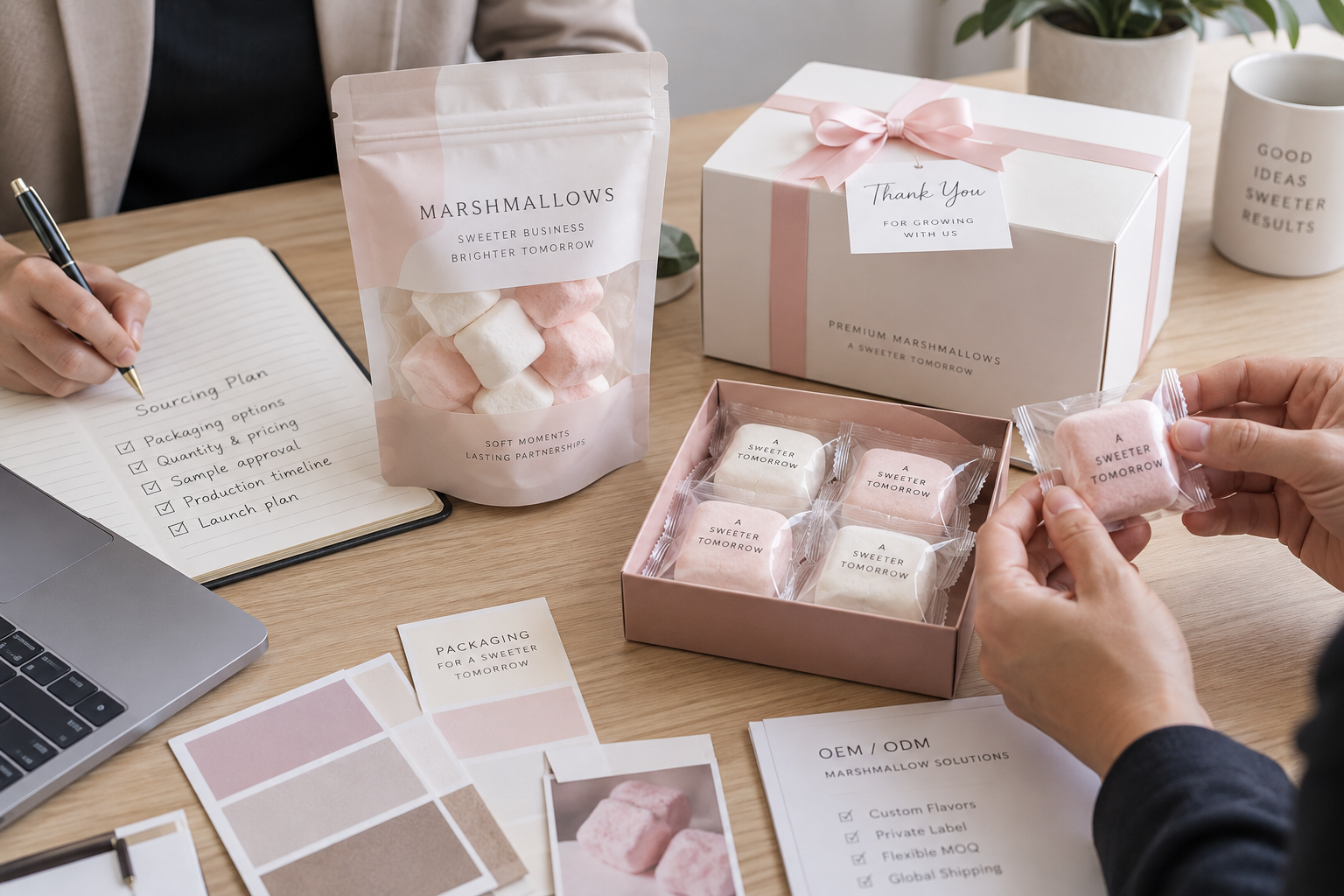
Good choices early make the rest simple. I will show realistic logo geometry options, how packaging adds cost and days, why labels must be locked first, and how to build a backward timeline. I will use real ranges from anonymous projects so you can model what works.
How realistic can Marshmallow Thank-You Gifts render your logo and colors?
Brand teams want perfection. Factories need physics. If you push fine details into a soft geometry or demand Pantone precision in edible color, you add rework and cost. I solve this by defining brand realism at the brief and tying it to tools, budget, and deadline.
A practical answer: I use a 3-tier path to balance brand fidelity with speed. Tier 1 is 2D emboss/deboss shapes. Tier 2 is simplified 3D molds. Tier 3 moves the logo to packaging while the marshmallow stays simple. Edible dyes approximate, not match Pantone 1:1.1
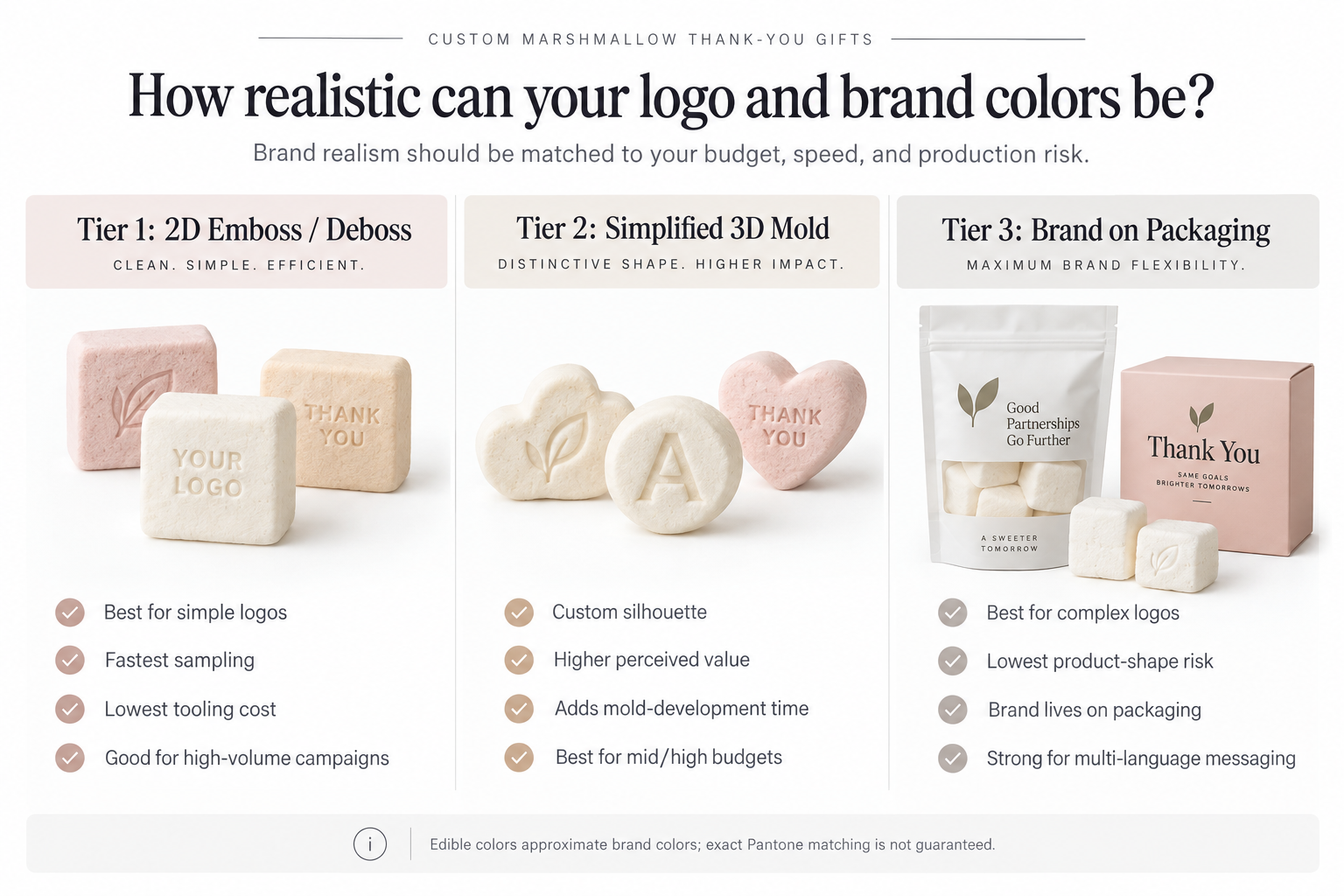
The 3-tier path for brand realism
I divide brand realization into three controlled options:
- Tier 1: 2D deboss/emboss
- Tier 2: Simplified 3D mold
- Tier 3: Brand on packaging
Tier 1 (2D deboss/emboss)
- Use: Flat logos, bold marks, simple type.
- Fidelity: Strong outline recognition; fine strokes may soften by 0.2–0.5 mm.
- Cost: No or low mold cost when we adapt existing tooling; otherwise low.
- Lead time: Fastest for sampling because we pull from a broad mold library.
- Application: Retail thank-you campaigns needing speed, larger volumes.
Tier 2 (Simplified 3D mold)
- Use: Iconic shapes with depth, no micro-detail.
- Fidelity: Recognizable silhouette; remove undercuts and thin walls.
- Cost: Custom mold fee required; amortized over volume.
- Lead time: Adds 5–10 days for tool machining and validation.
- Application: Gift boxes, higher perceived value, mid-to-high budgets.
Tier 3 (Brand carried by packaging)
- Use: Complex logos, tight brand color tolerance, multi-language messaging.
- Fidelity: Marshmallow remains simple (stars, hearts, cubes). The brand lives on flow-wrap, pouch, or box.
- Cost: Shifts spend from tooling to print; lower production risk.
- Lead time: Moves time to artwork approvals and print slots.
Color realities
- Edible colorants do not equal Pantone 1:1. I align to acceptable ranges and share a proof photo with a color swatch under daylight LEDs. Expect ΔE variation.2 I ask for a tolerance range at brief.
- White marshmallow can pick up hue from flavored doses.3 If exact hue matters, keep base neutral.
An anonymized case
- Brief: 60,000 units for a North American HR appreciation push. The logo had thin serifs and a gradient.
- Constraint: 9 weeks to in-store. Budget capped at a mid-tier price band.
- Decision: We dropped to Tier 1 with a bolded logotype and moved gradient branding to a printed flow-wrap.
- Result: We avoided a 3D tool, cut 8–12 days, and saved ~0.06–0.10 USD per unit in that volume band while maintaining brand recognition in pack. The campaign hit date with zero rework.
Technical note: I do not promise lab-grade color matching or perfect 3D replication. I state achievable tolerances, present simplified art, and document approvals.
Which packaging workflow keeps Marshmallow Thank-You Gifts on-budget and on-time?
Packaging feels cosmetic. It is not. Every extra sleeve, insert, or sticker is a station, a line setup, and a QC step. If you choose it late, you pay twice: one in cost and again in days. I lock packaging workflow at the brief.
The fastest path pairs a simple marshmallow with individual flow-wraps or a multi-count pouch. Gift boxes add perceived value but add kitting, labeling, and more inspection. More steps mean higher unit price and longer lead times.4
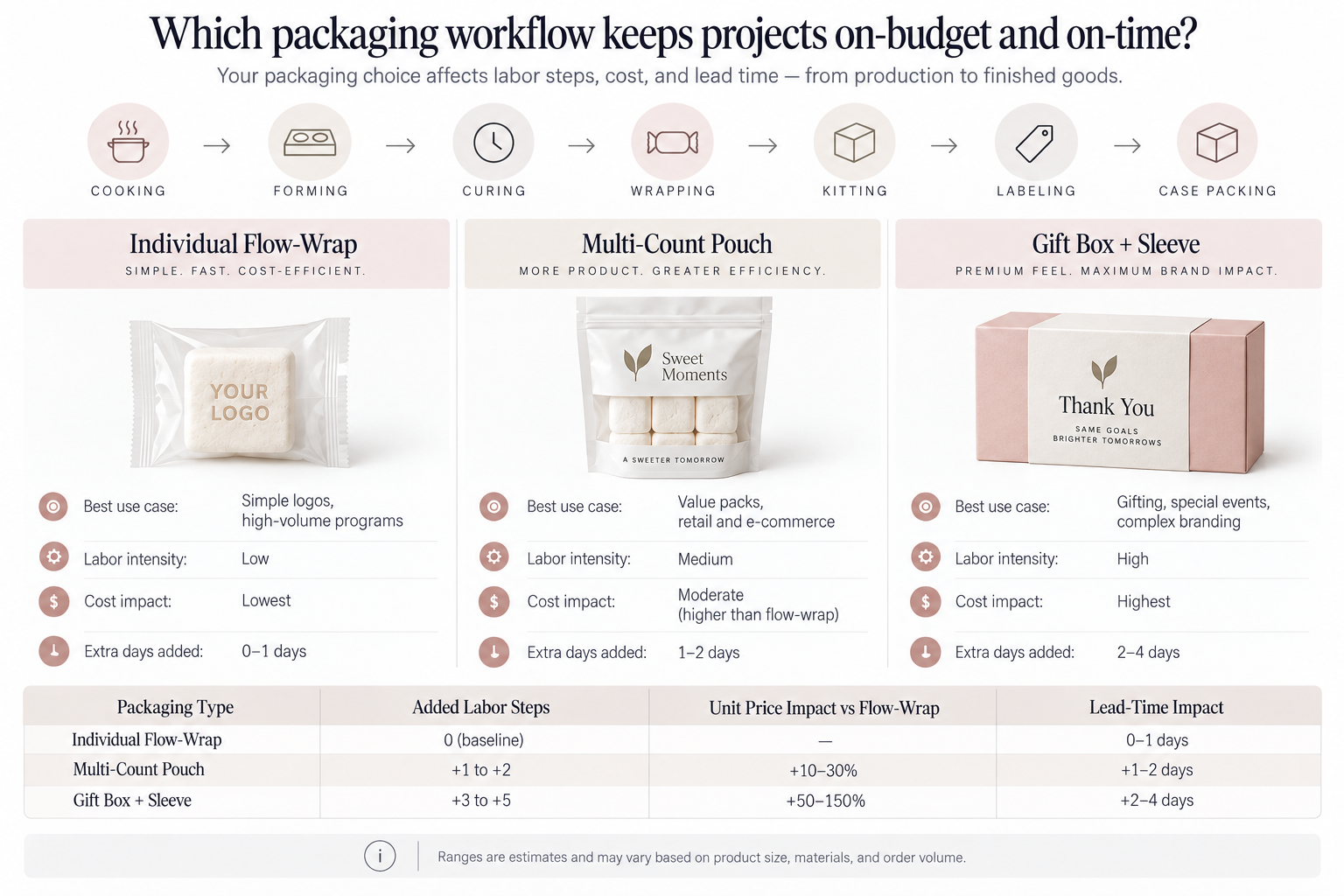
Map the packaging to your workflow and budget
I recommend deciding packaging before sampling. Here is the basic production flow and where packaging decisions add time:
Production flow 1) Cooking 2) Forming 3) Curing 4) Wrapping (flow-wrap or bagging) 5) Kitting/boxing (if required) 6) Labeling (primary/secondary) 7) Case packing and palletizing
Common corporate-packaging choices
- Individual flow-wrap: Best for events, mailers, office drops.
- Multi-count pouch (e.g., 6–12 pcs): Best for retail or gift baskets.
- Rigid gift box with sleeve or sticker: Best for premium positioning, high perceived value.
How each option changes complexity
- Individual flow-wrap
- Line setup: One wrapping line, inline date coding.
- Labor: Lowest manual intervention.
- Cost delta: Baseline.
- Days added: 0–1 for print changeovers.
- Multi-count pouch
- Line setup: Count-weighing and bagging; sometimes secondary sealing.
- Labor: Moderate for hand-check and pouch loading.
- Cost delta: +0.03–0.10 USD per unit versus flow-wrap, depending on count and film.
- Days added: +2–3 for pouch print and bagging validation.
- Gift box with kitting and sleeve
- Line setup: Kitting cell, box forming, insert placement, sleeve application.
- Labor: Highest; manual QC at multiple points.
- Cost delta: +0.15–0.50 USD per unit, driven by board grade, print, and insert complexity.
- Days added: +4–7 for box sourcing, print, and assembly rehearsal.
Packaging comparison
| Packaging type | Typical volumes | Added labor steps | Unit price impact vs. flow-wrap | Lead-time impact |
|---|---|---|---|---|
| Individual flow-wrap | 10k–500k+ | Low | Baseline | 0–1 days |
| Multi-count pouch | 5k–200k | Medium | +$0.03–$0.10 | +2–3 days |
| Gift box + sleeve | 2k–50k | High | +$0.15–$0.50 | +4–7 days |
Notes:
- These ranges reflect past orders we produced in our BRC-certified facility5. Your exact numbers depend on material specs, print counts, and labor market conditions.
- I always align on the packaging bill of materials at the brief. If you change later, I re-quote and reset timelines to protect quality.
An anonymized packaging case
- EU distributor, 25,000 sets, holiday thank-you packs.
- Original ask: Gift boxes with ribbon and window. Budget pressure surfaced in week 2.
- Pivot: We moved to a high-quality printed pouch with a custom header card. We cut 5 days of assembly and reduced unit costs by ~0.18 USD while maintaining a premium look. The retailer accepted the alternative with a simple in-store display.
How do compliance-first labels protect Marshmallow Thank-You Gifts in EU/US markets?
Returns, customs holds, and relabeling eat budgets. Teams leave labels to the end, then rush. I start compliance on day one. We decide markets, languages, allergens, and nutrition format before artwork. We run approvals like gates, not suggestions.
Lock your label early. Decide the market and languages, agree ingredient and allergen statements, and format your nutrition panel correctly before design. Approvals flow from spec sheet to pre-production sample. Our certifications signal capability but do not replace market rules.
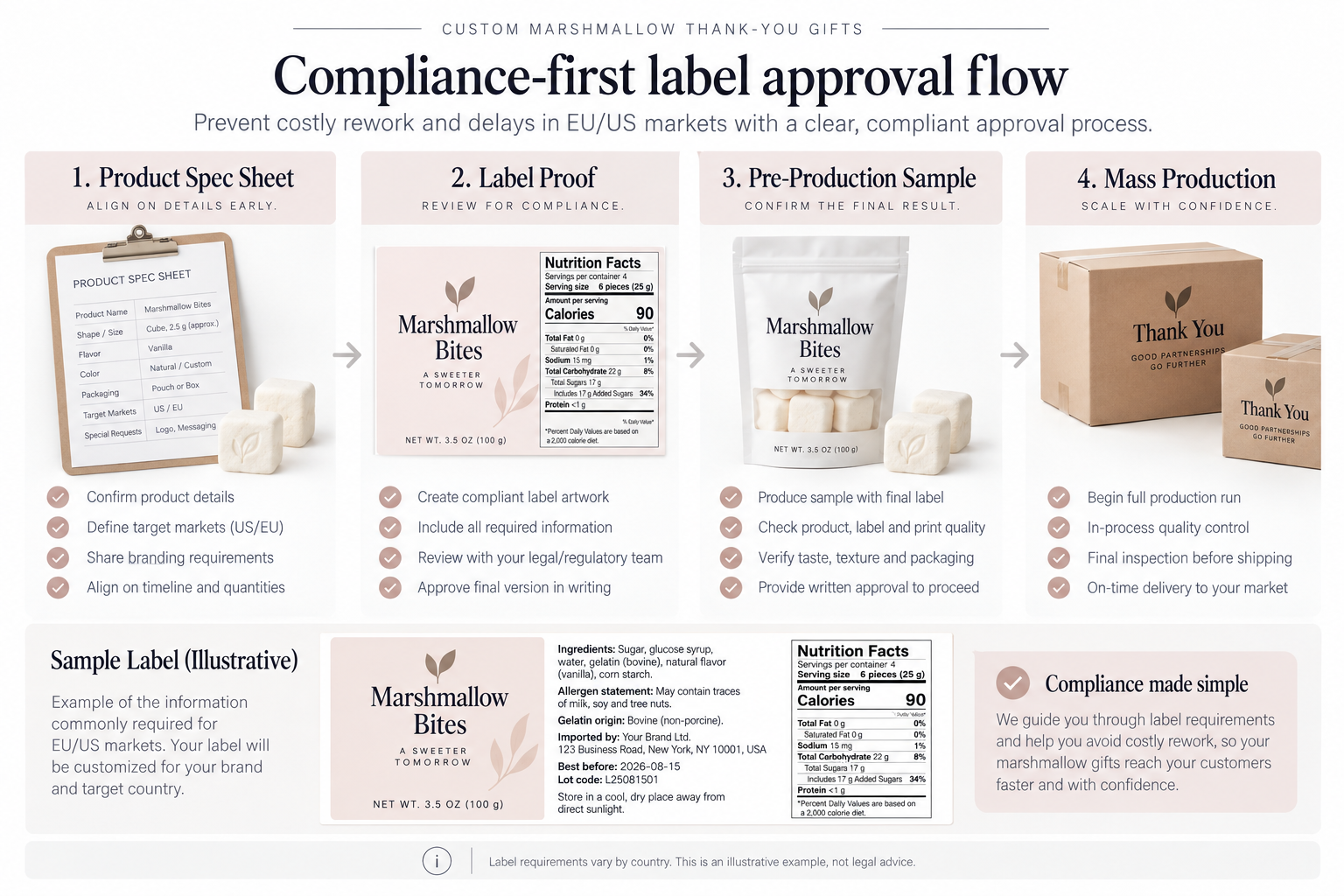
A label approval flow that prevents rework
I use an approval chain that reduces risk at each step:
1) Product spec sheet
- Includes formula, flavor, colorants, allergens, net weight, shelf life, storage.
- We align with your market requirements and languages upfront.
2) Label proof
- Nutrition panel format set for target market(s): e.g., FDA 21 CFR6 for the U.S., EU FIC7 for Europe.
- Ingredient order by weight, allergen emphasis per jurisdiction.
- Claims marked “to be verified” if you provide them.
3) Pre-production sample (PPS)
- Includes printed packaging or a high-fidelity mockup with correct barcodes and date codes.
- You or your compliance team signs off. I require this before mass run.
4) Mass production
- I follow the approved art files and spec references.
- QC checks for label placement, legibility, lot codes, and date codes are built into the control plan.
Important compliance notes
- Markets and languages: Decide upfront. EU markets often need multiple languages. Canada requires bilingual labeling.8 The U.S. has specific font and line rules for Nutrition Facts.9
- Allergen statements: Milk, soy, nut traces10, and gelatin origin need clear declarations. I provide our statements; your legal team verifies they meet your market standards.
- Origin and importer: Many markets require the importer’s name and address11. Provide accurate information before proofs.
- Certifications: Our factory holds BRC, is FDA-registered12, and has SMETA, ISO 22000, HACCP, and GMP. These are capability signals. They do not replace legal compliance. Buyers should verify certification documents and ensure market-specific rules are met by their regulatory advisors.
A compliance anecdote
- A U.S. client once added a “gluten-free” claim late. We paused, reviewed cross-contact risk in our HACCP plan, and removed the claim to avoid mislabeling. The pause saved a potential relabeling cost and prevented a customs query. Labels are never “add later.”
What lead time should you plan for Marshmallow Thank-You Gifts from brief to delivery?
People plan for production days but forget design and approvals. The critical path usually runs through molds, artwork, and label sign-offs. Compression is limited. I lay out buckets and build a backward schedule from your event date.
Typical total lead time spans 6–12 weeks door-to-door, depending on packaging and freight. The non-compressible parts are design decisions, mold tooling if needed, and label approvals. Air vs. sea freight changes the tail, not the front.
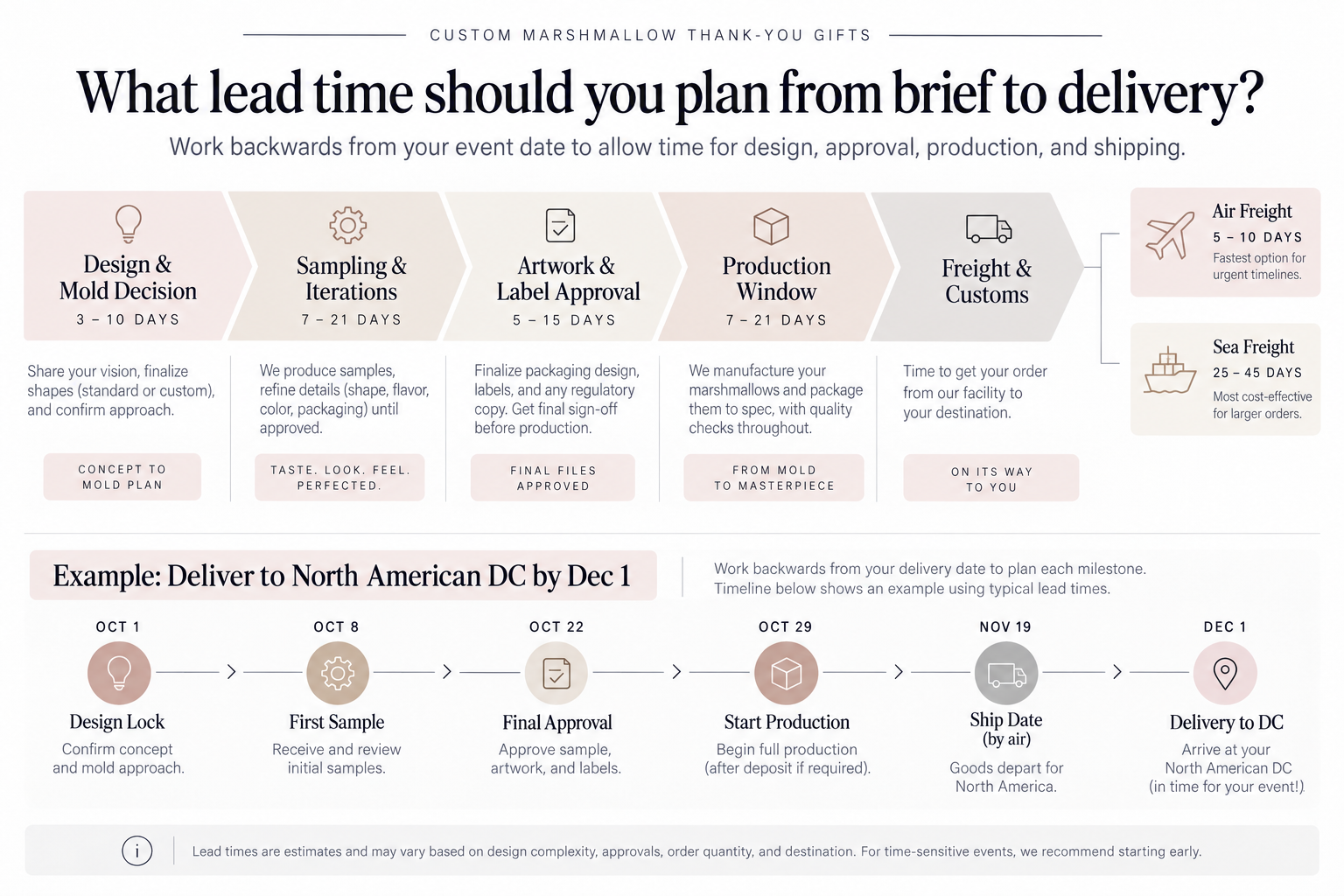
Time buckets and a backward plan
Core time buckets (indicative ranges)
- Design and mold decision: 3–10 days
- Sampling and iterations: 7–21 days
- Packaging artwork and proof approvals: 5–15 days
- Production window: 7–21 days (dependent on packaging)
- Freight and customs: Air 5–10 days; Sea 25–45 days
Back-scheduling from a fixed date
- Suppose you need delivery at a North American DC by December 1.
- Sea freight plan:
- Freight: 35 days → Ship no later than October 27.
- Production: 14 days → Start mass on October 13.
- Approvals: 14 days → Final approvals by September 29.
- Sampling: 14 days → First sample by September 15, one iteration buffer.
- Design/mold decision: 7 days → Locked by September 8.
- Air freight plan (higher unit cost):
- Freight: 7 days → Ship November 24.
- Production: 14 days → Start mass on November 10.
- Approvals: 10 days → Final approvals by October 31.
- Sampling: 10 days → First sample by October 21.
- Design/mold decision: 5 days → Locked by October 16.
What shifts timelines
- Exact Pantone demands add color iterations. Expect +3–7 days.
- New 3D molds add 5–10 days for machining and test.
- Gift box packaging adds +4–7 days for materials and kitting.
- Multi-market labels add +3–5 days for language layout and review.
- “Labels later” is not an option. It pushes the critical path and risks rework.
Achieved ranges in past projects
- Sample window: 10–21 days, depending on whether we opened a new mold.
- Mass production: 7–14 days for flow-wrap; 14–21 days for pouches and boxes, especially with kitting.
- We are a BRC-audited plant. We factor internal QA checkpoints that buyers can audit. I recommend buyers plan a pre-shipment inspection for added assurance.
What MOQs and unit-price bands apply to Marshmallow Thank-You Gifts?
Budgets move with volume and packaging. Teams ask for a unit price before confirming the workflow. That number drifts when packaging changes. I quote by volume band and by packaging path to keep expectations stable.
For most Marshmallow Thank-You Gifts, our MOQ starts around 3,000–5,000 units for simple flow-wrap and 2,000–3,000 sets for gift boxes. Unit-price bands widen with added labor and materials. Confirm packaging and we can fix a band early.
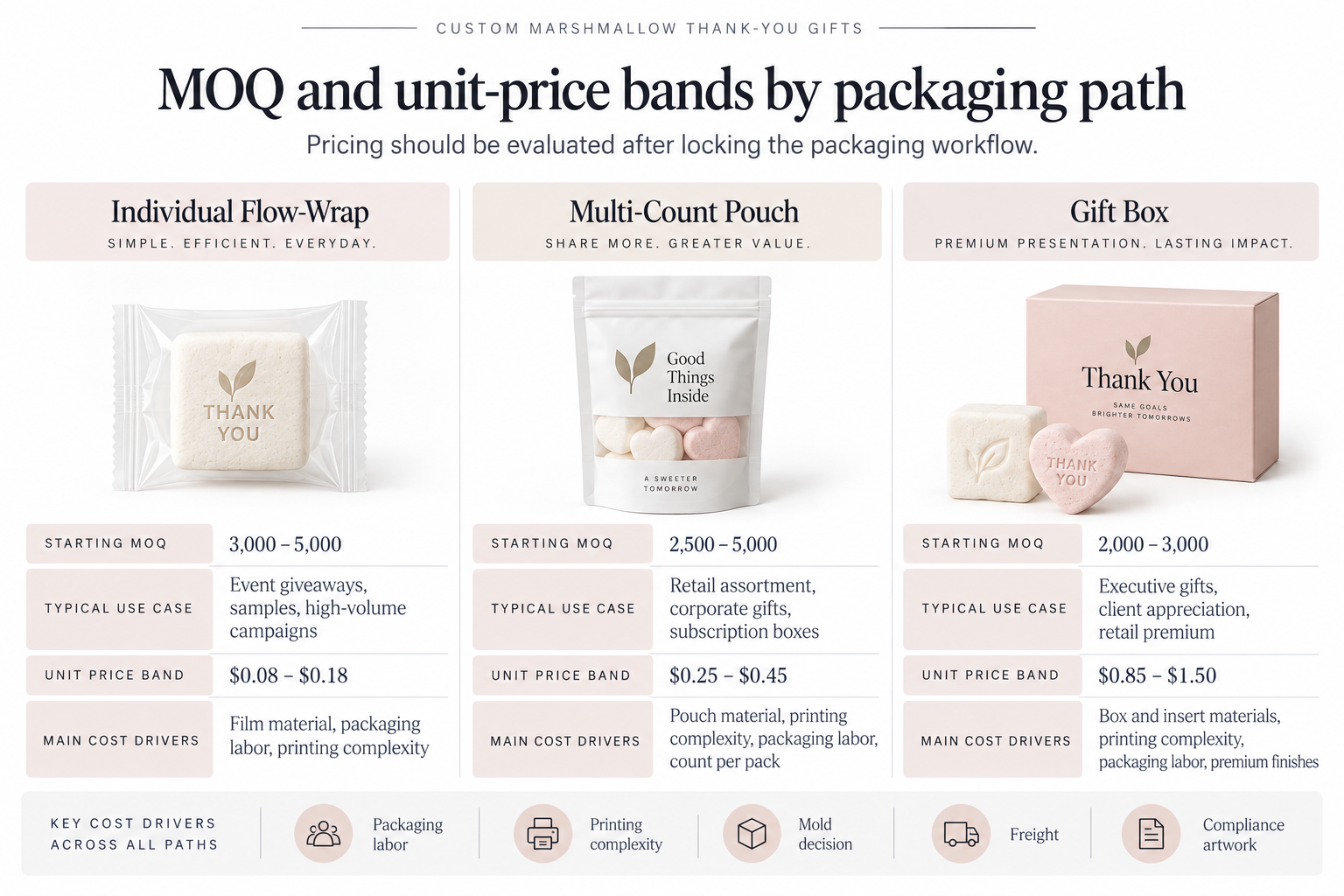
Volume bands and what drives cost
Indicative MOQs
- Individual flow-wrap: 3,000–5,000 units starting MOQ.
- Multi-count pouches: 2,500–5,000 pouches depending on counts and film print.
- Gift boxes: 2,000–3,000 boxes due to board MOQ and print runs.
What moves the unit price band
- Packaging labor steps: Each added manual step increases labor minutes per unit.
- Printing complexity: More colors, special finishes, and custom films add to material costs and lead time.
- Mold decisions: New tools add amortized costs; using our mold library reduces both cost and time.
- Freight: Air vs. sea changes landed cost substantially; we quote ex-works or FOB, and you model the freight.
- Compliance extras: Market-specific label layouts, extra languages, and importer statements add artwork time.
Experience-based ranges
- In a 10,000-unit flow-wrapped order, moving to a 6-count pouch added ~0.05–0.09 USD per unit in packaging costs and +2–3 days.
- In a 5,000-unit gift-box run, adding a sleeve and insert lifted the unit cost by ~0.20–0.35 USD and +5 days, but improved perceived value significantly in corporate gifting.
Commercial notes
- I do not lock price without locking the packaging workflow. It protects both of us.
- I provide a line-by-line bill of materials and labor assumptions for transparency.
- For application-specific compliance or claims, buyers should seek qualified professional verification and provide written approvals. I embed those approvals in the job traveler to align factory and buyer teams.
Frequently Asked Questions
Can you match our Pantone colors exactly on Marshmallow Thank-You Gifts?
Edible dyes do not allow 1:1 Pantone matches. I aim for close alignment within an agreed tolerance. I provide photo proofs under standard lighting. If exact color is critical, I recommend shifting strict brand color to printed packaging rather than the marshmallow body.
What is the fastest way to deliver Marshmallow Thank-You Gifts for a fixed event?
Choose a Tier 1 shape, go with individual flow-wrap or a simple pouch, and lock labels early. Approvals drive the critical path. Air freight can shorten shipping, but design and label gates remain non-compressible. Plan 6–8 weeks from brief to delivery for most cases.
Do your certifications cover EU and US retailer requirements?
Our facility holds BRC, FDA registration, SMETA, ISO 22000, HACCP, and GMP. These certifications signal capability and process control. Retailer and market-specific label rules still apply. Buyers should verify documents and ensure legal compliance for their jurisdictions and claims.
What samples do you provide for Marshmallow Thank-You Gifts?
I offer a staged approach: first an unbranded shape from our mold library when speed matters, then a branded pilot if we open a mold. For packaging, I provide printed proofs or high-fidelity mockups. We do not proceed to mass production without your formal sign-off.
How do you handle allergens and gelatin origin for corporate gifts?
We issue a full spec including ingredient list, allergen statements, and gelatin origin. If your market requires specific declarations, provide those requirements at the brief. Your regulatory team must verify compliance. We include these statements on labels before artwork approval.
Conclusion
Marshmallow Thank-You Gifts succeed when you make three decisions early: brand realism, packaging workflow, and compliant labels. These choices set cost, control lead time, and reduce risk. I am a China-based OEM/ODM supplier with BRC, FDA registration, SMETA, ISO 22000, HACCP, and GMP. If you are planning corporate appreciation at scale, share your event date and packaging path, and I will build a backward plan that lands on time.
"Spot color vs Process Color Printing", https://www.pantone.com/na/en-us/articles/technical/spot-vs-process-color?srsltid=AU7gw4XcIyL_ad6cZpSNfqD7etDtivG3bB3DUhmdk7ZJ7Fpb_a7rmoXK. Pantone is a proprietary spot-color system developed for printed inks; reproducing Pantone swatches on other substrates or media requires approximations rather than exact matches, a limitation that is especially pronounced for edible colorants with restricted pigment sets and food-matrix constraints. Evidence role: general_support; source type: encyclopedia. Supports: that Pantone is an ink-based spot color system and translating Pantone colors to non-print media like foods yields approximations rather than exact 1:1 matches. Scope note: This source explains Pantone and cross‑media limitations generally; it does not test edible dye performance on marshmallows. ↩
"Color difference", https://en.wikipedia.org/wiki/Color_difference. In color science, ΔE denotes the CIE color difference metric used to quantify how far a sample’s color is from a reference, providing a basis for setting acceptable tolerances in production. Evidence role: definition; source type: encyclopedia. Supports: what ΔE represents and that it is used to quantify perceptible differences between a sample and a reference. ↩
"On the Relationship(s) Between Color and Taste/Flavor - PMC", https://pmc.ncbi.nlm.nih.gov/articles/PMC7037180/. Studies on sugar confectionery report that added colorants and certain flavoring components can migrate within aerated matrices and modify surface appearance, which can tint otherwise white products. Evidence role: mechanism; source type: paper. Supports: that added dyes and some flavor compounds can diffuse or interact within sugar-aerated confections and alter perceived color over time. Scope note: Evidence is from related confectionery systems; specific magnitudes for marshmallows vary by formulation and processing. ↩
"Why Focusing on Lead Time, Not Just Efficiency and Cost ...", https://interpro.wisc.edu/lead-time-drives-manufacturing-success/. Operations‑management literature shows that each additional setup and handoff introduces processing and waiting time, raising labor cost and lengthening overall lead time through increased cycle time and work‑in‑process. Evidence role: mechanism; source type: education. Supports: that extra processing steps, setups, and handoffs add processing and waiting time, increasing unit cost and total lead time. Scope note: This is a general principle; the specific cost and time deltas depend on the plant’s processes and staffing. ↩
"Global Food Safety Initiative", https://en.wikipedia.org/wiki/Global_Food_Safety_Initiative. The BRCGS Global Standard for Food Safety is a third‑party certification scheme, recognized by the Global Food Safety Initiative, that assesses a site’s food safety and quality management systems. Evidence role: definition; source type: encyclopedia. Supports: that the BRCGS Global Standard for Food Safety is a third-party certification scheme recognized for auditing food safety management systems. ↩
"21 CFR 101.9 -- Nutrition labeling of food.", https://www.ecfr.gov/current/title-21/chapter-I/subchapter-B/part-101/subpart-A/section-101.9. Under 21 CFR 101.9, FDA sets the required content and formatting for the Nutrition Facts label on packaged foods in the United States. Evidence role: definition; source type: government. Supports: that FDA’s 21 CFR 101.9 and related sections prescribe the Nutrition Facts label’s content and format. ↩
"Food Labelling: A Brief Analysis of European Regulation 1169 ...", https://pmc.ncbi.nlm.nih.gov/articles/PMC5076719/. Regulation (EU) No 1169/2011 on the provision of food information to consumers sets EU‑wide requirements for the labeling, presentation, and advertising of foods. Evidence role: definition; source type: government. Supports: that Regulation (EU) No 1169/2011 establishes general food labelling requirements in the EU. ↩
"Canada - Labeling/Marking Requirements", https://www.trade.gov/country-commercial-guides/canada-labelingmarking-requirements. CFIA guidance states that mandatory information on most prepackaged food labels must appear in both English and French, subject to specified exemptions. Evidence role: general_support; source type: government. Supports: that Canada mandates bilingual (English and French) labeling for most prepackaged foods. Scope note: Certain products and circumstances are exempt; stakeholders should consult the detailed CFIA list. ↩
"The New Nutrition Facts Label Examples of Different ...", https://www.fda.gov/media/99151/download. FDA’s Nutrition Facts labeling specifications set required type sizes, permitted font styles, and rule (line) thicknesses for the panel’s standardized format. Evidence role: general_support; source type: government. Supports: that FDA prescribes type sizes, styles, and rule/line thicknesses for Nutrition Facts panels. ↩
"Food Allergies", https://www.fda.gov/food/nutrition-food-labeling-and-critical-foods/food-allergies. FDA identifies milk, soybeans, and tree nuts among the major allergens that must be declared on U.S. food labels; the EU’s Annex II similarly lists these allergens for mandatory emphasis in ingredient statements. Evidence role: definition; source type: government. Supports: that milk, soybeans, and tree nuts are designated major allergens requiring declaration in the U.S. and are similarly listed in the EU. Scope note: Advisory ‘may contain’ or ‘trace’ statements are voluntary in some jurisdictions and governed by separate guidance. ↩
"21 CFR 101.5 -- Food; name and place of business of ...", https://www.ecfr.gov/current/title-21/chapter-I/subchapter-B/part-101/subpart-A/section-101.5. EU FIC requires the name and address of the responsible food business operator on food labels; for imported foods, this role is typically fulfilled by the EU‑based importer responsible for placing the product on the market. Evidence role: general_support; source type: government. Supports: that EU labels must show the name and address of the responsible food business operator and, for imported goods, typically the EU-based importer. Scope note: Exact responsibilities and phrasing vary by jurisdiction and supply chain; U.S. law similarly requires a name and address (21 CFR 101.5). ↩
"Registration of Food Facilities and Other Submissions", https://www.fda.gov/food/guidance-regulation-food-and-dietary-supplements/registration-food-facilities-and-other-submissions. FDA requires domestic and foreign food facilities that manufacture, process, pack, or hold food for U.S. consumption to register; FDA notes that registration is a legal requirement and not an endorsement or approval. Evidence role: definition; source type: government. Supports: that food facilities must register with the FDA under federal law and that registration does not denote FDA approval of the establishment or its products. ↩