Fire-Roasting Marshmallows: Which Formulas Hold Shape Best?
Fire-roasting marshmallows looks simple, but the real problem is shape collapse over heat. That sag and drip frustrates buyers and demo staff. The fix is not “harder is better.” Instead, I manage three levers: the gelatin network, total solids/water activity, and the sugar system — and I verify with a repeatable pre‑buy test.
There is no single “best” formula for fire-roasting marshmallows. Shape retention depends on a stronger gelatin network (type/Bloom/dose), higher total solids with controlled water activity, and a sugar system balanced for higher glass transition. Buyers should run a simple, repeatable near-flame test with humidity pre-conditioning and lock suppliers to QA ranges and pilot lots.

You can get a marshmallow that browns quickly without collapsing. The key is to evaluate how your candidate formulas behave near real flame, control for humidity, and specify the right variables with your supplier. Let me break down what matters and how I advise buyers to test before they list.
Does hardness predict hold-shape for fire-roasting marshmallows?
A “firm” chew feels reassuring, but the problem is that firmness at room temperature does not equal heat stability over coals. Many buyers conflate bite resistance with fire performance. That mismatch leads to disappointment at demos and campsites when an “extra-firm” chew still slumps.
Firmness is not a reliable predictor.1 Heat stability depends on the gelatin network, total solids and water activity, and the sugar system’s glass transition behavior. A thicker coating only helps handling. It will not stop structural melt. Test over consistent near-flame conditions and score sag and drip, not just bite.
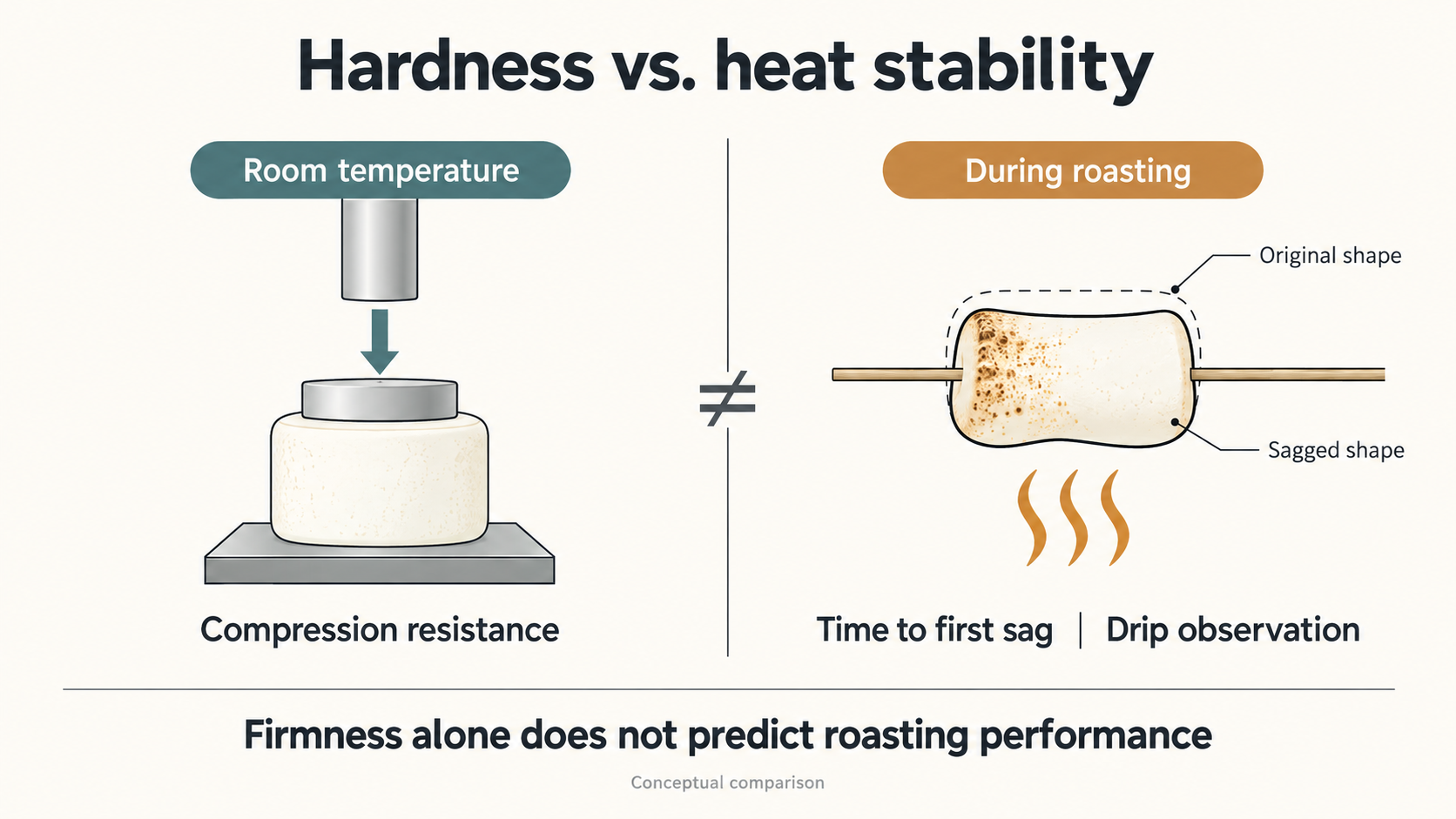
Dive deeper: Hardness vs. heat stability is a false friend
I learned this the hard way during a retailer camp-out demo. Our “firm chew” sample slumped at 40 seconds, while a slightly softer chew held for over a minute. Why? The second sample had a higher Bloom gelatin and a tighter water activity window, even though it felt softer at room temp.
- Bite firmness relates to elastic modulus at ambient. That is a function of aeration, gelatin set, and sugar phase. It says little about performance at 150–200°C radiant heat.
- Over a campfire, key transitions kick in:
- Gelatin network softens as bound water mobilizes.
- Sugar phase approaches its glass transition temperature (Tg), where viscoelastic flow increases.
- Surface browns (Maillard/caramelization) while the interior warms.
Three controllable levers determine hold-shape:
- Gelatin: Bloom strength and dose define the network’s ability to resist sag until the interior warms through.
- Total solids and water activity: Higher total solids and controlled aw shift the softening window upward and reduce internal flow.
- Sugar system: Sucrose/glucose/fructose balance influences Tg and viscosity as temperature rises.
A quick comparison I use to reset expectations:
| Sensory cue at room temp | Heat-behavior indicator | Likely outcome over flame |
|---|---|---|
| “Extra firm” chew with low gelatin | Low Bloom, high syrup | Early sag and stringing |
| “Moderate chew” with strong gel | High Bloom, tighter aw | Better hold, controlled browning |
| Thick powdered coating | Cosmetic dryness | No structural benefit |
Bottom line: measure the right thing. If your goal is “no slump for 60–90 seconds,” tune formulation variables and validate over heat, not just at ambient bite.
How do gelatin networks influence fire-roasting marshmallows?
Most droop issues start with the gel. Buyers chase firmer chews without asking about gelatin Bloom or dose, which determine how the foam resists gravity when heated. Incorrect gelatin selection leads to uneven warm-through and quick collapse in damp environments.
A higher Bloom gelatin at a controlled dose strengthens the network and delays sag under heat. Typical marshmallow ranges are in the ~180–260 Bloom window2, with dose tailored to geometry. Specify a target range and verify on a Certificate of Analysis. Geometry matters: larger shapes often need slightly higher network strength.
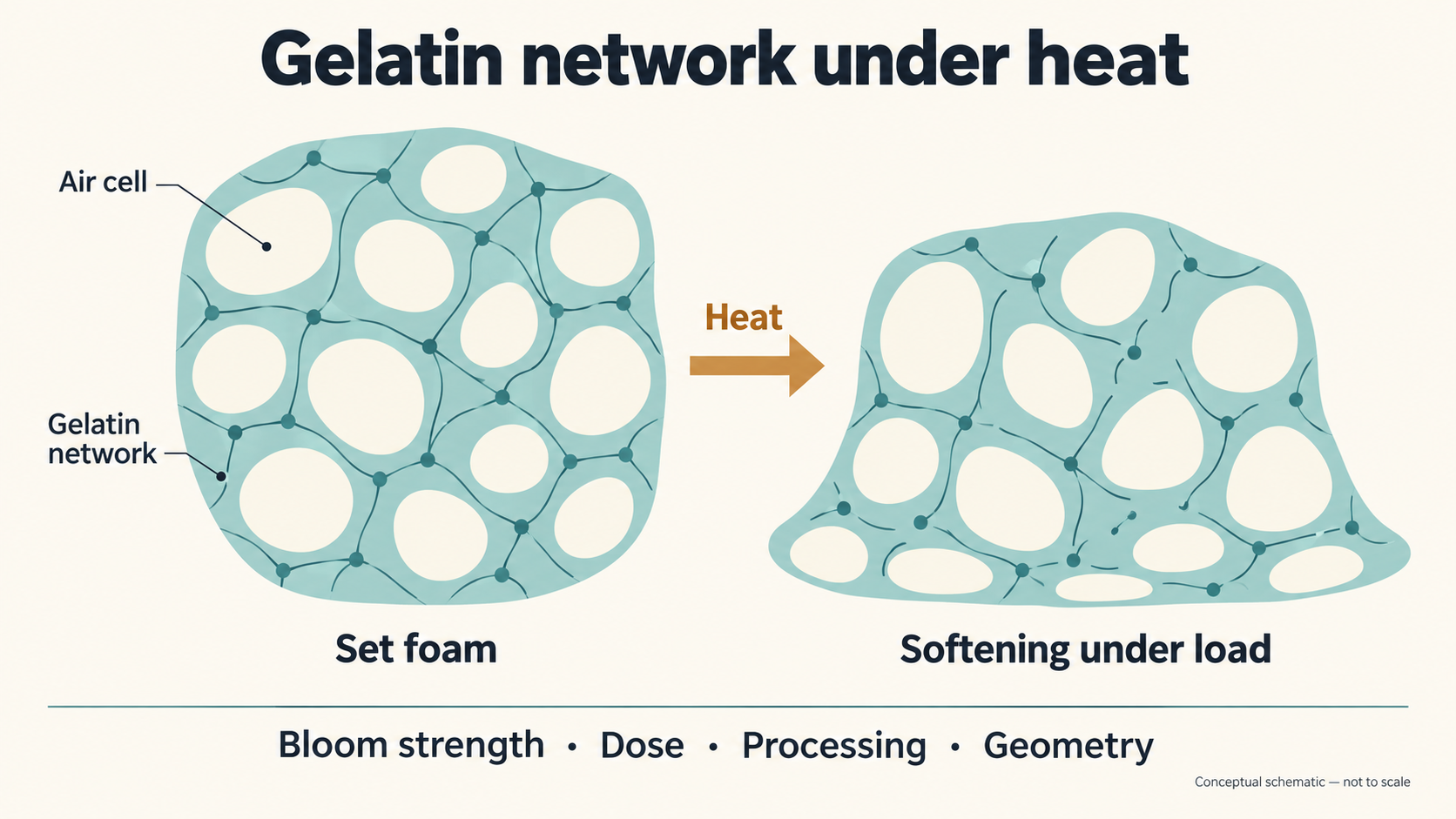
Dive deeper: Bloom strength, dose, and geometry
In our OEM trials, we see consistent patterns. Formulas tuned for roasting use higher Bloom ranges and tighter dosing compared to formulas optimized for ultra-soft chew. I avoid absolutes because applications differ, but practical guidelines help buyers frame requests:
- Gelatin Bloom:
- Market-typical Bloom for marshmallows is roughly 180–260. For roasting-oriented performance, we often target the upper band of that range.
- Higher Bloom increases gel stiffness and thermal hold, at the cost of a firmer bite. Balance against your brand’s sensory target.
- Dose:
- Gelatin dose scales with shape and size. A 15 g shaped marshmallow with broad “ears” or “wings” behaves differently from a compact cylinder.
- Suppliers should provide a dose range per geometry. Ask for this as a range, not a secret formula.
- Gelatin type and processing:
- Type A vs. Type B3 and their setting profiles can change thermal behavior. Ask for directionality and consistency, not confidential ratios.
- Process consistency matters. Poor hydration or inconsistent cooking yields variable networks even within the same spec.
Practical buyer tips:
- Request geometry-aware samples—exactly the size and shape you plan to sell—because thin protrusions sag sooner.
- Tie Bloom/dose targets to your screening protocol. For example: “Accept if time-to-first-sag ≥ 60 seconds at X distance and room aw 0.60–0.65.”
Remember: coatings and starch dusting do not fortify the network.4 They reduce tack, which helps handling, but they cannot stop internal flow once the gel lets go.
What buyer-side test screens fire-roasting marshmallows consistently?
Roasting tests can be chaotic. Different flames, rotations, and ambient conditions make apples-to-apples comparisons difficult. Buyers need a simple, repeatable protocol that bridges lab and camp reality without specialized gear.
Use a standardized near-flame test: hold at a fixed distance, rotate steadily, and record time-to-first-sag, drip presence, exterior scorch versus interior warm-through, and stickiness on the skewer. Pre-condition samples in high humidity to see if performance collapses in damp markets. Replicate across three units per formula.
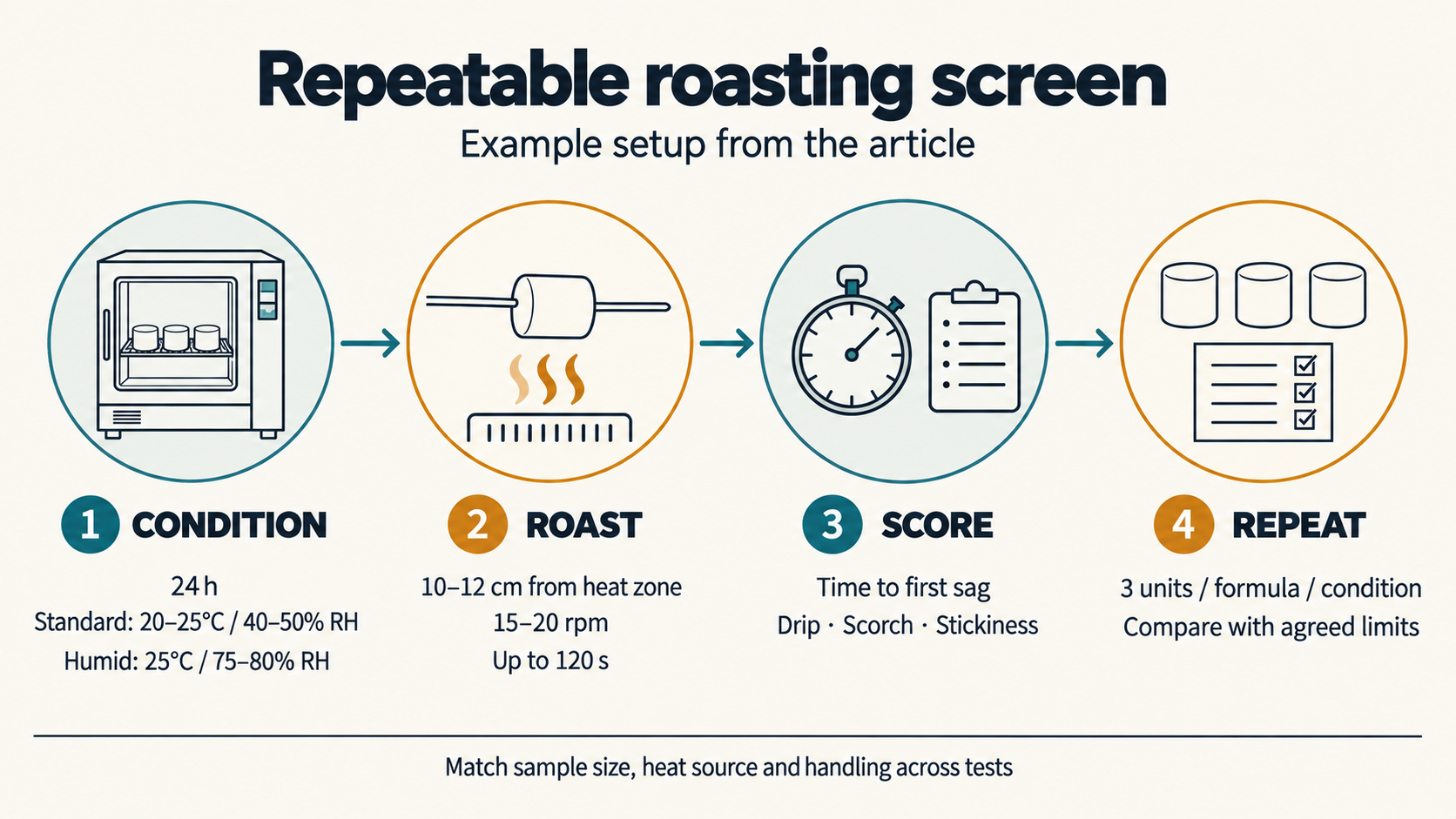
Dive deeper: A practical, repeatable screening protocol
I developed a protocol that retail buyers and QA teams can run without a lab. It mirrors camp conditions while controlling the biggest variables.
H3: Equipment and setup
- Heat source: consistent gas flame or charcoal bed. Avoid direct contact with flames to prevent instant charring.
- Distance: 10–12 cm from the flame tip or above the charcoal heat zone.
- Rotation: 15–20 rpm by hand; use a metronome app to keep tempo.
- Environment: Record ambient temperature and relative humidity. For humid tests, pre-condition samples.
H3: Steps and scoring
- Pre-condition:
- Standard: store samples 24 hours at 20–25°C, 40–50% RH.
- Humid stress: store 24 hours at 25°C, 75–80% RH (sealed vs. opened packaging scenarios).
- Test:
- Mount one unit per skewer. Hold at set distance.
- Rotate at steady tempo for up to 120 seconds.
- Record:
- Time-to-first-sag (seconds)
- Drip presence (none/minor/major)
- Exterior scorch before interior warm-through (Y/N)
- Stickiness/strings on skewer (low/medium/high)
- Replicate:
- Test three units per formula per condition.
- Decision rule:
- Define pass thresholds matching your brand promise. Example:
- Time-to-first-sag ≥ 60 s (standard), ≥ 45 s (humid stress)
- No major drip
- Interior warmed by 60–75 s without collapse
- Stickiness ≤ medium
- Define pass thresholds matching your brand promise. Example:
H3: Sample scoring template
| Metric | Unit 1 | Unit 2 | Unit 3 | Average | Threshold | Pass/Fail |
|---|---|---|---|---|---|---|
| Time-to-first-sag (s) | ≥ 60 | |||||
| Drip presence | None/Minor | |||||
| Exterior scorch pre warm-through | No | |||||
| Stickiness/strings | ≤ Medium |
Why humidity matters: marshmallows pick up moisture, which lowers Tg5 and softens the network. If your market is coastal or tropical, this stress screen is essential. I have watched good formulas fail in Miami in August because buyers only tested in dry offices. Incorporate this step to prevent returns and complaints.
Which sugar systems and water activity targets improve shape retention for fire-roasting marshmallows?
Sugar selection is often invisible to buyers, yet it dominates heat behavior. Incorrect sugar balance lowers glass transition and encourages flow. Improper water activity accelerates sag and stickiness, especially in humid markets.
Favor sucrose plus higher DE glucose syrup over high-fructose direction for roasting use. Target higher total solids and a tighter water activity window. This raises Tg and reduces internal flow under heat. Align your sugar system with your browning goals to balance caramelization and hold.
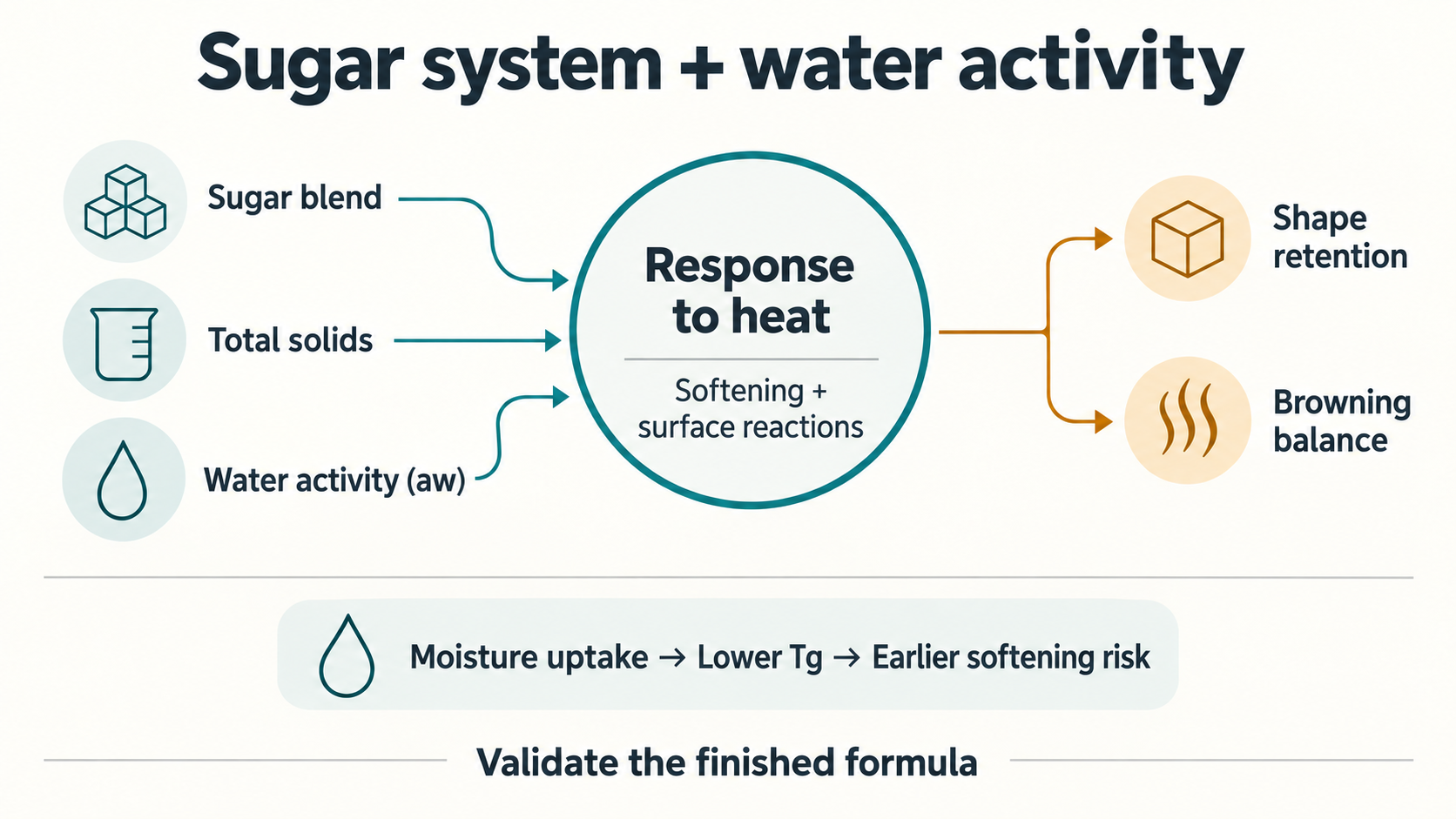
Dive deeper: Sugar balance, Tg, and browning
In our trials, sugar-system direction is the silent lever behind most “mystery” failures. Two batches with the same gelatin can diverge over flame because their sugar systems diverged:
H3: Sugar system direction
- Sucrose + glucose syrup (moderate-to-higher DE) tends to yield a higher Tg than systems weighted toward fructose. Higher Tg delays flow as temperature rises.6
- Excess invert sugar or high-fructose content lowers Tg and increases hygroscopicity7. That helps softness and shelf-life in some contexts but hurts roasting stability.
- Balance is key. You still want pleasant caramelization and flavor development without premature collapse.
H3: Total solids and water activity
- Marshmallow syrups are typically cooked to high solids. Many roasting-friendly systems land in a total solids band that supports a lower aw—commonly in the neighborhood of aw 0.58–0.688 when freshly packed.
- Higher total solids tighten the internal matrix. However, push too high and chew becomes tough or brittle. This is a negotiation between sensory and performance.
- Water activity management is critical for humid markets. Once aw creeps higher, the product softens and sticks, slashing hold-time.
H3: Browning without collapse
- A surface that browns too fast may scorch before the interior warms. Align sugar ratios to control browning rate:
- Slightly lower reducing sugar exposure at the surface can reduce early scorching.
- Surface dusting is for handling; it does not regulate browning meaningfully.
- For demos, I favor systems that brown at 60–80 seconds with minimal drip and a warm interior by that time.
Practical requests to suppliers:
- Ask for the sugar system “direction” rather than a recipe: sucrose-to-glucose balance, presence of invert/fructose, and target DE ranges of glucose syrup.
- Tie this to your test: “We aim for no major drip by 75 seconds at X distance, with browning onset around 50–60 seconds.”
What should you ask suppliers before committing to fire-roasting marshmallows?
Procurement risk shows up in variability. A strong pilot batch can be followed by a weak production lot if you do not anchor ranges. Many buyers accept “trust me,” then discover saggy demos months later.
Ask for target ranges for gelatin Bloom and dose, total solids and water activity at pack, and sugar system direction. Request geometry-matched samples, a roasting-use pilot lot, and a COA with QA tolerances tied to these variables. Document pass/fail thresholds from your screening protocol.
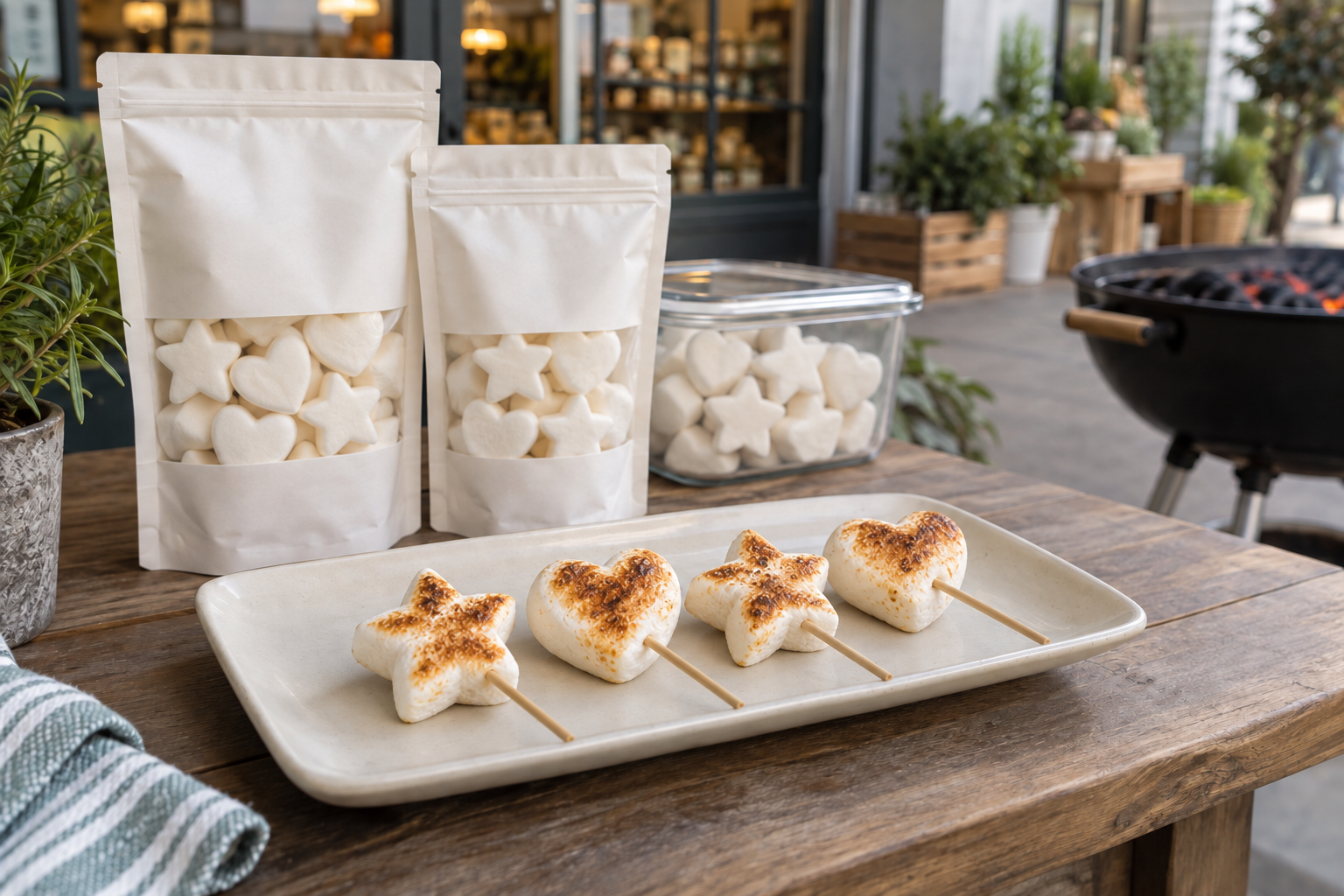
Dive deeper: Procurement checklists and QA anchors
I work with buyers who need repeatable performance. This is the minimum I recommend:
H3: Specification anchors
- Gelatin:
- Bloom target range (e.g., “upper 200s Bloom ± X”).
- Dose range per geometry (supplier provides guidance).
- Sugar system direction:
- Sucrose/glucose emphasis; DE range for glucose syrup.
- Statement on invert/fructose use (directional).
- Total solids and aw:
- Finished product moisture/solids window.
- Water activity window at pack and typical at 3–6 months.
- Geometry and mass:
- Samples and production in the same mass and shape as the intended retail SKU.
H3: QA documentation and verification
- Request COA per lot covering:
- Bloom verification, moisture, and aw.
- Process checks relevant to foam aeration.
- Run your roasting screen on the pilot lot. Archive photos, times, and notes.
- Set batch-acceptance criteria based on your test averages. Example: “Lot passes if average time-to-first-sag ≥ 60 seconds under standard condition, no major drip.”
H3: Compliance and audits
- Verify certifications rather than assume:
- BRC or equivalent GFSI scheme.
- FDA facility registration for U.S. imports.
- SMETA/Sedex audit summary if your brand requires social compliance.
- ISO 22000, HACCP, and GMP documentation.
- Treat these as necessary but not sufficient. They assure process hygiene, not roasting performance.
Our factory holds BRC, FDA registration, SMETA, ISO 22000, HACCP, and GMP. I always encourage buyers to request and verify documents. Tie your technical targets to these QA systems so roasting performance is managed, not left to chance.
How should retailers position and demo fire-roasting marshmallows?
Demos sell, but they also expose weak formulas. Retailers often push for fast caramelization, then suffer drips and complaints. The answer is to align product, handling guidance, and packaging to the climate and use-case.
Position the SKU as “roast-ready,” specify distance and rotation on-pack, and choose barrier packaging for humid markets. For longer hold-time demos, prioritize stronger gelatin and tighter aw. Balance browning at the surface with internal stability to avoid collapse.
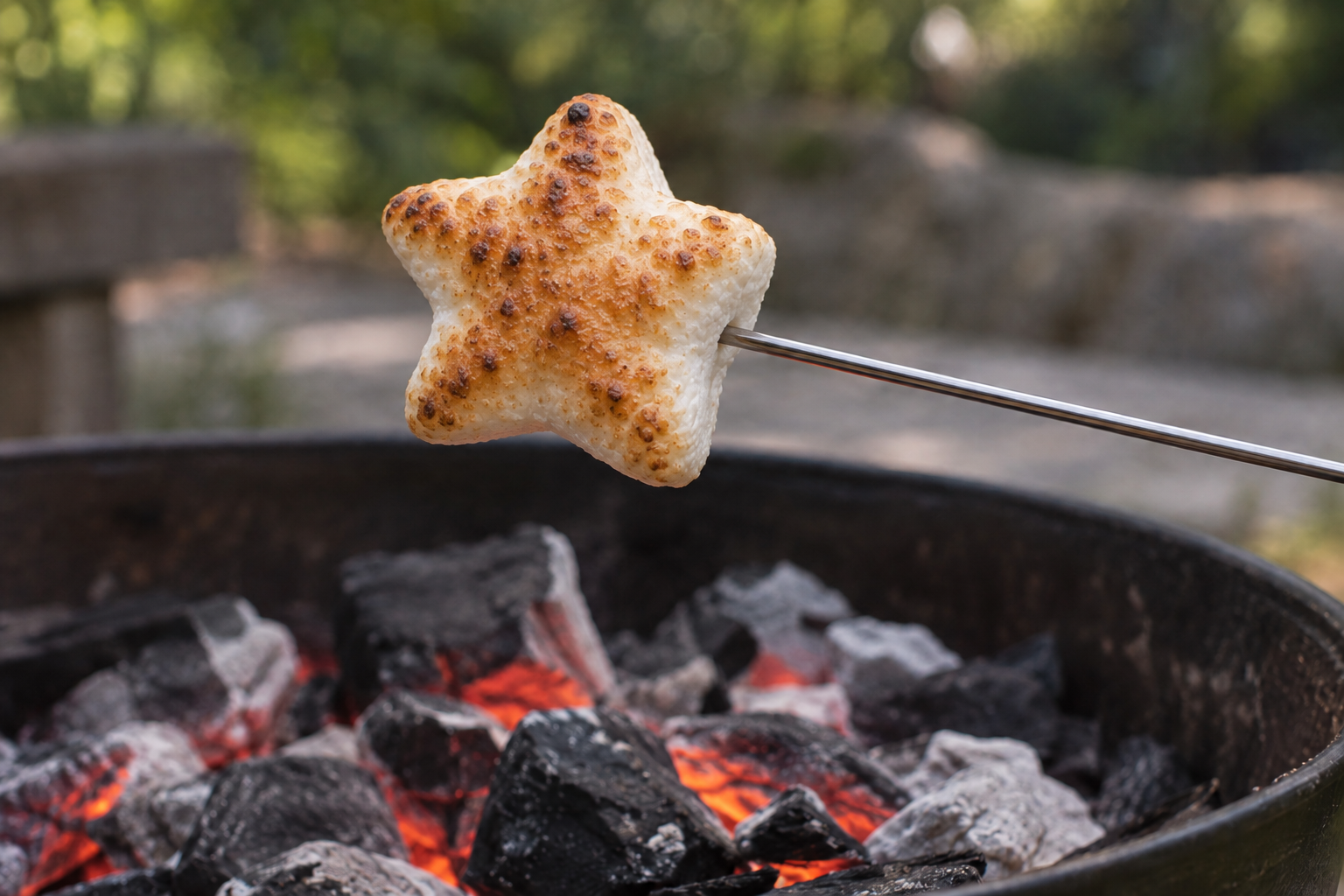
Dive deeper: Demo strategy, signage, and packaging
I have stood next to demo stations watching outcomes vary with simple handling. A little guidance turns near-misses into wins.
H3: Demo technique checklist
- Distance and rotation:
- Maintain 10–12 cm from flame tips, rotate 15–20 rpm.
- Avoid direct flame contact. It scorches the surface before heat penetrates.9
- Time targets:
- Aim for 60–90 seconds to brown and warm through.
- If browning starts early, pull back slightly to lengthen the window.
- Skewer handling:
- Use clean, dry skewers to reduce strings.
- After removal, wait 5–10 seconds before serving to set the surface.
H3: On-pack guidance and claims
- Include clear instructions:
- “Hold 10–12 cm from flame. Rotate steadily for 60–90 seconds.”
- “For best results in humid weather, roast slightly farther from direct flames.”
- Claims to avoid:
- Do not promise “won’t melt” or “no drip ever.” Instead, set realistic expectations: “Roast-ready with balanced browning and shape hold when used as directed.”
H3: Packaging and climate strategy
- For high-humidity regions:
- Use barrier films (e.g., BOPP with EVOH or metallization10) and robust seals.
- Consider desiccant where legal and appropriate.
- For shelf demos:
- Store demo packs in sealed containers between sessions.
- Replace open packs frequently; high aw undermines performance quickly.
Trade-offs:
- Longer hold-time often means a slightly firmer chew. If your brand leans “pillowy soft,” choose a midline: improved network and aw control with sugar direction that still delivers fast, even browning.
Frequently Asked Questions
Do larger shaped marshmallows hold up worse over fire?
Larger or wide-appendage shapes tend to sag sooner because geometry increases leverage against the gel network.11 Request geometry-matched samples and adjust gelatin Bloom/dose for the exact shape. Validate with your screening protocol to ensure consistent performance across the intended SKU.
Will a thicker coating or dusting stop marshmallows from dripping?
No. Coatings improve handling and reduce tack but do not reinforce internal structure. If the gelatin network and sugar system soften under heat, the product will still sag and drip. Address root variables: gel strength, total solids, water activity, and sugar balance.
What water activity should I target for better roasting stability?
Many roasting-friendly products land in a controlled aw window roughly around 0.58–0.68 at pack. The exact target depends on your sensory goal and sugar system. More important is consistency and humidity resilience. Test standard and humid-stressed samples with your protocol.
How many samples should I test before listing a new formula?
At minimum, test three units per condition (standard and humid) per formula. Run your near-flame protocol and average the results. For critical launches, add a small roasting-use pilot lot and test across multiple boxes to see batch variability before confirming purchase orders.
Are certifications enough to guarantee roasting performance?
Certifications like BRC, FDA registration, SMETA, ISO 22000, HACCP, and GMP confirm compliance and process control. They do not guarantee roasting behavior.12 Always verify documents and run your roasting-specific screening to lock performance, not just hygiene and safety.
Conclusion
The best fire-roasting marshmallows are not the firmest at room temperature. They are the ones with a tuned gelatin network, controlled total solids and water activity, and a sugar system that raises Tg without killing browning. Use a simple, repeatable pre-buy test to manage risk and secure batch-stable, demo-friendly performance. If you want geometry-matched samples, a roasting-use pilot lot, and COAs tied to these variables, contact our OEM/ODM team at York. We will help you specify, verify, and scale the formula that fits your market.
"Correlations Between Sensory Evaluations and Instrumental ...", https://pmc.ncbi.nlm.nih.gov/articles/PMC12984600/. Studies of gelatin‑stabilized confectionery foams indicate that thermal softening is driven by the gelatin network and the sugar matrix’s glass transition, so room‑temperature firmness is not a reliable predictor of shape retention when heated. Evidence role: mechanism; source type: paper. Supports: That thermal sag in gelatin–sugar foams is governed by gelatin network integrity and the glass transition of the amorphous sugar phase rather than by ambient firmness.. Scope note: Most studies examine controlled heating of gelatin–sugar systems rather than open‑flame roasting conditions. ↩
"Understanding Gelatin Bloom Strength - Yasin", https://www.yasingelatin.com/understanding-gelatin-bloom-strength/. Confectionery formulation references describe marshmallow products as generally using high‑Bloom gelatins on the order of 180–260 Bloom to provide sufficient foam strength and texture. Evidence role: general_support; source type: education. Supports: That marshmallows are commonly formulated with high‑Bloom gelatins around 180–260 Bloom to achieve adequate foam strength.. Scope note: Exact Bloom selection varies by geometry, processing, and desired bite, so published ranges are indicative rather than prescriptive. ↩
"Effects of Relative Molecular Weight Distribution and ... - PMC", https://pmc.ncbi.nlm.nih.gov/articles/PMC9178206/. Reference sources on gelatin note that Type A and Type B gelatins are produced by different pretreatments and exhibit distinct isoelectric points and gelling behaviors, which can alter setting and thermal performance in confectionery systems. Evidence role: definition; source type: encyclopedia. Supports: That Type A (acid-processed) and Type B (alkali-processed) gelatins have different isoelectric points and gelling characteristics relevant to setting and thermal response.. Scope note: These references summarize general properties and do not quantify roasting outcomes for marshmallows. ↩
"Fluffy, Homemade Ghost Marshmallows with Just Five ...", https://www.ice.edu/blog/fluffy-homemade-ghost-marshmallows-with-just-five-ingredients. Confectionery processing guides describe starch or sugar dusting on marshmallows as an anti‑sticking measure to improve handling, not as a means to reinforce the internal gel‑foam network against softening. Evidence role: general_support; source type: education. Supports: That dusting/coatings are used for anti‑sticking and handling, not for reinforcing internal structure.. Scope note: These sources emphasize manufacturing practice; they rarely quantify changes in high‑temperature structural integrity. ↩
"Moisture and shelf life in sugar confections", https://pubmed.ncbi.nlm.nih.gov/20112158/. Food polymer science studies show that water plasticizes amorphous carbohydrate matrices, reducing glass transition temperature and increasing viscoelastic flow, thereby explaining why moisture uptake lowers Tg and softens marshmallow structure. Evidence role: mechanism; source type: paper. Supports: That water acts as a plasticizer in amorphous sugar matrices, depressing Tg and increasing flow/softening.. Scope note: Evidence typically comes from controlled relative humidity exposure of model confections rather than marshmallows roasted near open flames. ↩
"Glass transition", https://en.wikipedia.org/wiki/Glass_transition. Polymer and food polymer science texts explain that amorphous materials exhibit limited molecular mobility below Tg and markedly increased flow above Tg, so elevating Tg postpones softening and flow during heating. Evidence role: mechanism; source type: education. Supports: That materials remain comparatively rigid below Tg and soften/flow more above Tg, so increasing Tg delays flow at a given temperature.. ↩
"Systematic Investigation on the Glass Transition Temperature ...", https://pmc.ncbi.nlm.nih.gov/articles/PMC9222662/. Comparative carbohydrate studies report that fructose‑rich or invert sugar systems exhibit lower glass transition temperatures and higher hygroscopicity than sucrose–glucose matrices, consistent with earlier softening and stickiness under heat and humidity. Evidence role: mechanism; source type: paper. Supports: That fructose/invert sugar mixtures have lower Tg and greater hygroscopicity than sucrose–glucose systems, affecting heat and humidity performance.. Scope note: Quantitative shifts depend on exact composition and moisture; findings provide direction rather than a specific formulation rule. ↩
"Water Activity (aw) in Foods", https://www.fda.gov/inspections-compliance-enforcement-and-criminal-investigations/inspection-technical-guides/water-activity-aw-foods. Educational references on water activity list marshmallows among low‑moisture confections with typical aw values near 0.6, aligning with the stated packing‑time window. Evidence role: statistic; source type: education. Supports: That marshmallows are typically low‑aw confections with values near 0.6.. Scope note: Published tables report typical ranges, not brand‑specific specifications. ↩
"The science of roasting marshmallows!", https://www.canr.msu.edu/news/science_at_the_campfire_the_science_of_roasting_marshmallows. Educational materials on heat transfer and cooking advise keeping foods out of the flame’s hottest zone because rapid surface pyrolysis outpaces internal heating, explaining why direct flame contact scorches a marshmallow’s exterior before the inside warms. Evidence role: mechanism; source type: education. Supports: That exposure to a flame’s hottest region causes rapid surface charring while internal heating lags.. Scope note: The support is based on general heat‑transfer principles and cooking guidance rather than measurements on marshmallows. ↩
"Barrier properties of ethylene vinyl alcohol films in thermal ...", https://rex.libraries.wsu.edu/esploro/outputs/doctoral/Barrier-properties-of-ethylene-vinyl-alcohol/99901055021101842. Packaging references document that oriented polypropylene structures incorporating high‑barrier layers such as EVOH or metallization achieve much lower water‑vapor transmission rates than plain films, supporting their use to limit moisture ingress in humid climates. Evidence role: general_support; source type: education. Supports: That OPP films with EVOH or metallized layers have substantially lower water‑vapor transmission than unsupported films.. Scope note: Barrier performance depends on film thickness, layer design, and seal integrity, which vary by package. ↩
"Constitutive Equations for Analyzing Stress Relaxation and ...", https://pmc.ncbi.nlm.nih.gov/articles/PMC9143375/. Soft‑matter mechanics literature shows that viscoelastic gels and foams deform more under self‑weight as unsupported spans and bending moments increase, supporting the expectation that wider appendages or larger shapes will sag sooner. Evidence role: mechanism; source type: research. Supports: That increased unsupported length or moment arms in soft gels/foams leads to greater deformation under self‑weight.. Scope note: This is theoretical/mechanistic support and not a direct test on marshmallow shapes during roasting. ↩
"HACCP Principles & Application Guidelines", https://www.fda.gov/food/hazard-analysis-critical-control-point-haccp/haccp-principles-application-guidelines. Standards bodies clarify that schemes such as BRCGS and ISO 22000 establish food safety and quality management system requirements, while regulatory registration and audits (e.g., FDA, HACCP, GMP, SMETA) address compliance and process control rather than guaranteeing product‑specific performance like roasting behavior. Evidence role: definition; source type: institution. Supports: That BRCGS/ISO 22000 and related schemes define management and safety requirements rather than certifying specific product performance attributes.. Scope note: Program scopes differ; this clarification addresses general intent rather than detailed terms of any single certificate. ↩