Marshmallow Hot Chocolate for Airlines & Train Services: Wholesale?
Marshmallow Hot Chocolate sounds simple, but onboard reality is not. Procurement teams want brand delight, yet crews need fast dissolution, clean handling, and route-wide compliance. When those operations-first constraints are designed in, shaped marshmallows become a low-risk, high-reward add-on. I will show how I spec, test, and supply them for airline and rail programs.
Marshmallow Hot Chocolate can work at scale when you spec it operations-first: validate dissolution time with your galley or trolley equipment, choose a shape/size that melts consistently, use single-serve sachets that open quickly with gloves, and align gelatin source and labeling to each route. Branding follows after those risks are controlled.

Most buyers I meet assume all marshmallows melt the same and that retail packs fit inflight service. They do not. Below I translate what crews actually face into specifications, pilots, and supplier controls you can adopt for Marshmallow Hot Chocolate without operational surprises.
What operations-first specs make Marshmallow Hot Chocolate work onboard?
Hot chocolate service is time-bound. Crews cannot wait for slow-melting cubes or clean sticky residue mid-service. If you do not set acceptance criteria early, your brand moment will become a bottleneck. This is fixable with a practical, stepwise spec.
A workable spec defines target dissolution time with your actual water temperature and stirring method, a stable shape/gram-weight per cup, and an SOP that crews can repeat. Pilot pours with your real galley tools confirm assumptions before rollout.
Define and validate the melt, don’t assume it
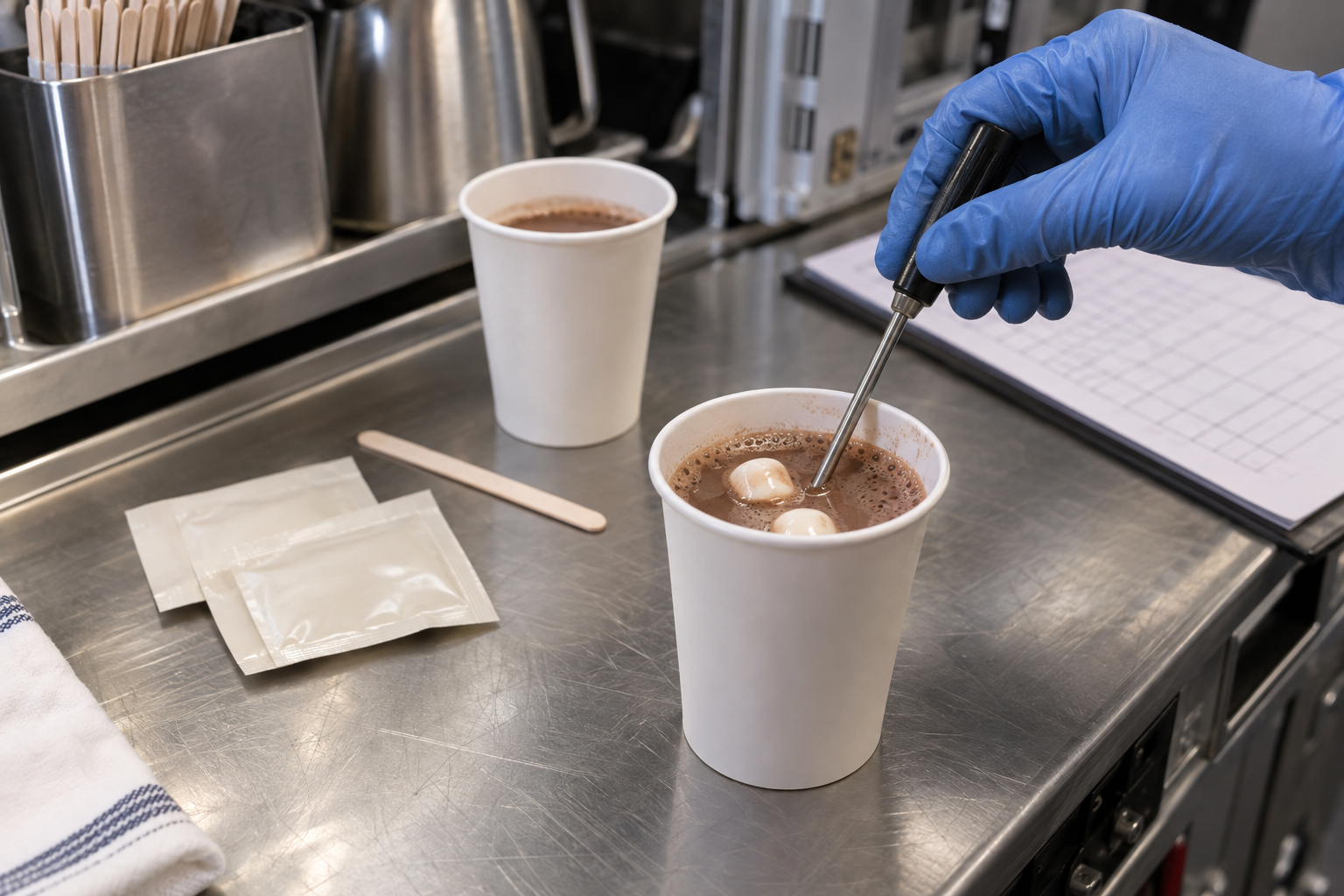
In procurement meetings, I hear two misconceptions: “retail cubes will be fine” and “our boilers are always hot enough.” In practice, galley water temperatures and stirring cycles vary across fleets and railsets. Cabin pressure1, service pacing, and cup materials affect heat retention. So we anchor the spec to your reality.
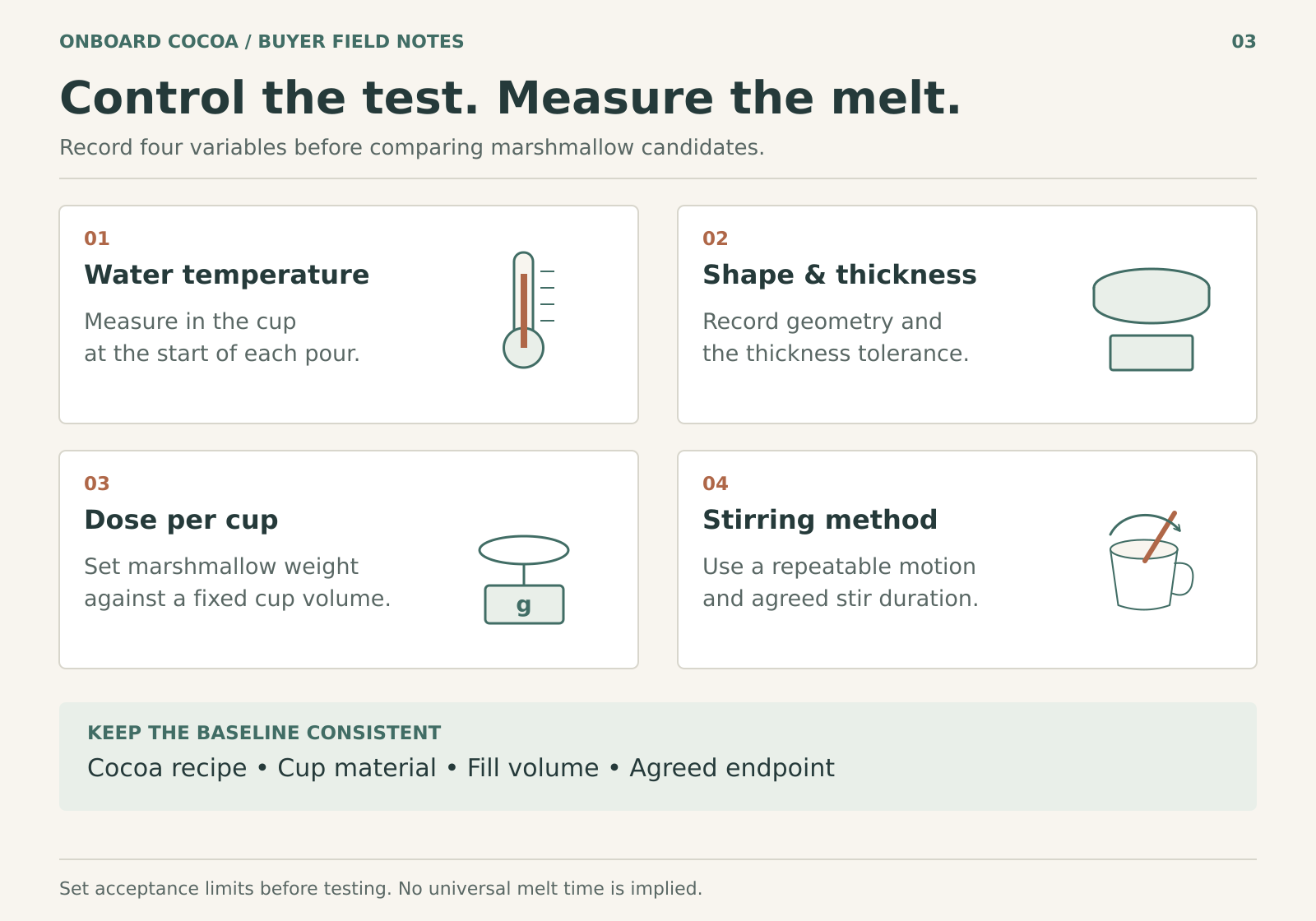
- Set a target dissolution window. Agree a maximum time from the first stir to “no visible pieces,” tied to your service window. Do not guess the number. Measure it with your equipment.
- Control surface area. Shallow coin shapes and thin logo reliefs dissolve more consistently than thick novelty blocks. Surface-area-to-volume drives melt time.2
- Fix a dose. Decide grams of marshmallow per cup, informed by your cocoa recipe and cup volume. More grams can improve foam and mouthfeel but slow melt.
- Standardize stirring. Specify the number of stirs or seconds with the crew’s normal motion. Electric stirrers? Note model and speed. Spoons-only? Note spoon size and pattern.
H3: What I capture in a pilot form I use a simple worksheet that includes:
- Equipment: trolley hot water urn or galley boiler, supplier, and model
- Water-in-cup temperature at pour start (measured)
- Cup type and lid (paper, plastic, insulated)
- Cocoa base details (brand, dose per cup, sugar level)
- Marshmallow shape and weight per sachet
- Stir method and time
- Dissolution endpoint judgement (“no pieces,” “small specks,” “film only”)
- Residue rating on cup and spoon
- Crew feedback on steps and time perception
H3: Typical outcomes and trade-offs I see
- Thin “coin” marshmallows dissolve faster and more evenly, especially when crews stir only briefly. Thick 3D shapes look amazing but raise variance.
- Dusting reduces stickiness3 but can mute color/brand imprint if overdone. We balance it.
- A clear per-cup dose avoids overuse when crews double up to force melt speed, which can blow cost.
Once we align on a realistic acceptance band, my team dials shape thickness and formula to hit it. We treat any exact time/temperature assumptions as “to be validated” until pilots confirm.
How should single-serve packaging be designed for inflight Marshmallow Hot Chocolate?
Crew motions matter. Gloves, wet hands, and moving aisles make finicky packaging a liability. Retail multi-packs leak sugar, cause wipe-downs, and slow trolley flow. Single-serve sachets fix the mess and support hygiene, traceability4, and branding.
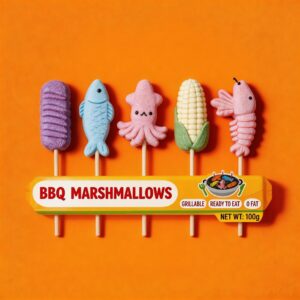
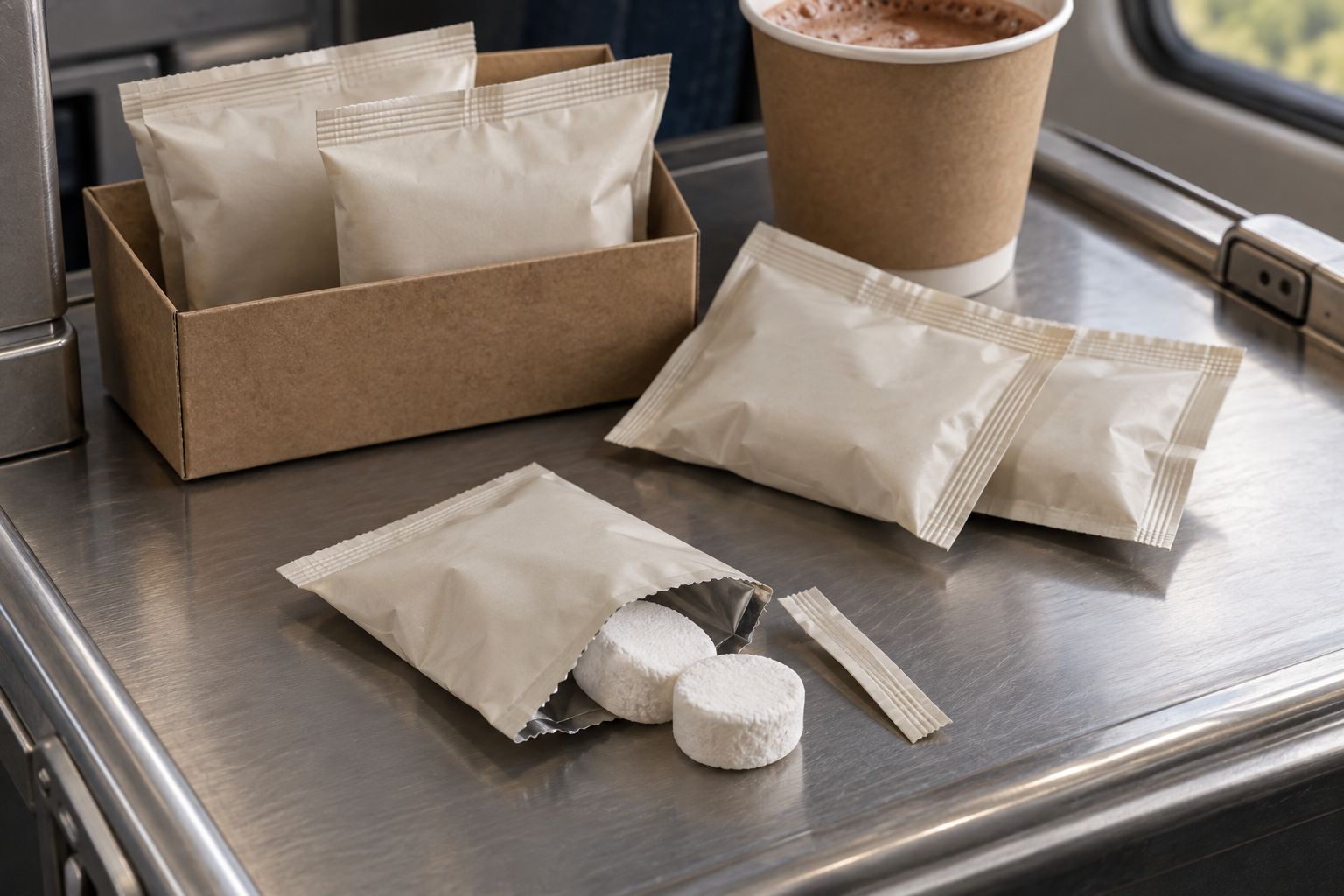
Choose portion-controlled sachets with fast-open tear notches that work with gloves on. Specify film that resists sugar dust migration, print clear allergen and route labels, and pack out to fit Atlas/KSSU carts. Branding can sit on the sachet, not on difficult-to-melt shapes.
Design for “gloves-on” and zero extra wipes
From crew interviews and my own cabin observations, sachets that open in one motion are gold. Here is how we design them:
- Easy-open: Dual tear notches and a calibrated notch depth so torn edges do not shred gloves. We test with nitrile gloves during pilots.
- Film choice: PET/ALU/PE5 or high-barrier PET/PE structures that hold aroma, block moisture, and prevent dust “ghosting” through the film. Transparent windows look nice but often underperform on barrier.6
- Portion control: 1 piece or multiple small coins per sachet, aligned to your per-cup gram target. Clear “1 portion = 1 cup” message reduces overuse.
- Cleanliness: Anti-caking dusting is optimized to prevent sticky residue without whitening artwork. We prototype to the minimum effective dose.
- Trolley fit: Case and inner dimensions mapped to Atlas or KSSU trolley7 shelves and standard drawers. We size inner boxes so crews can pinch and grab quickly without crumpling packs.
- Labeling: Route-specific allergen statements, ingredient list, and origin. Distinct color bands for gelatin vs pectin variants eliminate mix-ups.
- Traceability: Lot code, date format agreed with your QA. Barcode on each sachet if your caterer scans items.
For trains, movements are bumpier and stations can be short-turn. The identical single-serve approach applies. We may add an extra millimeter of seal width to handle rough handling in bar carts.
What compliance and route coverage decisions affect Marshmallow Hot Chocolate procurement?
Compliance can make or break a launch. Gelatin source, faith-based requirements, and retailer audits vary by route and code-share. Buyers who address these early avoid last-minute reformulations and write-off stock.
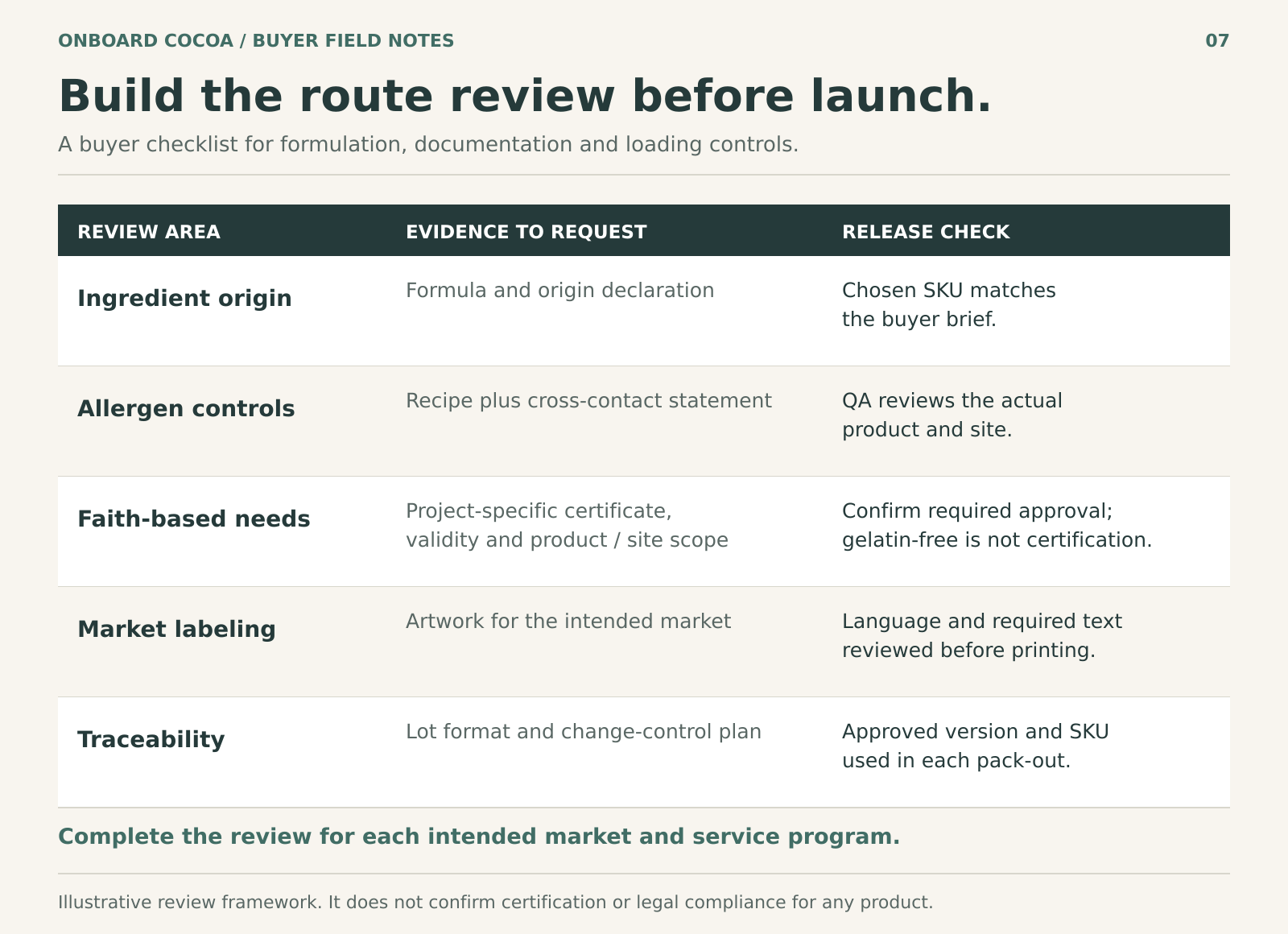
Clarify gelatin source (bovine, porcine) and any Halal/Kosher requirements in the brief. Where needed, plan dual formulations (gelatin vs pectin) with distinct labels and color-coding. Anchor supplier selection to verifiable food-safety certifications and secure route-by-route legal sign-off.
Map requirements, then pick the formulation
Here is how I guide teams through compliance without surprises:
H3: Ingredient origin and faith-based choices
- Gelatin source: State your policy in the RFP. Some carriers accept bovine gelatin on domestic routes but require non-gelatin (pectin) on specific international or codeshare segments.
- Dual-SKU strategy: If routes diverge, we run a gelatin-based SKU and a pectin-based SKU. We color-band sachets and master cases to avoid cross-loading.
- Certification status: We operate under BRC, FDA registration, SMETA, ISO 22000, HACCP, and GMP. Buyers should verify current certificates and scope. Halal and Kosher can be arranged per request, subject to audit8 and separate line-time; do not assume availability without confirmation.
H3: Labeling and claims by market
- Ingredient and allergen statements must meet destination rules. Marshmallow ingredients are typically free of top allergens9, but cross-contact depends on your supplier’s controls. Request a current allergen control statement.
- Nutrition panels and language requirements change per route.10 We supply print files for your legal review before mass run.
H3: Stability and shelf life
- Marshmallows are stable in ambient conditions. Typical shelf-life windows we ship are 9–12 months depending on formula and pack barrier. Your QA should validate shelf life with transit and caterer storage conditions.
- Cabin storage: Avoid high-humidity11 staging areas. We specify moisture barriers that handle typical galley cycles, but good practice still applies.
A clean compliance plan upfront reduces relabeling, dual inventory confusion, and gate-hold headaches.
Can branded shapes for Marshmallow Hot Chocolate protect melt performance and consistency?
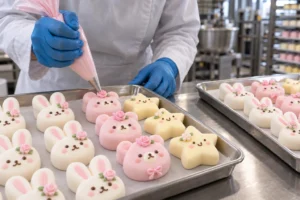
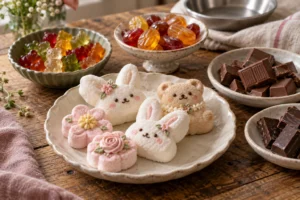
Everyone loves a 3D mascot. Crews do not love waiting for it to dissolve. The good news: you can brand without sacrificing melt. The trick is shape engineering and tolerance control.
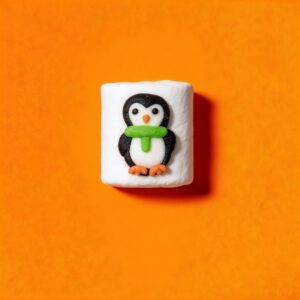
Favor shallow-relief logo coins or thin cut-outs with high surface area. Set thickness and weight tolerances that protect dissolution. Use anti-caking that does not mute imprint. Budget for mold development and pilot tooling to validate uniformity.
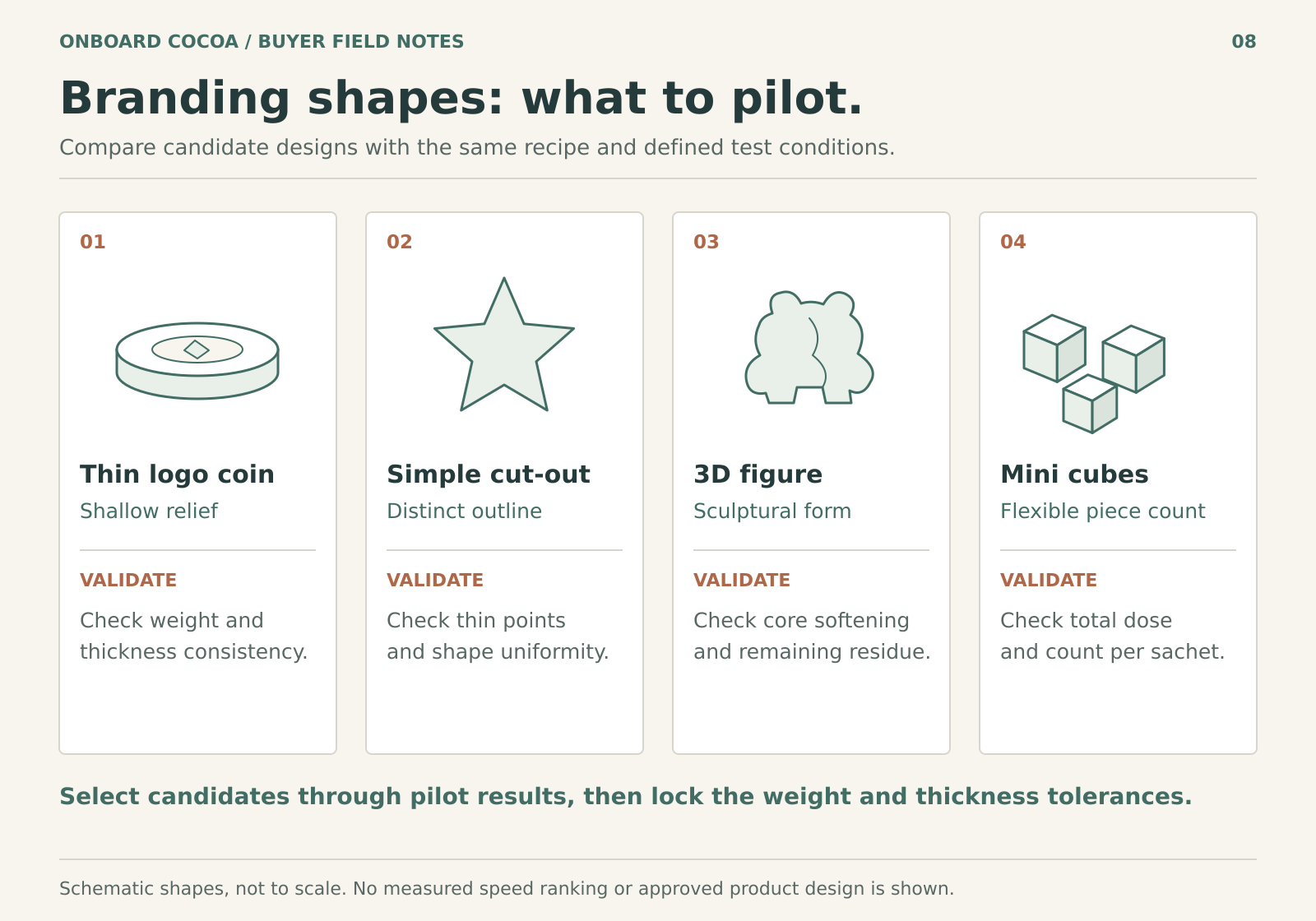
Design for the melt, then for the moment
From our mold library and custom projects, here is what consistently works:
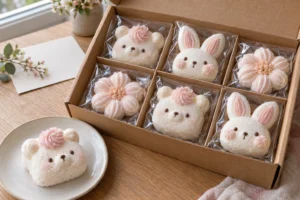
- Shape style: Shallow relief, embossed/debossed coins, or thin stars/hearts. 3D figurines are visually rich but prone to cold spots and slower melt.
- Thickness: Keep it thin. High surface area shortens melt time. We agree a thickness band and control it in QC.
- Tolerances: We set weight and thickness tolerances to keep per-cup dosing and melt predictable. Buyers should request these in the spec.
- Anti-caking: Cornstarch or a tailored dusting blend prevents sticking. We target the minimum needed, so logos remain vivid.
- Color and print: Pastels and natural tones hold up well. Deep dyes can bleed if overused. We prototype color fastness and appearance after dusting.
Table: Shape options and operational impact
| Shape type | Melt performance | Batch consistency | Brand impact | Cost/complexity |
|---|---|---|---|---|
| Thin logo coin | Fast | High | Strong | Moderate |
| Simple cut-out (star) | Fast | High | Moderate | Low–Moderate |
| Thick 3D figurine | Slow/variable | Medium–Low | Very strong | High |
| Mini cubes (multi) | Medium–Fast | High | Low | Low |
I often start with a thin logo coin in two sizes, run dissolution pilots, and then add a seasonal cut-out for holidays. This keeps your Marshmallow Hot Chocolate program on time, on budget, and consistent across kitchens.
What pilot protocol proves Marshmallow Hot Chocolate works with your SOP?
Beautiful samples are not enough. A pilot aligned to your SOP is the only reliable gate before rollout. I treat it as a mini validation: document the setup, measure outcomes, and record crew feedback.
Run pilots on real flights and rail segments with your equipment. Capture water-in-cup temperature, stir steps, dissolution time, residue, and crew motions. Set pass/fail ranges before testing. Adjust shape, dose, or pack based on findings.

A simple, defensible pilot plan
H3: Scope and setup
- Select 2–3 representative routes per fleet type or rail service class.
- Use the actual cocoa base and cups you will deploy.
- Assign a cabin/galley lead to measure and log water-in-cup temperature at pour start.
H3: Test matrix
- Shapes: 2 variants (e.g., thin coin vs simple cut-out).
- Doses: 1 base gram target plus ±1 small increment.
- Stir patterns: crew-normal and a slightly longer variant to test robustness.
H3: Acceptance criteria to pre-define
- Dissolution: No visible pieces within the agreed time.
- Cup and spoon residue: At or below your defined level; no sticky rim.
- Handling: Sachet opens in one motion with gloves; no sugar dust on trolley.
- Crew pace: No additional service time beyond your target; no added wipe-down.
H3: Data capture and review
- Use a one-page checklist per run. Photographs of cups at 30-second intervals help QA review.
- Gather qualitative comments from crews: “felt fast,” “needed a second stir,” “easy to open,” “left dust.”
- Decide change points: If melt is borderline, we can reduce thickness or adjust formula. If sachet opening is tricky, we tweak notches or film stiffness.
I have seen tight programs move from first samples to live service in one planning cycle using this format. The key is agreeing the pass/fail band before anyone boards a plane or train with product.
How do cost, MOQ, and supplier selection work for Marshmallow Hot Chocolate programs?
Cost is not just the marshmallow. Shape complexity, sachet film, print colors, certifications, and logistics all add up. MOQs are driven by molding and packing lines. Choosing a supplier who can show controls, not just catalogs, pays off in fewer change orders.
Expect mold development, pilot runs, and then scaled production. Typical MOQs for custom sachets sit in the tens of thousands. Verify certifications, audit readiness, and route compliance support before you commit.
Price drivers and practical ranges
H3: What moves the unit cost
- Formulation: Pectin-based (gelatin-free) variants cost more than bovine-gelatin equivalents. They may also melt differently; pilot both.
- Shape: Thin logo coins are cost-effective. Deep 3D shapes require longer setting times and higher variance checks.
- Portion sachet: High-barrier films and multi-color prints increase cost. They are often worth it for hygiene and branding.
- Pack-out: Inner trays or easy-grab cartons reduce crew time; small incremental cost can pay back in service speed.
H3: MOQ and lead times
- Custom molds: Budget a tooling fee and 2–4 weeks for development, depending on complexity.
- MOQ: For shaped marshmallows in branded sachets, plan for MOQs on the order of 30,000–100,000 sachets depending on film, print, and packing line setups.
- Lead time: After approvals, allow 4–8 weeks for production and export, subject to seasonal load and packaging procurement. Build time for route-specific labels and any faith-based audits if requested.
H3: Supplier evaluation
- Food safety: Ask for BRC certificate, FDA registration details, ISO 22000, HACCP, and GMP documentation. Verify current validity and scope. We hold these and provide copies for buyer verification.
- Social responsibility: SMETA audit reports help your ESG compliance. Again, verify scope and date.
- QA practice: Request examples of melt/dissolution test reports, weight/thickness control charts, and change-control procedures.
- Route compliance: Does the supplier support dual-SKU labeling and color-coding for gelatin vs pectin? Can they manage language variants?
- Logistics: Confirm export documentation experience for your lanes, and whether they can ship by sea or air with moisture protection.
As a China-based OEM/ODM factory focused on shaped marshmallows, we balance creative branding with operational consistency. Our own York brand is small by design; our core is building private-label and custom programs that survive the realities of trolleys and galleys.
Frequently Asked Questions
Will marshmallows dissolve in lower-temperature galley or trolley water?
They can, but speed depends on shape, dose, and stirring. I recommend measuring water-in-cup temperature during pilots, then choosing thin, high-surface-area shapes. Define a target dissolution time aligned to your service window and validate with the actual stir method crews use.
Can we use pectin-based marshmallows for Halal/Kosher routes?
Yes, pectin-based formulations avoid animal gelatin12 and can suit routes with Halal/Kosher needs. Availability of formal Halal/Kosher certification depends on audit arrangements and should be confirmed per project. Plan a dual-SKU approach with distinct labels and color-coding to prevent loading errors.
What portion size per cup works best?
It varies with your cocoa recipe and cup volume. Many programs converge on a small, single-sachet dose that enhances foam without slowing melt. I define the gram target during pilots and lock it with tolerances so crews can rely on a one-sachet-per-cup SOP.
Can we co-pack cocoa powder and marshmallows in one sachet?
It is possible, but moisture migration and dusting can affect both components. Most airlines prefer separate cocoa and marshmallow sachets for handling and flexibility. If you want co-pack, run stability tests and ensure the divider or internal film prevents clumping.
What shelf life should we expect and how should we store it?
Marshmallows are generally stable at ambient conditions. We commonly ship with 9–12 months shelf life, subject to formulation and packaging. Store in a cool, dry place away from humidity. Your QA should validate shelf life in the intended caterer and galley storage conditions.
Conclusion
Airline and rail buyers can make Marshmallow Hot Chocolate a reliable delight by leading with operations: validated melt time, single-serve sachets, and route-ready compliance. Branding sits on top of that foundation. If you want to pilot shapes, doses, and packaging with a supplier who lives in OEM/ODM details, contact us. We are a China-based shaped-marshmallow factory (brand: York) with BRC, FDA registration, SMETA, ISO 22000, HACCP, and GMP, and we are ready to co-design your next onboard hot chocolate moment.
"The Aircraft Cabin Environment - PMC - NIH", https://pmc.ncbi.nlm.nih.gov/articles/PMC7152029/. Aviation agency materials describe cabin pressurization (often equivalent to several thousand feet of altitude), and standard thermodynamics shows that water’s boiling point falls with decreasing pressure; together, these points explain why onboard hot water may be cooler than 100°C, affecting dissolution rates. Evidence role: mechanism; source type: government. Supports: That commercial aircraft cabins are pressurized to reduced pressures corresponding to high cabin altitudes, causing water to boil below 100°C and potentially lowering available hot-water temperatures for beverage service.. Scope note: The cited sources typically provide cabin pressure ranges and boiling-point principles; they do not directly measure marshmallow melt in service. ↩
"Dissolution Kinetics of a BCS Class II Active Pharmaceutical ...", https://pmc.ncbi.nlm.nih.gov/articles/PMC8014923/. Reference works on dissolution kinetics state that, all else equal, increasing exposed surface area accelerates dissolution, supporting the claim that thinner, higher-surface-area shapes melt faster. Evidence role: mechanism; source type: encyclopedia. Supports: That dissolution rate increases with greater surface area and agitation, consistent with the Noyes–Whitney relationship.. Scope note: This support is general to dissolution phenomena and not specific to marshmallow matrices. ↩
"Can cornstarch be omitted from homemade marshmallow ...", https://www.facebook.com/groups/TheWeddingCookieTableCommunity/posts/3148732255413930/. Encyclopedic summaries of marshmallow manufacture note that finished pieces are dusted with starch or powdered sugar to prevent sticking, consistent with the claim that dusting reduces stickiness. Evidence role: general_support; source type: encyclopedia. Supports: That marshmallows are commonly dusted with starch or powdered sugar to prevent sticking.. Scope note: Such references typically describe the practice but do not quantify the reduction in stickiness or effects on branding. ↩
"FDA Food Code 2022: Full Document", https://www.fda.gov/media/164194/download. The U.S. FDA Food Code advises using single-use/single-service articles to reduce contamination in foodservice, and standard traceability guidance supports lot coding at the package level; together these points support hygiene and traceability benefits of single-serve sachets. Evidence role: general_support; source type: government. Supports: That food codes encourage single-use/single-service items to minimize contamination risk and that unit-level packaging can aid traceability when lot-coded.. Scope note: The Food Code is general and does not address marshmallow sachets specifically or quantify operational speed benefits. ↩
"Comparing Optimum Barrier Variables of Aluminium and ...", https://repository.rit.edu/cgi/viewcontent.cgi?article=1043&context=japr. Packaging references describe aluminium foil as providing an effective barrier to moisture, oxygen, and aroma when used in laminates, supporting the use of PET/ALU/PE structures as high‑barrier sachet films. Evidence role: general_support; source type: encyclopedia. Supports: That aluminium foil layers in laminates provide a strong barrier to moisture, oxygen, light, and aroma in food packaging.. Scope note: Barrier performance depends on foil thickness and laminate construction, which vary by supplier. ↩
"Influence of Pinholes on Water Vapor and Oxygen ...", https://repository.rit.edu/cgi/viewcontent.cgi?article=1211&context=japr. Introductory packaging resources explain that clear polymer films (e.g., PET, PP) have higher OTR/WVTR than metallised or foil laminates, supporting the statement that transparent windows often underperform on barrier. Evidence role: general_support; source type: encyclopedia. Supports: That uncoated transparent polymer films typically have higher oxygen and water vapour transmission rates than metallised or foil laminates used for high-barrier applications.. Scope note: Barrier coatings and specific polymers can improve performance; the statement is a general tendency. ↩
"Airline service trolley", https://en.wikipedia.org/wiki/Airline_service_trolley. Encyclopedic entries on airline service trolleys identify Atlas and KSSU as the two prevalent galley standards for carts and drawers, which supports referencing these formats in packaging specifications. Evidence role: definition; source type: encyclopedia. Supports: That Atlas and KSSU are established standards for airline service trolleys and inserts.. Scope note: Individual airlines or caterers may use variants or mixed fleets. ↩
"Kosher Certification in USA", https://ias-certification.com/kosher-certification-in-usa/. Certification bodies describe Kosher and Halal approvals as requiring on-site inspections and ongoing supervision, supporting the statement that such certifications are subject to audits and may require scheduled line time. Evidence role: expert_consensus; source type: institution. Supports: That Kosher (and Halal) certifications involve facility inspections/audits and ongoing supervision by certifying bodies.. Scope note: Specific audit scope and frequency vary by certifier and region. ↩
"Food Allergies", https://www.fda.gov/food/nutrition-food-labeling-and-critical-foods/food-allergies. FDA identifies nine major food allergens (including milk, eggs, wheat, soy, peanuts, tree nuts, fish, crustacean shellfish, and sesame); typical marshmallow recipes do not inherently contain these, although some formulations may include egg whites or be subject to cross-contact. Evidence role: general_support; source type: government. Supports: That the FDA recognizes nine major food allergens and that common marshmallow ingredients (sugar, corn syrup, water, gelatin) are not among them.. Scope note: The FDA list is general; actual product recipes and manufacturing controls vary. ↩
"21 CFR Part 101 -- Food Labeling", https://www.ecfr.gov/current/title-21/chapter-I/subchapter-B/part-101. The Codex General Standard for the Labelling of Prepackaged Foods outlines required label information and language provisions, and national regulations (e.g., EU, US) add jurisdiction-specific rules, supporting the need to adjust nutrition panels and language by route. Evidence role: general_support; source type: institution. Supports: That international frameworks (e.g., Codex) and national laws specify labeling content and language requirements for prepackaged foods.. Scope note: Codex serves as guidance; binding requirements come from local law, which varies by destination. ↩
"Moisture and Shelf Life in Sugar Confections", https://talcottlab.tamu.edu/wp-content/uploads/sites/108/2019/01/Moistuer-and-Sugar-in-Shelf-Life.pdf. Basic references note that sugars are hygroscopic and absorb moisture from humid environments, supporting the advice to avoid high-humidity staging areas for marshmallows. Evidence role: mechanism; source type: encyclopedia. Supports: That sugars are hygroscopic, absorbing moisture from humid air, which can cause stickiness in confections.. Scope note: Actual moisture uptake depends on formulation, water activity, and packaging barrier. ↩
"Pectin Hydrogels: Gel-Forming Behaviors, Mechanisms ... - PMC", https://pmc.ncbi.nlm.nih.gov/articles/PMC10530747/. Reference materials describe pectin as a plant-derived polysaccharide and gelatin as an animal-derived protein; replacing gelatin with pectin removes animal origin, which can be a prerequisite for Halal/Kosher acceptance subject to certification. Evidence role: definition; source type: encyclopedia. Supports: That pectin is a plant-derived polysaccharide gelling agent and gelatin is an animal-derived protein.. Scope note: Religious acceptance depends on certification bodies and specific processing, not just ingredient origin. ↩