Marshmallow Gift Tin Wholesale: Reusable Premium Packaging?
Marshmallow gift tin wholesale sounds glamorous, but it can quietly erode margins if you do not model it rigorously. Buyers love the premium look; finance hates unplanned costs. The fix is simple: map the full cost blocks, quantify dent risk, and align the channel and occasion. If those check out, tins are worth it.
Marshmallow gift tin wholesale pays off when the price band can absorb the packaging uplift, the channel rewards “giftability,” and your risk-adjusted margin stays on target after a realistic dent/damage allowance. Default to product in a sealed inner food bag with the tin as secondary packaging. Engineer for transit, validate with small shipments, then scale.
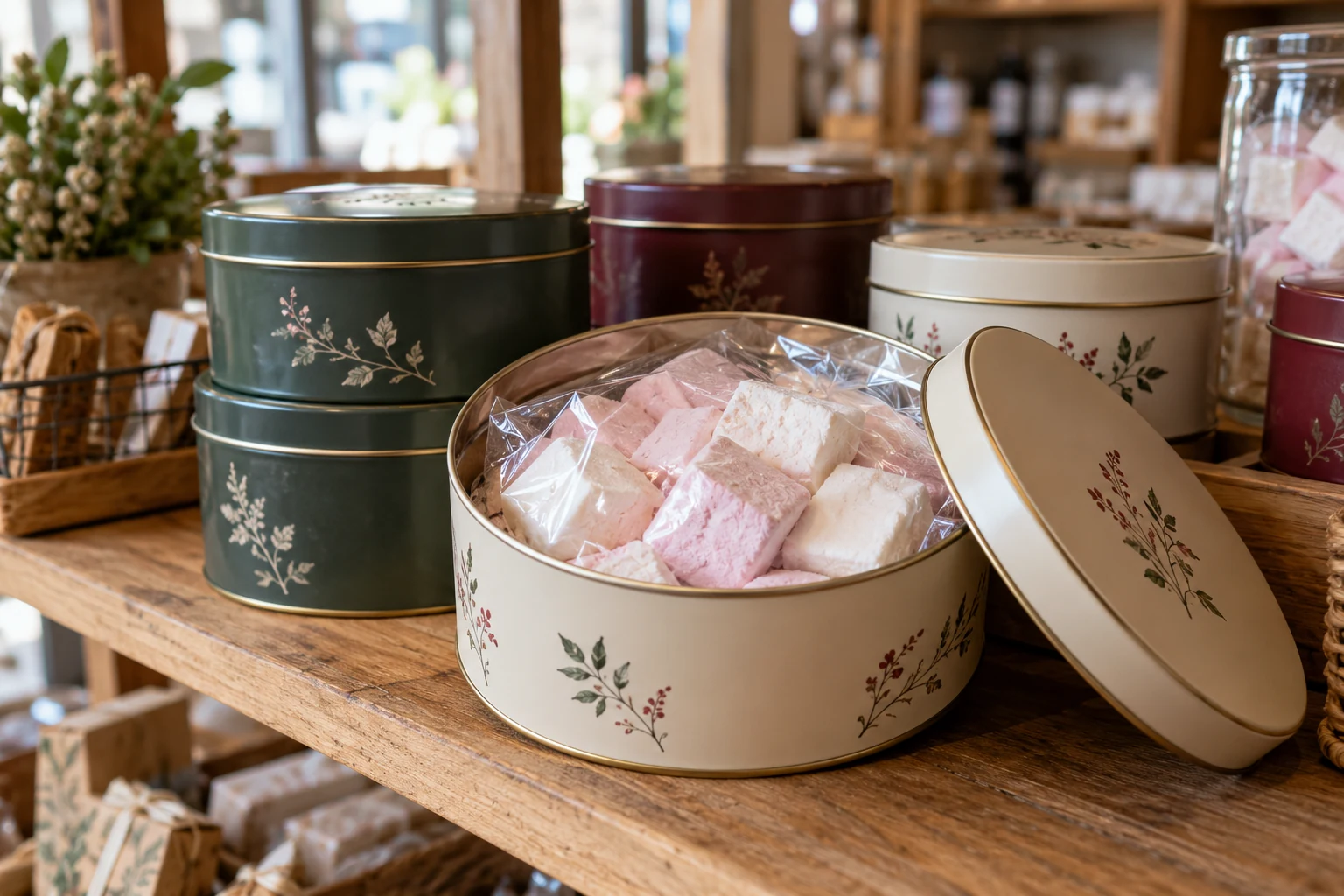
I will break down how I evaluate tins as an OEM/ODM marshmallow manufacturer. I will share the decisions that changed between sampling, trial runs, and mass production. If you need a simple yes/no gate and a practical spec path, keep reading.
When does marshmallow gift tin wholesale actually pay off?
You want the premium feel, but you worry about margin and dents. I have been there during pre-holiday crunches. The problem is fuzzy ROI. The agitation comes when post-launch complaints or freight overruns wipe out the upside. The solution is a two-gate test and a risk-adjusted margin model.
A marshmallow gift tin wholesale program pays off when three conditions align: the channel monetizes giftability and reuse, the retail price band supports a premium, and effective gross margin (after damage allowance) meets your threshold. If any of the three fails, stay with pouches/boxes or consider a limited-run tin for seasonal or gifting-only SKUs.
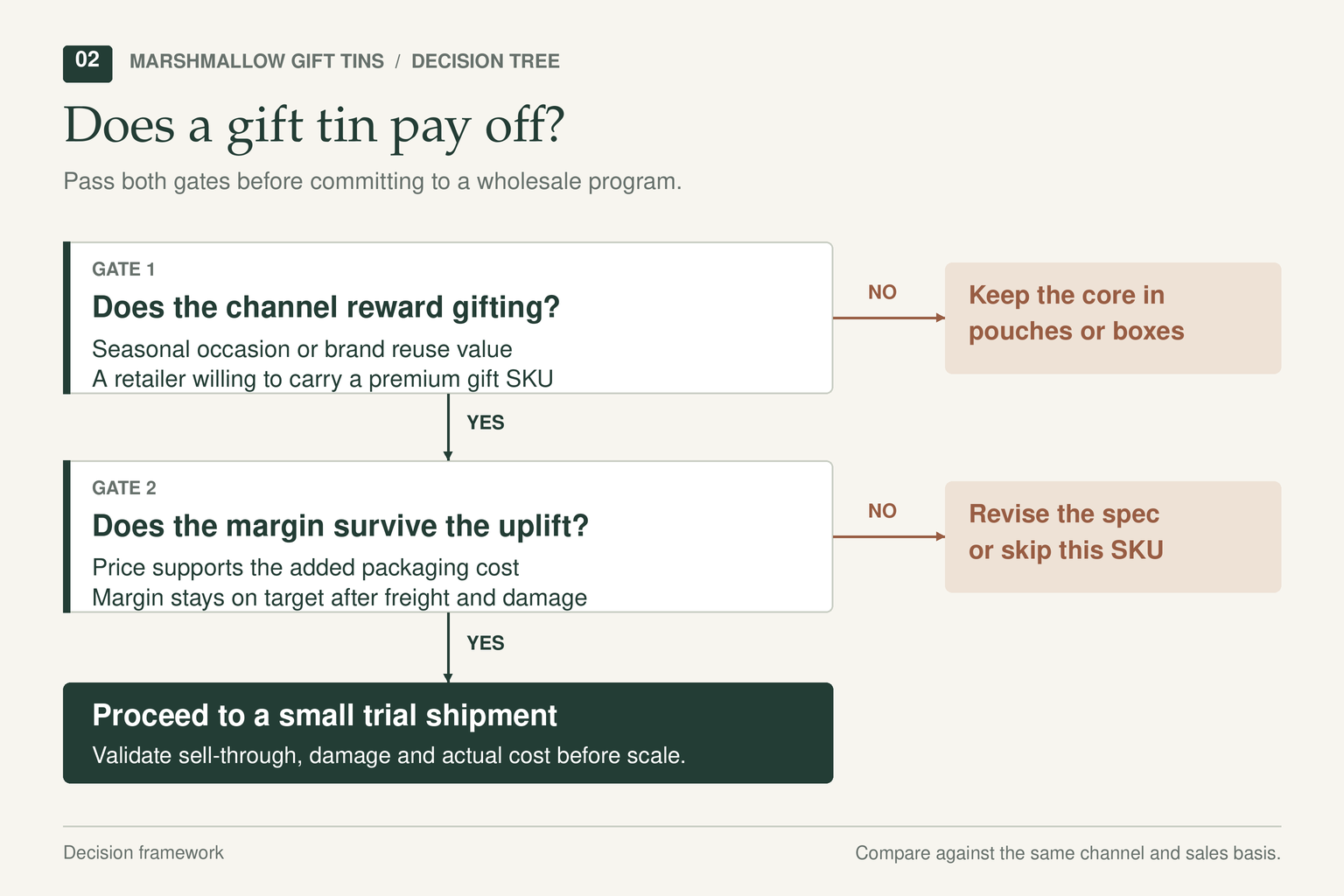
The two-gate decision framework
-
Gate 1: Channel and occasion fit
- Seasonal or gifting-led?
- Brand “leave-behind” value important?
- Retailer accepts slower turns for gift SKUs?
-
Gate 2: Price band and effective margin
- Can the price band carry the packaging uplift?
- After dent/damage allowance, is margin still on target?
Here is how I model it in practice.
1) Build the cost blocks:
- Tin spec and printing (stock vs custom, litho colors, emboss/deboss, special finishes)
- Inner food bag (film spec, gas flush or desiccant if needed)
- Protective inserts (paperboard cradle, corner posts, molded pulp or foam where necessary)
- Master carton changes (board grade, partitions, tighter fit)
- Freight and cube impact (tins ship airier; pallet efficiency matters)
- Handling and rework (QC checks, repacks for trial runs)
2) Assign a dent/damage allowance:
- Never zero. I use a realistic allowance based on design robustness and transit testing results.
- A simple AQL target will translate to an expected complaint/refund rate.1
3) Calculate “effective gross margin”:
- Retail price minus product + packaging + logistics + expected damage cost.
- Adjust the retail price only if the channel can bear it.
If the effective margin meets your threshold and the channel rewards giftability, proceed. If not, the honest answer is to skip tins for that SKU or run a very limited seasonal edition to learn without risking your core line.
In recent seasonal programs, we saw the biggest margin killers were not tin unit costs but freight cube penalties and insufficient transit engineering. Tightening master cartons and adding rolled-edge tins cut dent complaints from double-digit to low single-digit percentages in trial orders before we scaled.
How should I model ROI for marshmallow gift tin wholesale without guesswork?
Buyers often treat tins like a design choice. Finance treats them like a risk. The gap is an ROI model that everyone trusts. The problem is hidden costs and wishful retail pricing. The solution is a block-by-block model plus a reality-based damage allowance.
Start with a base-case pouch/box P&L. Layer in each tin cost block, quantify freight cube changes, and subtract a dent/damage allowance grounded in real transit tests. If the resulting effective gross margin is at or above target, greenlight the tin. If not, revise spec or decline.
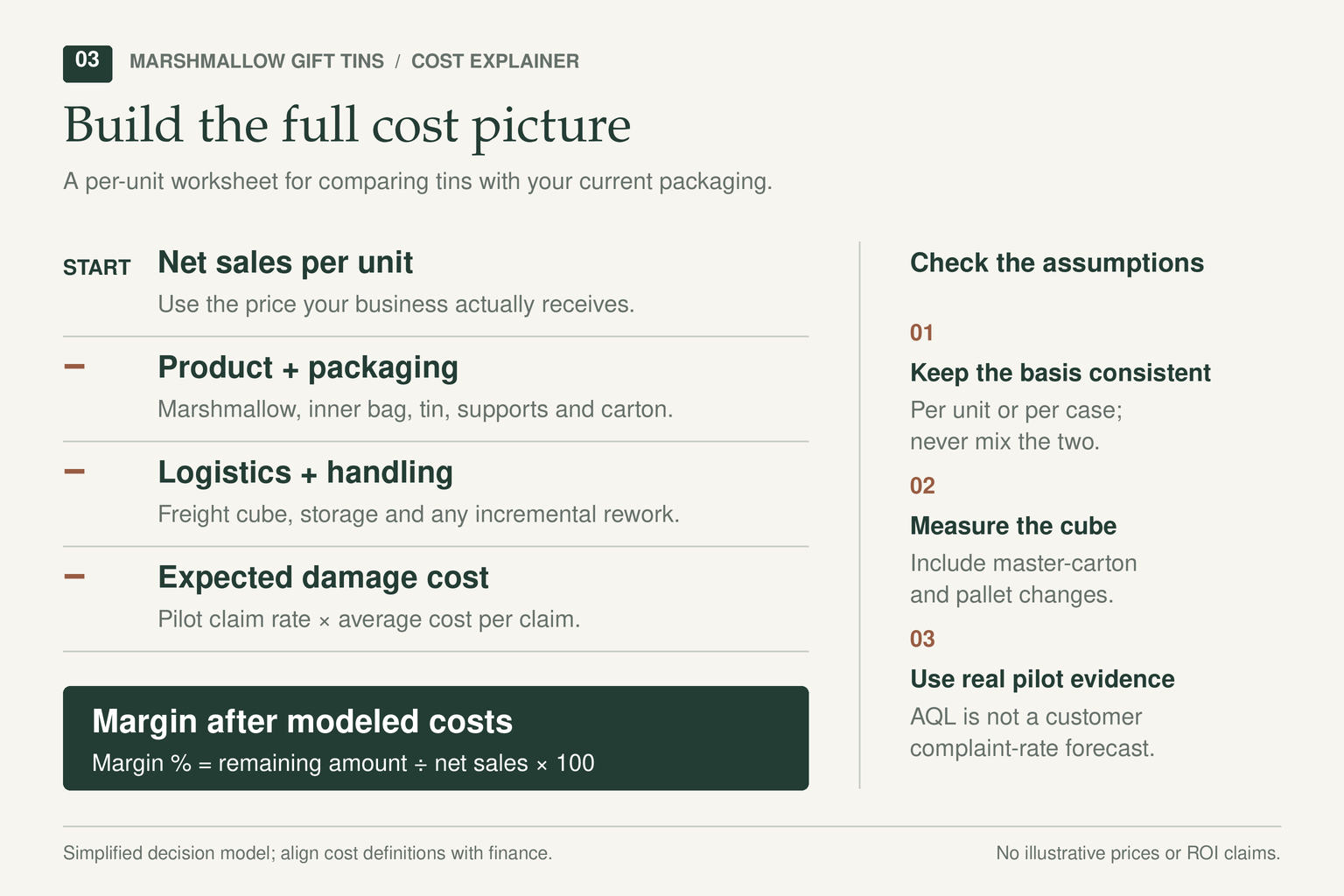
The ROI worksheet I use
-
H3: Cost blocks and typical drivers
- Tin body
- Stock shape vs custom mold
- Wall thickness; ribs/rolled edges
- Litho colors, spot varnish, emboss/deboss
- Inner food bag
- Material: PET/PE, PP, or metallized barrier films
- Gas flush vs desiccant for texture control2
- Print or blank
- Inserts and protection
- Paperboard collar, corner posts, molded pulp, foam
- Unit separators if multiple flavors/shapes
- Master carton and palletization
- Board grade upgrade (e.g., from B/C singlewall to doublewall)
- Partitioning or snug-fit redesign
- Stacking pattern and pallet tie-high changes
- Freight and handling
- Cube increase: tins are space-inefficient compared to flat pouches3
- Weight deltas are minor; cube is the main driver
- Rework or QC time for trial shipments
-
H3: Damage allowance and AQL
- Set an Acceptable Quality Limit for dents/scratches at the tin-only level.
- Translate AQL to an expected complaint/credit cost per case.
- Plan a small-batch shipment to validate assumptions before mass roll-out.
-
H3: Effective gross margin formula (simplified)
- Effective GM = Retail price
- [COGS (marshmallow + inner bag + tin + inserts)]
- [Logistics (freight-in + cube penalty + warehousing if relevant)]
- [Expected damage/complaint cost]
- Sanity check against channel’s allowable retail price band.
-
H3: What often moves the needle
- Switching to a rolled-edge, ribbed-wall stock tin reduces corner-dent incidents materially.
- Upgrading master carton fit reduces scuffing and edge crush.
- Accepting one fewer unit per shipper to tighten fit can lower complaints enough to pay for itself.
- Over-spec finishing (heavy emboss + gloss + dark inks) looks great but raises scuff visibility; choose finishes intentionally.
I present this worksheet in early scoping so buyers, design, and finance align on facts. When we do this, we avoid mid-project surprises, and we deploy tin SKUs only where they actually return cash.
Which channels capture the most value from marshmallow gift tin wholesale?
Not every channel will reward tins. The problem is assuming universal premium. The agitation comes when an everyday shelf SKU with tight price bands can’t move volume at a higher price. The solution is channel triage before you spec anything.
Marshmallow gift tin wholesale creates value in seasonal gifting, curated gift baskets, and private label programs needing brand “leave-behind.” Everyday shelf items with fast-turn price ceilings seldom recover the packaging uplift. If a retailer accepts a slower-turn gift SKU and ups the retail, tins can work. If not, stick with pouches/boxes.

Where tins shine (and where they do not)
-
H3: High-fit channels
- Seasonal and holiday programs: Halloween, Christmas, Easter, Valentine’s Day
- Gift baskets and curated sets: retailers and corporate gifting consolidators
- Private label “brand leave-behind”: tins reused at home keep your logo visible
- Specialty confection and premium coffee/cocoa partners: perceived value per unit is higher
-
H3: Lower-fit channels
- Everyday shelf with narrow price bands and strict planogram expectations
- Discount-led channels where packaging rarely influences price elasticity
- High-frequency restocking where cube inefficiency hits logistics hard
-
H3: A simple channel gate I use
- Is seasonal or brand leave-behind essential to success?
- Will consumers pay a clear premium at this retailer?
- Will the buyer accept a slower-turn gift SKU with appropriate margin?
If you answer yes to all three, proceed. If you answer no to two or more, you probably save time and margin by keeping tins for a special edition and maintaining pouches/boxes as your core.
In our own holiday and private-label projects, the strongest outcomes came when the tin was part of a broader story: limited-edition flavors, co-branded cocoa pairings, or collectible graphics. The tin amplified an already compelling proposition; it did not need to carry the whole value narrative by itself.
What packaging spec prevents dents without killing margin?
Tins dent. That is reality. The problem is treating dents as a deal-breaker instead of a managed risk. The agitation is refund requests and bad reviews. The solution is engineering for transit, setting an AQL, and trading small costs for predictable complaint rates.
Use forms with rolled edges or ribs, add minimal but strategic inner supports, tighten master carton fit, and validate with small-batch shipments. Do not promise zero dents. Promise a plan: incremental packaging measures versus a measurable reduction in complaints.
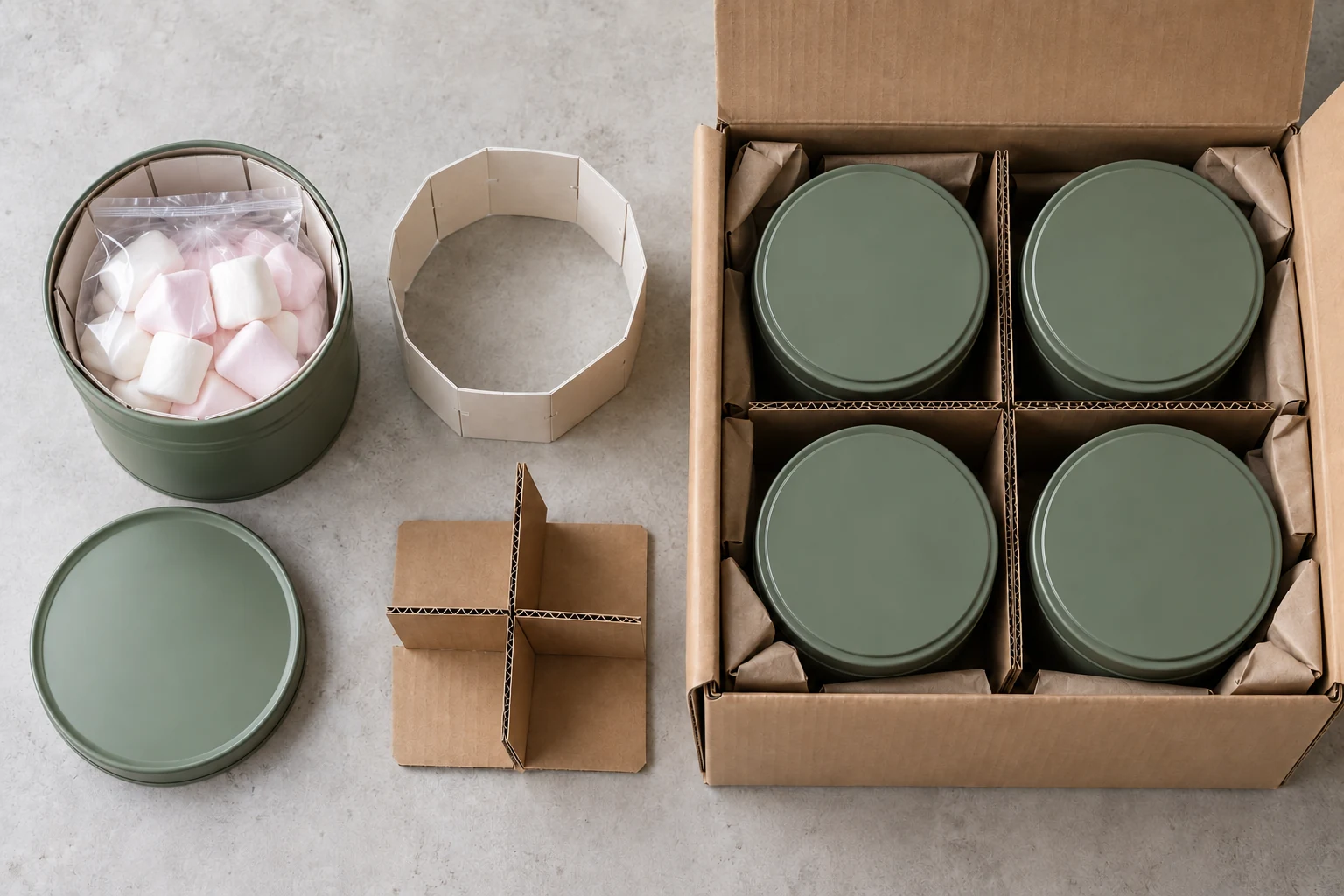
My practical dent-control playbook
-
H3: Tin body choices that matter
- Rolled edges reduce edge crush vulnerability.4
- Ribbed walls improve stiffness without massive cost.5
- Duller finishes or micro-texture hide scuffs better than high-gloss dark inks.
-
H3: Inside the tin
- Keep marshmallows in a sealed inner bag to isolate texture and aroma.
- Use a paperboard cradle or ring to keep the bag centered away from wall impacts.
- If you pack multiple items, add a simple divider to stop internal rattle.
-
H3: Master carton and palletization
- Upgrade board grade and tighten the fit; void space invites dents.6
- Use partitions for larger tins; add corner posts for stacking strength.
- Re-think tie-high to keep top-layer compression within safe limits.7
-
H3: Validation before scale
- Run drop, vibration, and compression checks on packed shippers.8
- Ship a small trial batch to the destination region with typical carriers.9
- Track complaint types by SKU and packaging revision to guide the next tweak.
In recent trial runs, the single most effective intervention was improving master carton geometry to remove rattle. We paired that with rolled-edge tins and reduced glossy dark artwork. Complaints shifted from dent-heavy to sporadic scuffs, and overall rates dropped into a low, predictable band we could plan for.
What compliance path should I choose for tins in the US/EU?
Compliance can sound intimidating. The problem is baking complexity into your first run. The agitation is delay from document requests late in onboarding. The solution is a conservative default and market-by-market validation.
Default to “food in an independent inner bag; tin as secondary packaging.”10 This avoids direct food-contact for the tin and simplifies compliance. If you want direct-contact coatings for a luxury unbagged presentation, confirm requirements per destination market before you proceed.
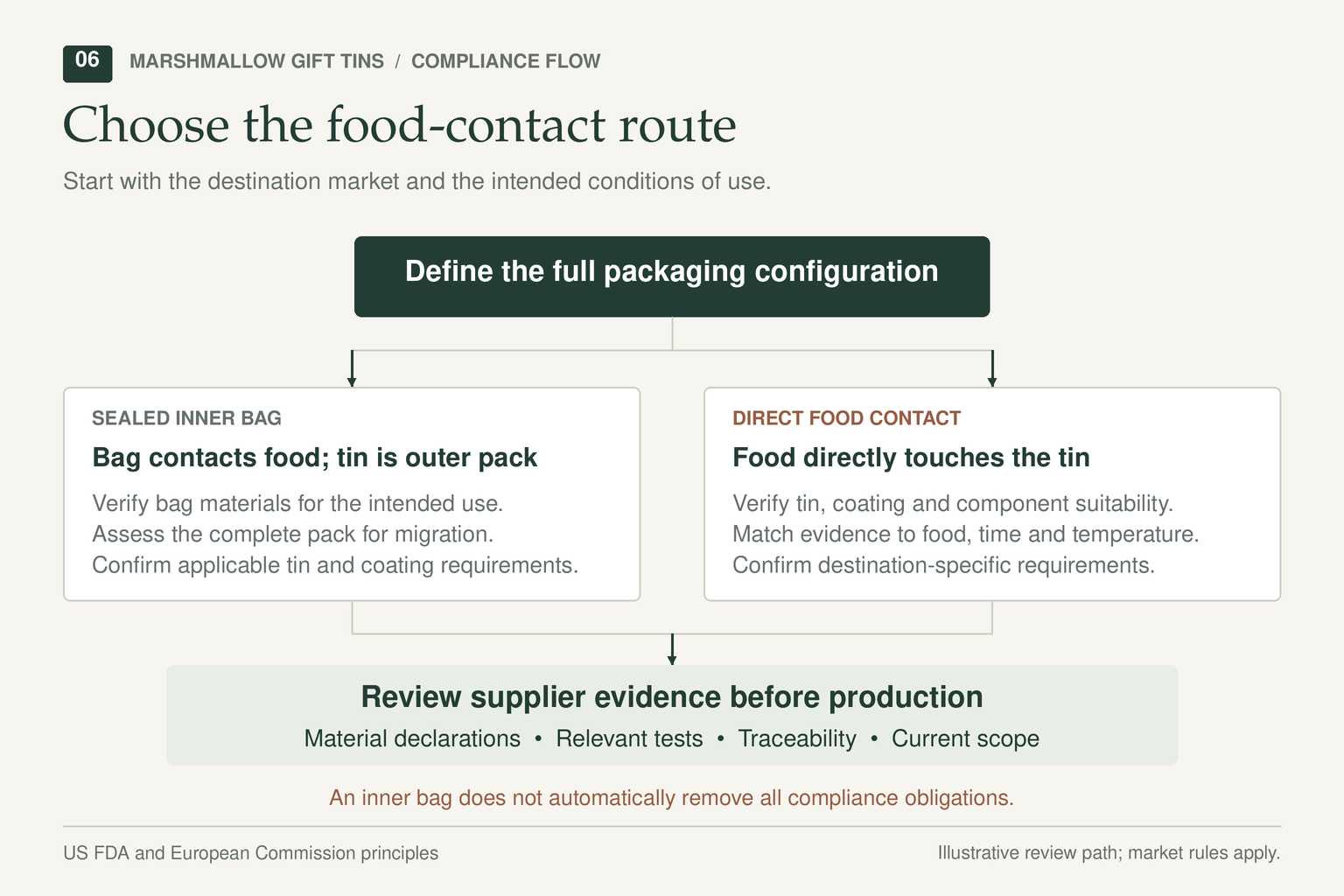
How I frame compliance (as a manufacturer, not a regulator)
-
H3: The low-drama default
- Product in a sealed inner bag with its own food-contact documentation.
- Tin treated as secondary packaging; focus on heavy metal limits and coatings safety per market.11
- This path preserves texture/shelf-life control and simplifies microbiological risk management.
-
H3: When direct contact might be requested
- High-end unbagged presentation or windowed tins.
- Requires tin coating systems validated for direct contact where sold.
- Documentation must be confirmed per market; regulations differ.
-
H3: Documentation buyers typically request
- For inner bag: food-contact declarations referencing relevant frameworks (e.g., US FDA 21 CFR where applicable; EU frameworks such as EC 1935/200412 and related national measures; to be confirmed per target market).
- For tins: coating and heavy metal content declarations aligned with destination requirements.
- Factory-level certifications: BRC, FDA registration, SMETA, ISO 22000, HACCP, GMP — buyers should verify current certificates and scope.
We maintain BRC, FDA registration, SMETA, ISO 22000, HACCP, and GMP at our facility. We share documents during onboarding and we encourage buyers to verify validity and applicability to their products and markets. For direct-contact tin coatings, we proceed only after you confirm requirements with your compliance team.
Should I use a stock tin or commission a custom mold for marshmallow gift tin wholesale?
Custom molds are tempting. The problem is cost and lead time. The agitation is needing MOQ and long approvals before peak season. The solution is to start with a stock tin matched to your brand, then scale to custom once repeat sales justify the investment.
For marshmallow gift tin wholesale, use stock shapes and sizes for the first season. Validate sell-through and complaint rates. If reorder velocity and brand goals support it, move to a custom mold in year two for a differentiated silhouette and tighter internal fit.
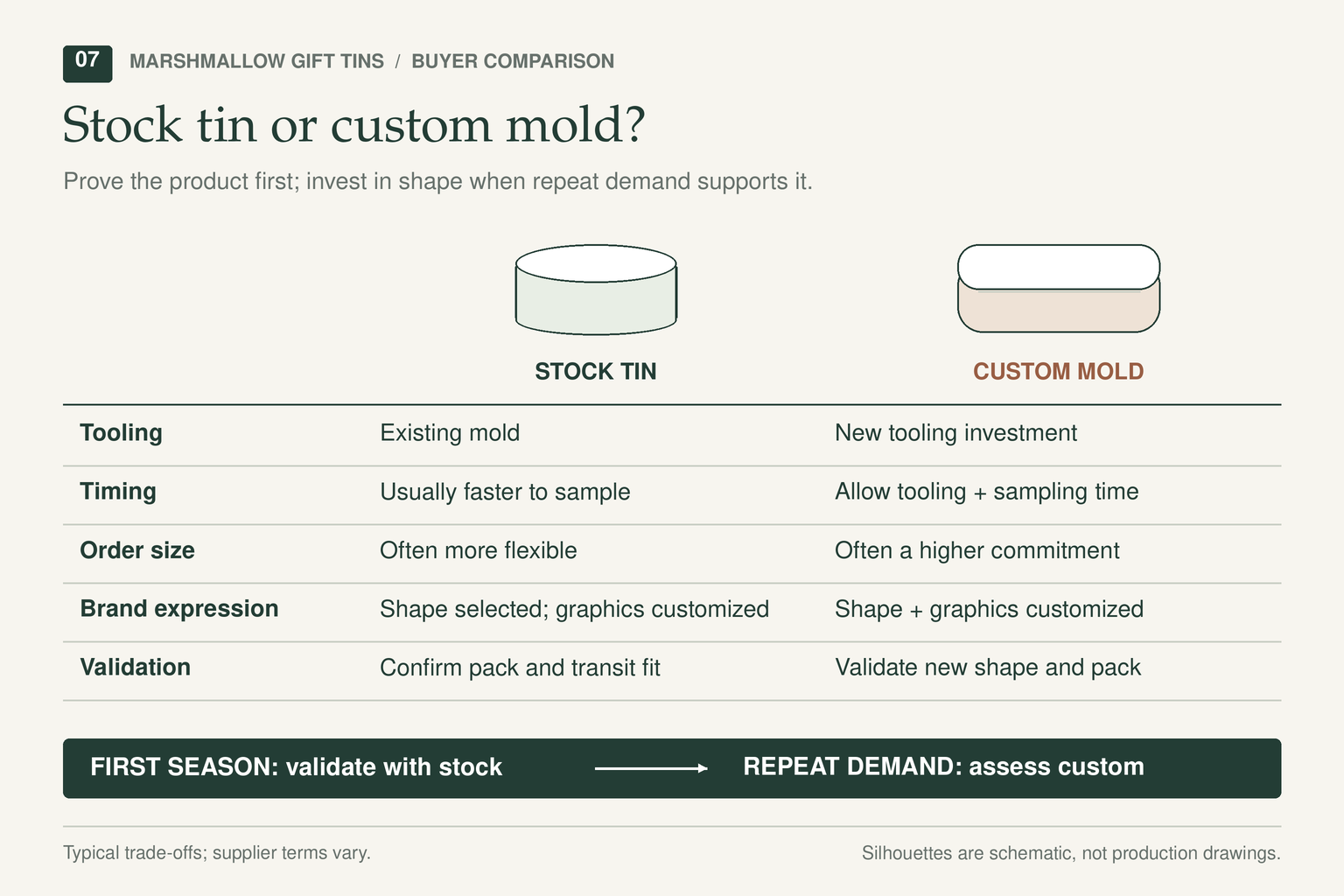
Stock vs custom: how I compare options
| Aspect | Stock Tin | Custom Mold Tin |
|---|---|---|
| Upfront cost | None | Tooling investment required |
| Lead time | Fast (existing tools) | Longer (tooling + sampling) |
| MOQ | Lower, flexible | Higher, tied to tooling ROI |
| Brand impact | Graphics-led differentiation | Shape + graphics differentiation |
| Freight/cube | Known, optimized sizes | Variable; can optimize to product |
| Transit risk | Known performance | Must validate with tests |
| Compliance | Straightforward as secondary pack | Same; confirm coatings if direct contact |
- H3: A phased approach I recommend
- Season 1: Stock tin with strong litho, rolled edges, and inner supports. Learn your complaint rate and retail response.
- Season 2: If velocity is strong, consider a custom mold to match brand cues (logo relief, unique silhouette) and potentially optimize internal geometry to reduce inserts.
In my experience, brands that resist the urge to custom-mold immediately avoid missed delivery windows and preserve cash. Once the SKU proves itself, a custom tin becomes a calculated upgrade, not a gamble.
How do I set AQL and transit tests for marshmallow gift tin wholesale?
Everyone wants “no dents.” The problem is that absolute promises fail in real logistics. The agitation comes from day-one escalations. The solution is to define acceptable limits and validate packaging against real-world handling.
Set an AQL for dents/scratches at the tin level and a separate AQL for finished goods. Run drop, vibration, and compression tests on master cartons. Ship a small batch through the intended carriers to confirm assumptions before mass production.
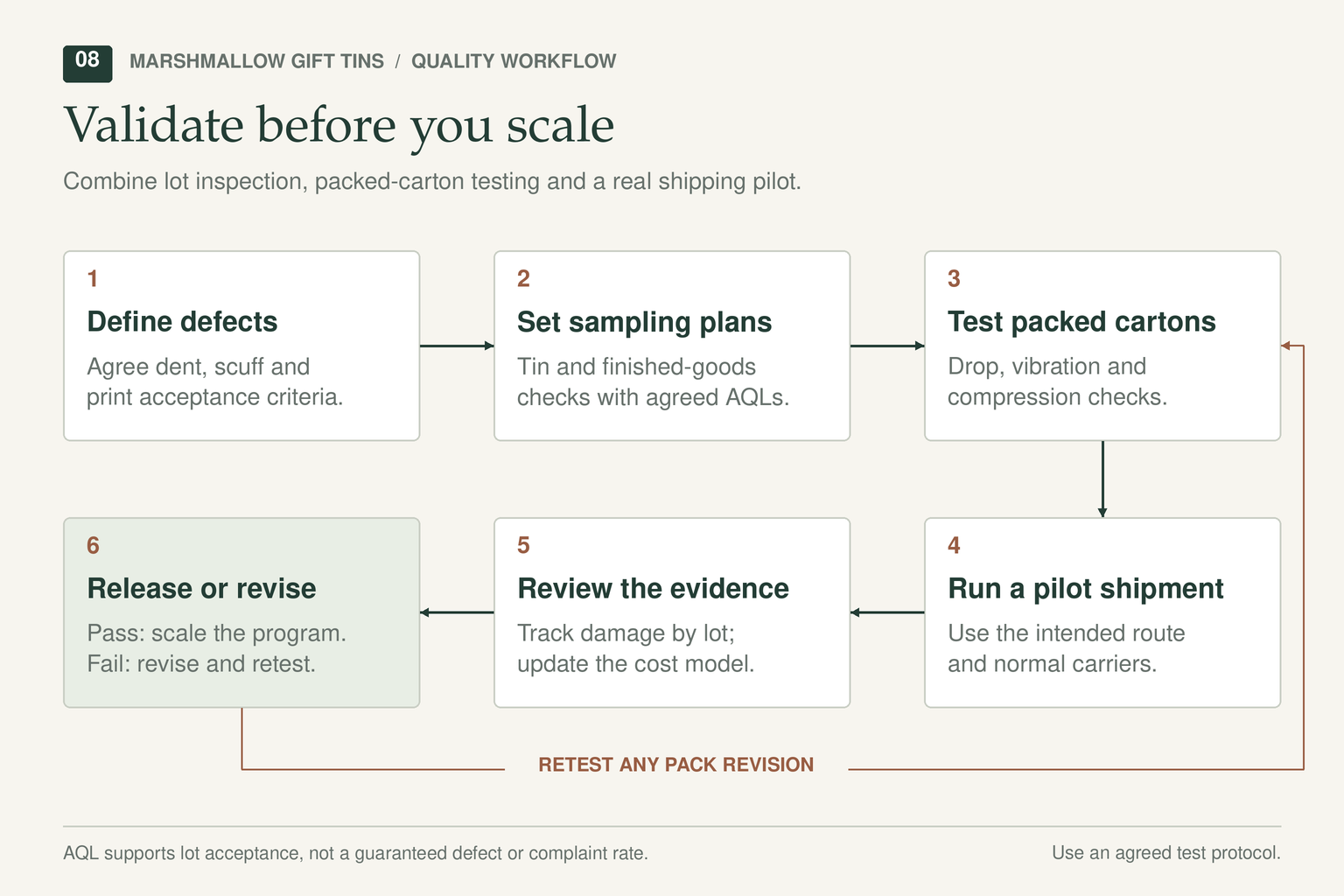
Practical test-and-learn steps
-
H3: Define quality criteria
- Cosmetic standards: minor scuffs acceptable? Define zones (lid top vs side).
- Dent classification: measurable thresholds to distinguish critical from minor.
- Labeling/print scuff criteria: specify gloss/varnish tolerance.
-
H3: AQL setup
- Separate tin-only inspection from finished goods inspection.
- Pick AQL levels that reflect retail expectations for gift items.
- Align with your QC partner on sampling plans and defect categories.
-
H3: Transit simulation and real shipments
- Lab-style tests: free-fall drops at carton corners, edges, faces; vibration; top-load compression.
- Real-world pilot: a controlled small batch shipped by your actual logistics path.
- Feedback loop: trace complaints by SKU, packaging lot, and carrier to refine.
-
H3: Iterate intentionally
- If corner dents dominate, add corner posts or adjust partitioning before increasing foam.
- If scuffs dominate, adjust varnish and artwork tone; darker gloss shows more.
- Re-check the ROI model after each tweak to confirm the margin still holds.
I tell buyers up front that we control risk, not eliminate it. That expectation setting builds trust and gives us room to trade tiny cost increases for measurable complaint reductions.
Frequently Asked Questions
Is a marshmallow gift tin wholesale program viable for everyday shelf items?
It is usually hard. Everyday shelf items face tight price bands and fast-turn expectations. Unless your retailer positions a gift SKU with higher pricing and slower turns, tins struggle to recoup their costs. Keep tins for seasonal and gift-driven placements and use pouches/boxes for daily shelf.
Do I need a food-contact tin coating if my marshmallows are bagged inside?
No in most cases. If the product is in a sealed inner bag, we treat the tin as secondary packaging. That simplifies compliance and protects texture. If you want unbagged presentation, confirm coating requirements with your compliance team per the destination market.
How many dents are acceptable in a gift tin program?
There is no universal number. Define an AQL that matches your brand and retailer standards, classify dent severity, and validate through pilot shipments. We aim for predictable, low complaint rates rather than promising zero dents, which is not realistic.
What inner bag materials work best for marshmallows in tins?
We commonly use PET/PE, PP, or metallized barrier films depending on texture and shelf-life targets. Gas flush or desiccants can help in certain climates. The bag carries the food-contact burden, while the tin provides premium presentation and reuse value.
When should I move from a stock tin to a custom mold?
After the SKU proves itself. Use a stock tin in season one to validate retail uptake and complaint rates. If reorder velocity and brand goals justify it, invest in a custom mold for season two to differentiate shape and fine-tune internal geometry.
Conclusion
Reusable tins can elevate marshmallows, but marshmallow gift tin wholesale only works when channel fit, price band, and risk-adjusted margin align. Model the ROI block by block, default to inner-bag compliance, and engineer transit protection with a defined AQL. If you want to scope a tin SKU or run a pilot, contact our OEM/ODM team for a fast, grounded feasibility review and samples.
"ISO 2859-1", https://chemistry.unt.edu/~tgolden/courses/iso2859-1.pdf. Acceptance sampling literature defines AQL as a parameter describing an expected proportion of nonconforming units deemed acceptable for a process or lot, enabling estimation of defect rates. Evidence role: definition; source type: encyclopedia. Supports: That AQL is a statistical concept from acceptance sampling used to set and estimate acceptable nonconformance rates in lots.. Scope note: While AQL quantifies defect proportions, converting these into complaint/refund costs requires additional assumptions about consumer behavior and retail policies. ↩
"Sugar reduction methods and their application in confections", https://pmc.ncbi.nlm.nih.gov/articles/PMC8994798/. Overviews of modified atmosphere packaging describe replacing headspace air with controlled gases to limit oxygen and moisture, while desiccants are used to reduce humidity—both practices relevant to preserving texture in moisture-sensitive products. Evidence role: mechanism; source type: encyclopedia. Supports: That modified atmosphere packaging replaces headspace air to manage oxygen and moisture exposure, and desiccants control humidity inside packages.. Scope note: General references do not address marshmallows specifically; product-specific validation of texture outcomes is required. ↩
"Dimensional weight", https://en.wikipedia.org/wiki/Dimensional_weight. References on dimensional weight explain that many carriers assess charges based on package volume for light items, so bulkier formats can incur higher costs than compact ones even at the same mass. Evidence role: mechanism; source type: encyclopedia. Supports: That carriers use volumetric/dimensional weight, making bulkier packages less efficient and often costlier to ship than compact flexible packs.. Scope note: The source explains the general pricing mechanism but does not quantify tins versus pouches; the relationship should be validated for the specific SKU dimensions. ↩
"Sheet Metal Hemming Explained: Types, Flange & Uses", https://jlccnc.com/blog/what-is-sheet-metal-hemming. Engineering guidelines for sheet metal design note that hems or rolled edges act as stiffeners by increasing the local moment of inertia, which improves resistance to edge deformation under load. Evidence role: mechanism; source type: education. Supports: That hems/rolled edges in sheet metal increase local bending stiffness and resistance to deformation by increasing section modulus.. Scope note: General sheet metal mechanics support the effect, but the magnitude for specific tin geometries and gauges should be validated experimentally. ↩
"Beaded metamaterials - PMC", https://pmc.ncbi.nlm.nih.gov/articles/PMC12379288/. Mechanical design references describe that adding beads or ribs to thin sheet increases out-of-plane stiffness by increasing the section’s second moment of area, offering rigidity gains without proportional material costs. Evidence role: mechanism; source type: education. Supports: That stiffening beads/ribs in sheet metal panels increase rigidity by raising the second moment of area, often at lower cost than thicker material.. Scope note: This principle is general; the exact stiffness improvement depends on rib geometry and material properties of the specific tin. ↩
"Void Fill Packaging: The Missing Piece in Your Damage ...", https://www.linkedin.com/pulse/void-fill-packaging-missing-piece-your-damage-ben-thompson-kvfue. Distribution packaging guidelines from testing institutions emphasize eliminating void space and selecting appropriate corrugated strength to limit product motion and impact, reducing damage during shipping. Evidence role: mechanism; source type: institution. Supports: That distribution packaging guidance emphasizes minimizing void space and using adequate board grades to reduce movement and impact damage.. Scope note: These are general best practices; the optimal fit and board grade depend on specific tin geometry and distribution environment. ↩
"How Much Load Can My Pallet Carry?", https://unitload.vt.edu/education/white-papers/5-wp-load-carrying-capacity-of-pallets.html. References on box compression tests and stacking strength explain that corrugated containers have finite compression capacity; higher stack heights increase top-load, risking failure if limits are exceeded. Evidence role: mechanism; source type: encyclopedia. Supports: That box compression strength and stacking capacity limit how much top load can be applied; excessive tie-high increases compression beyond safe limits.. Scope note: These principles apply to corrugated shippers generally; safe tie-high for a given program requires testing with the specific carton and load. ↩
"Package testing", https://en.wikipedia.org/wiki/Package_testing. Overviews of package testing explain that drop, vibration, and compression evaluations are standard elements for assessing protective performance through distribution. Evidence role: general_support; source type: encyclopedia. Supports: That recognized package testing regimens commonly include drop, vibration, and compression tests to simulate distribution hazards.. Scope note: The overview identifies common tests but does not specify which exact protocol (e.g., ISTA, ASTM) should be used for a given product or channel. ↩
"Package testing", https://en.wikipedia.org/wiki/Package_testing. Package testing references recognize field trials as a complement to laboratory simulations, providing validation under actual distribution environments and carriers. Evidence role: general_support; source type: encyclopedia. Supports: That real-world field testing is used alongside laboratory tests to validate packaging under actual distribution conditions.. Scope note: General references endorse field testing but do not prescribe specific sample sizes or routes; those must be tailored to the supply chain. ↩
"Food Packaging & Other Substances that Come in Contact ...", https://www.fda.gov/food/food-ingredients-packaging/food-packaging-other-substances-come-contact-food-information-consumers. EU Regulation (EC) No 1935/2004 establishes that materials and articles intended to come into contact with food must be safe and appropriately documented; making the inner bag the sole food-contact layer confines direct-contact compliance to that material. Evidence role: definition; source type: government. Supports: That EU law regulates materials intended to contact food (e.g., EC 1935/2004), so designating only the inner bag as the food-contact layer focuses compliance obligations on that component.. Scope note: This legal framework is jurisdiction-specific and does not by itself determine compliance; individual product designs and market-specific implementing measures still need review. ↩
"Balancing Functionality and Safety in Food Packaging Coatings", https://pmc.ncbi.nlm.nih.gov/articles/PMC12896733/. The EU Packaging and Packaging Waste Directive (94/62/EC) establishes concentration limits for lead, cadmium, mercury, and hexavalent chromium in packaging and components, underscoring the need to control heavy metals and ensure coating safety for market compliance. Evidence role: definition; source type: government. Supports: That EU law (e.g., Directive 94/62/EC) sets concentration limits for certain heavy metals in packaging, informing compliance focus for metal tins and coatings.. Scope note: Implementation and enforcement vary by jurisdiction, and non-EU markets may impose different or additional requirements. ↩
"21 CFR Part 174 -- Indirect Food Additives: General", https://www.ecfr.gov/current/title-21/chapter-I/subchapter-B/part-174. FDA’s food-contact regulatory scheme, including 21 CFR parts addressing indirect food additives, and EU Regulation (EC) No 1935/2004 governing food-contact materials, are commonly referenced frameworks for supplier declarations of compliance. Evidence role: definition; source type: government. Supports: That FDA regulations in 21 CFR (e.g., Parts 174–178) and EU Regulation EC 1935/2004 are core frameworks governing food-contact materials frequently cited in compliance documentation.. Scope note: Specific parts of 21 CFR and additional EU or national measures depend on the material and use case; exact applicability must be confirmed per product. ↩