Marshmallow Competitor Analysis Template for Brand Owners?
The Marshmallow Competitor Analysis Template you use can make or break a launch. Many teams fixate on shapes and FOB price, then discover compliance gaps or shelf-life failures late. That hurts margins and reputations. I propose a category-specific framework that gates for compliance and stability first, then ranks viable SKUs by cost, packaging, and channel-season fit.
A marshmallow competitor analysis template for brand owners should gate Compliance, Stability, and Calendar first, then score viable SKUs through five modules: SKU comparison matrix, cost-and-margin model, compliance checklist, channel & calendar fit, and supply/process risk. Only rank price, mold complexity, and packaging after a product passes these gates.
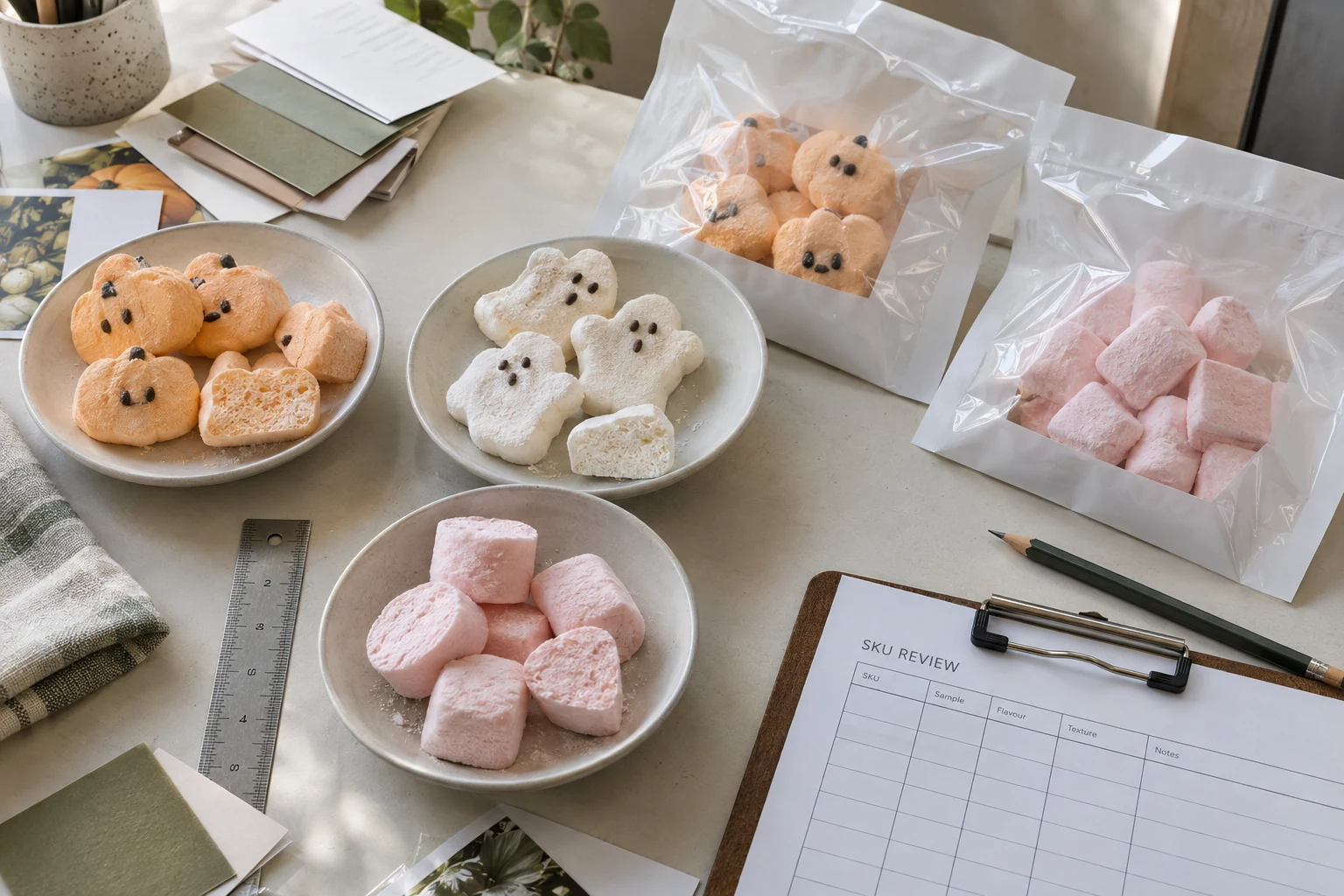
If that sounds strict, good. Shaped marshmallows are deceptively sensitive to moisture, dusting, and transit heat.1 I have seen compliant products fail in real-world logistics. Below, I unpack a practical template that reflects how brand owners actually procure, pilot, and scale—without betting the season on a pretty shape.
Why reweight decisions in a Marshmallow Competitor Analysis Template?
You want the cutest shape at the sharpest price. Then shelf-life slumps during a humid summer route, or a colorant misses an EU restriction.2 The problem is misweighting. Compliance and stability are not features; they are gates. The solution is reweighting your template to reflect real failure points.
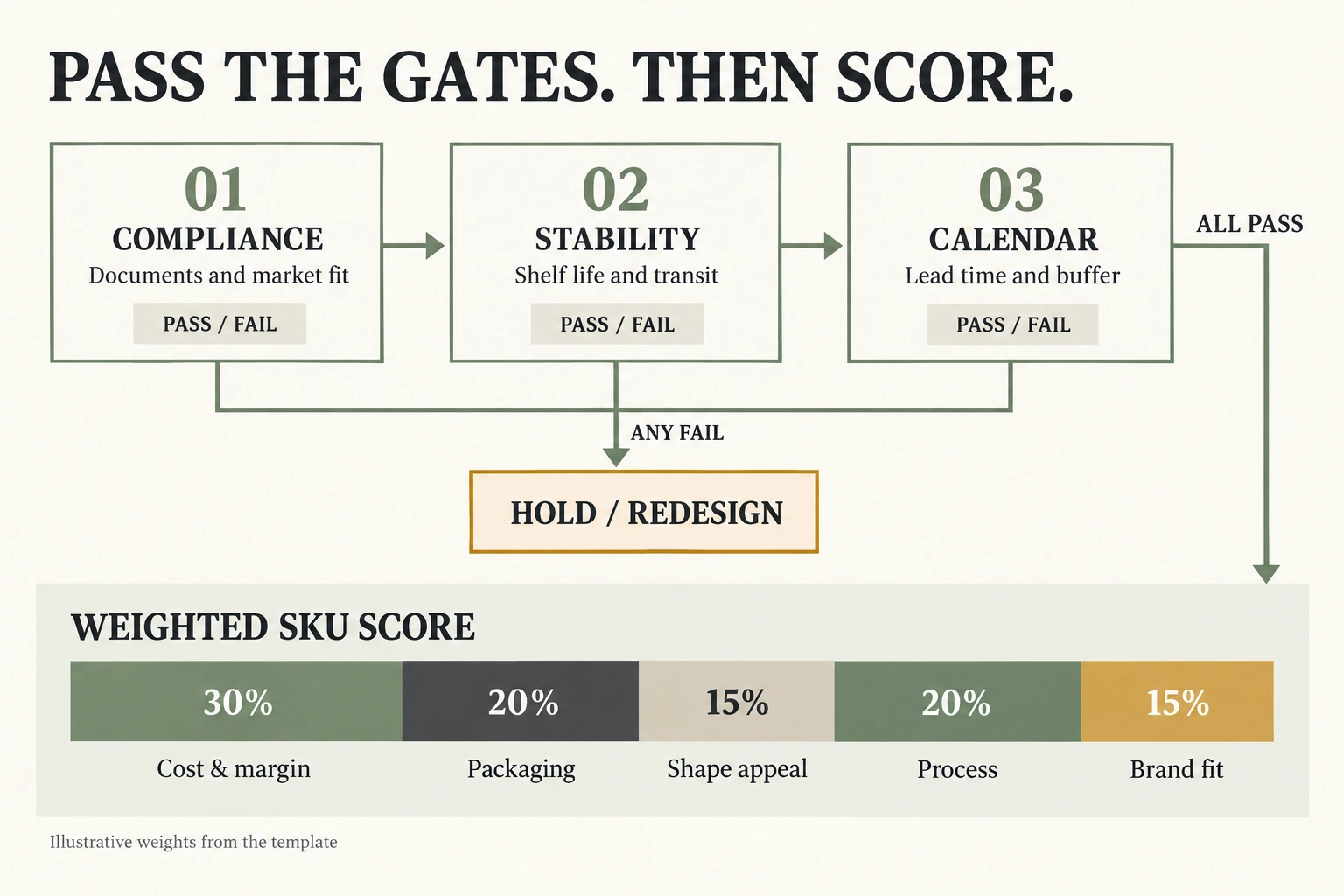
Reweight your marshmallow competitor analysis template so that Compliance, Stability, and Calendar are pass/fail gates. Only after a SKU passes these gates should you score price, molds, packaging, and aesthetics. This prevents late-stage surprises and keeps focus on shelf-life, process feasibility, and must-hit dates.
The real-world rationale
I partner with Western brand owners as an OEM/ODM factory. In one Halloween program, a SKU cleared compliance but softened in transit because anti-sticking dust was under-specified for a heat wave. The calendar gate failed at the port, and a substitute had to ship by air. Margin evaporated. That experience, plus multi-project data (MOQ, typical loss during mold or color switches, complaints/returns), convinced me that marshmallow decisions need category-specific weights.
- Compliance is a gate. Documents like BRC, FDA facility registration, HACCP/ISO 22000, and SMETA are baseline.3 Market-specific colorant/allergen restrictions must be verified.4 We always label unchecked claims as “to-verify.”
- Stability is a gate. Shelf-life and texture stability under your logistics matter more than shape.5 A great shape that sticks or collapses in warm transit is not a SKU; it is a complaint pipeline.
- Calendar is a gate. If your Easter display ships late, no price savings can fix lost sell-through. Lead-time windows, buffer days, and port congestion tolerance must be modeled up front.
Only after these gates pass should we rank by price, mold complexity, packaging aesthetics, and marketing pull. I keep a living weight table to make this explicit:
| Decision element | Type | Weight/Gate | Rationale |
|---|---|---|---|
| Compliance docs | Gate | Pass/Fail | Retail acceptance and legal risk |
| Shelf-life & stability | Gate | Pass/Fail | Real-world transit conditions |
| Calendar fit | Gate | Pass/Fail | Seasonal sales windows |
| Cost and margin | Weighted | 30% | Channel-adjusted GM, allowances |
| Packaging/display fit | Weighted | 20% | Price ladders, planograms |
| Mold/shape appeal | Weighted | 15% | Incremental consumer pull |
| Process feasibility | Weighted | 20% | Changeovers, loss risk |
| Other (brand fit, novelty) | Weighted | 15% | Differentiation potential |
I never infer product cost from shelf retail. I normalize comparisons by unit count, pack sizes, and promotions before I rank product power.
How does the SKU comparison matrix work in the Marshmallow Competitor Analysis Template?
Comparisons collapse when teams mix shapes, packs, and promos without a consistent structure. The pain is confusion and false conclusions. The fix is a standardized matrix that captures technical and sensory variables that truly drive outcomes.
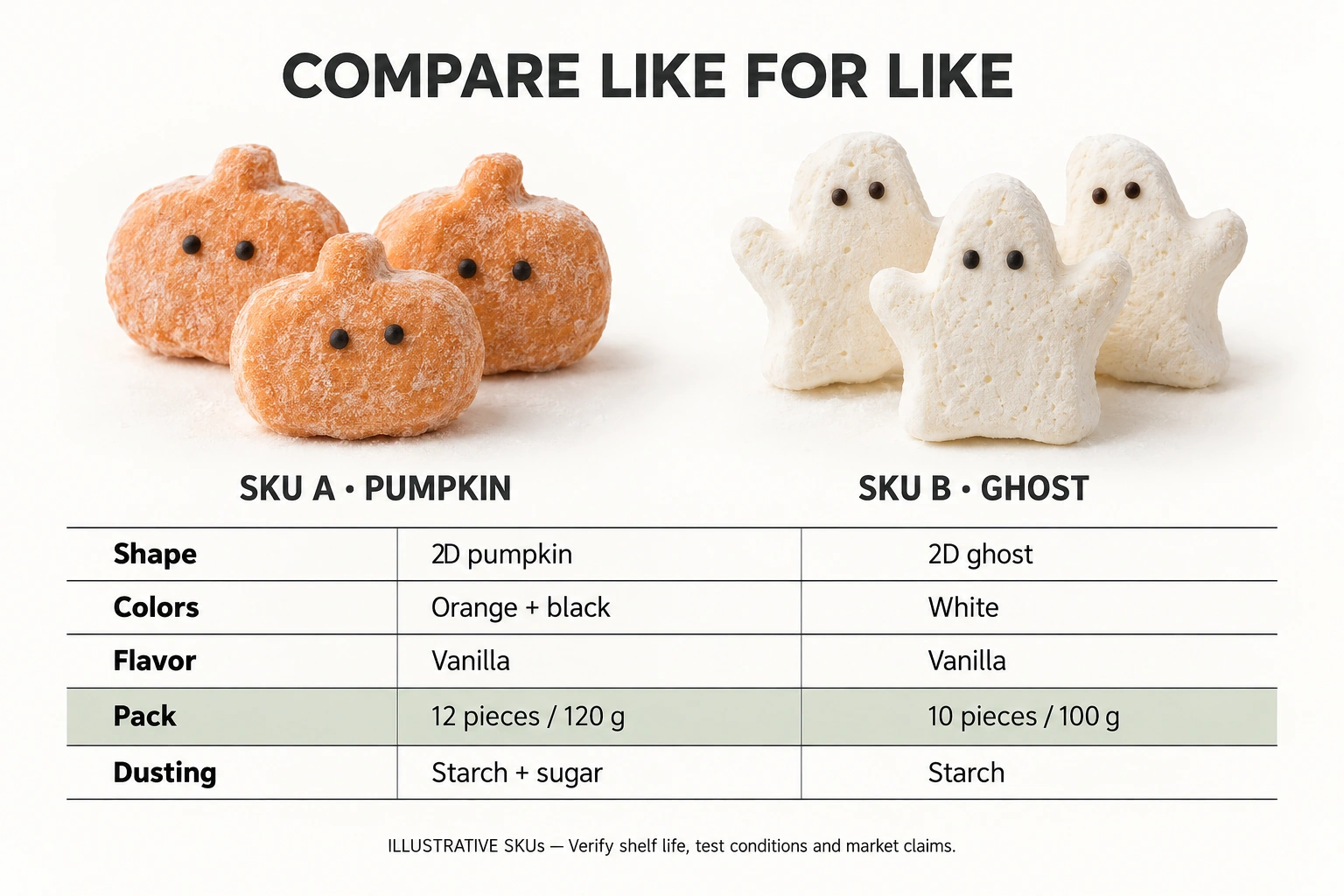
Build a SKU comparison matrix that captures shape, color system, flavor, mouthfeel, shelf-life, anti-sticking method, and packaging specs. Normalize across unit counts and pack sizes. This grounds competitor analysis in comparable, decision-ready data, not just appearance or shelf price.
What to capture and why it matters
I use this matrix to compare internal SKUs, competitor references, and supplier proposals. Every field maps to a decision variable, weight, or gate:
- Shape and mold complexity: Impacts mold cost, changeover time, and loss rates.
- Color system: Single, dual, or multi-color affects downtime during color changes.
- Flavor profile and intensity: Links to regional preferences and pairing (e.g., hot chocolate).
- Mouthfeel: Soft, bouncy, or chewy—affects consumer acceptance and co-use in drinks.
- Shelf-life claim and test conditions: Drives gate decision for Stability.
- Moisture/anti-sticking: Starch dusting, powdered sugar, or hybrid coatings; impacts stickiness and transit performance.6
- Packaging spec: Unit count, net weight, dimensions; affects price ladders, freight density, and planogram fit.
- Pallet and case configuration: Influences logistics windows and display constraints.
Here is an illustrative snippet from a matrix I share with buyers:
| Field | SKU A (Competitor) | SKU B (Supplier) |
|---|---|---|
| Shape | Pumpkin (2D) | Ghost (2D) |
| Colors | Orange + black | White |
| Flavor | Vanilla | Vanilla |
| Mouthfeel | Soft-bouncy | Soft |
| Shelf-life claim | 12 months at 20–25°C | 12 months at ≤25°C |
| Anti-sticking | Starch + sugar | Starch |
| Pack | 12ct, 120 g | 10ct, 100 g |
| Dimensions | 150 x 200 mm | 130 x 180 mm |
| Notes | Promo-heavy Q4 | Fewer color changes—less downtime |
I always annotate with notes sourced from projects: “Typical loss spikes 2–3% during orange/black color switches,” or “To-verify: competitor claims EU-compliant black colorant.” This habit keeps the template honest and actionable.
Pro tip: Add a “Normalize Price” row that converts retail to per-unit comparable only after controlling for unit count and promo intensity. This prevents false inferences about cost or product power.
How does the cost-and-margin module fit the Marshmallow Competitor Analysis Template?
Price-only debates hide margin-killers: loss from color switches, unexpected freight, or promotional allowances. The risk is selecting a “cheaper” SKU that underperforms Gross Margin after channel realities. The solution is a channel-adjusted model that outputs comparable margins.
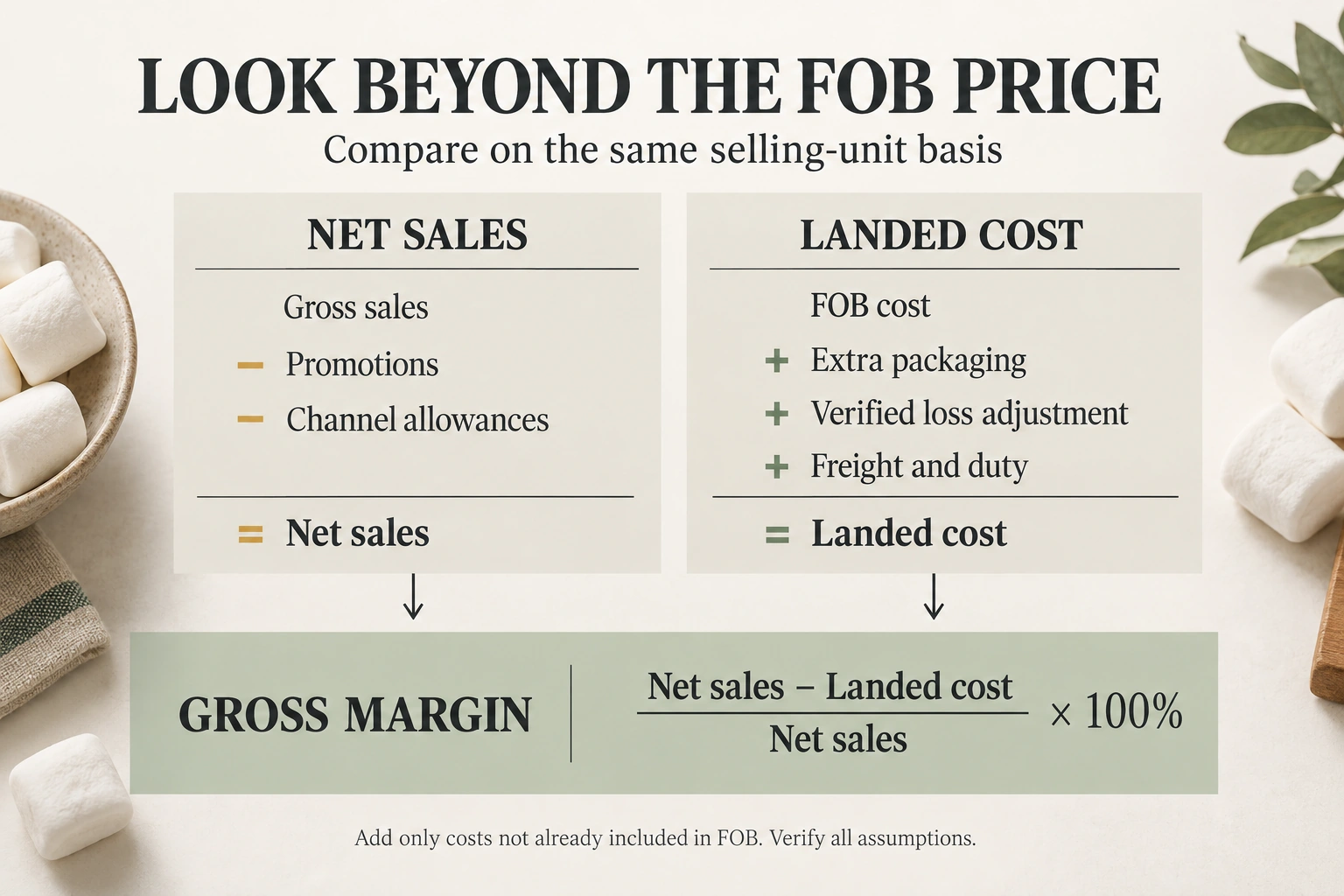
Build a cost-and-margin module that includes FOB, MOQs, expected loss by changeover, packaging cost deltas, freight and duty assumptions, and promo/allowance structures. Output a channel-adjusted gross margin so you rank SKUs by true economics, not nominal FOB.
What to include and how to use it
From factory side, I see margin erosion in predictable places:
- Color/mold changeovers: Downtime and scrap add 1–4% loss depending on sequence.7 We track this by shape and color complexity.
- MOQ pressure: Small seasonal buys push unit cost up due to packaging component MOQs (e.g., printed film and cartons).
- Freight and duties: Heat-controlled routings or peak-season surcharges matter for marshmallows.
- Promo and allowances: Off-invoice, TPRs, display fees, and spoilage allowances must be in the model.
I recommend a simple calculator with the following structure:
- Input:
- FOB/unit
- Packaging deltas (e.g., windowed pouch vs. plain)
- Expected loss/scrap by shape and color (baseline + switches)
- Freight per case and duty rate by destination
- Channel allowances (% of net)
- Retail price ladders and promo cadence
- Output:
- Landed unit cost
- Channel-adjusted GM at Everyday and Promo
- Sensitivity to pack size (e.g., 100 g vs. 120 g)
Example (simplified):
| Variable | SKU C | SKU D |
|---|---|---|
| FOB/unit | $0.22 | $0.19 |
| Expected loss | 2.5% | 4.0% |
| Freight + duty/unit | $0.06 | $0.07 |
| Packaging delta | +$0.02 | +$0.01 |
| Allowances | 12% | 15% |
| Everyday retail | $2.99 | $2.79 |
| Adjusted GM | 33% | 29% |
SKU D looks cheaper on FOB but loses on GM due to higher loss and allowances. This is why I urge teams to separate product power from channel mechanics and normalize inputs before deciding.
Note: I do not infer cost directly from shelf price. I always normalize across unit count and promotions first, then run the economics. Any external cost assumptions are labeled “to-verify.”
Which compliance gates belong in your Marshmallow Competitor Analysis Template?
Compliance “later” becomes non-compliance “never.” The pain is a delayed or rejected listing. The fix is to treat compliance as a hard gate with documented verification. The template should flag missing proofs and market-specific constraints before you shortlist.
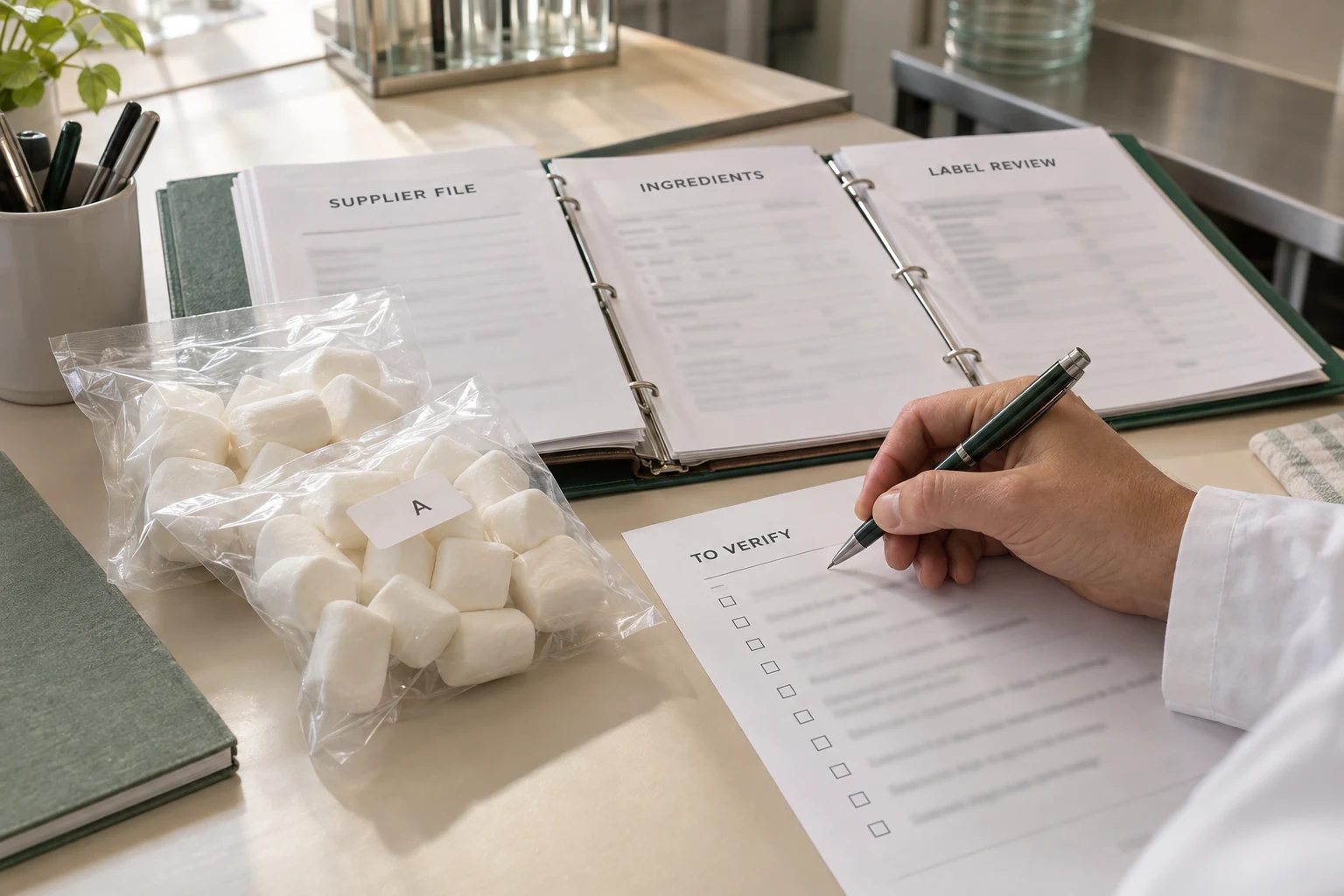
Use a compliance checklist as a gate in your marshmallow competitor analysis template: BRC, FDA facility registration, HACCP/ISO 22000, SMETA, allergen status, and market-specific colorant compliance. Require documents and mark unverified items as “to-verify.” Do not advance non-compliant SKUs.
Gate fields and verification
I structure compliance as a pass/fail panel with mandatory uploads and notes:
- Factory certifications: BRC, ISO 22000, HACCP, SMETA. Buyers verify documents’ validity and scope. I always provide current certificates; I encourage third-party confirmation.
- Market access:
- USA: FDA facility registration confirmation.8
- EU/UK: Allergen statements, E-number colorants admissible in target countries.9
- Labeling readiness: Ingredient lists, nutrition facts formats, allergen labeling for the market.
- Additives and claims: Any claim (e.g., natural color, halal/vegetarian status) marked “to-verify” unless accompanied by third-party certification.
- Traceability and GMP: Batch coding and recall procedures mapped to retailer requirements.
I treat these as non-negotiable. A beautiful seasonal SKU without clear compliance is not a candidate. I also add a “Stability” gate adjacent to compliance: shelf-life under expected storage/transport conditions and anti-sticking method suitability. We test under agreed conditions and annotate observed risks (e.g., stickiness in >28°C high humidity). We recommend buyers engage independent labs or QA teams for market-specific verifications; we do not present lab determinations.
Output fields at this stage:
- Gate: Compliance = Pass/Fail
- Gate: Stability = Pass/Fail
- Notes: Documents attached; items “to-verify”
- Tier suggestion: Advance only Pass/Pass items to cost and channel scoring
How do channel and calendar fit shape decisions in the Marshmallow Competitor Analysis Template?
You can have a perfect product that misses the season. The pain is markdowns and broken margins. The fix is a calendar-aware module that locks display windows and buffers before you get excited about shapes and price.
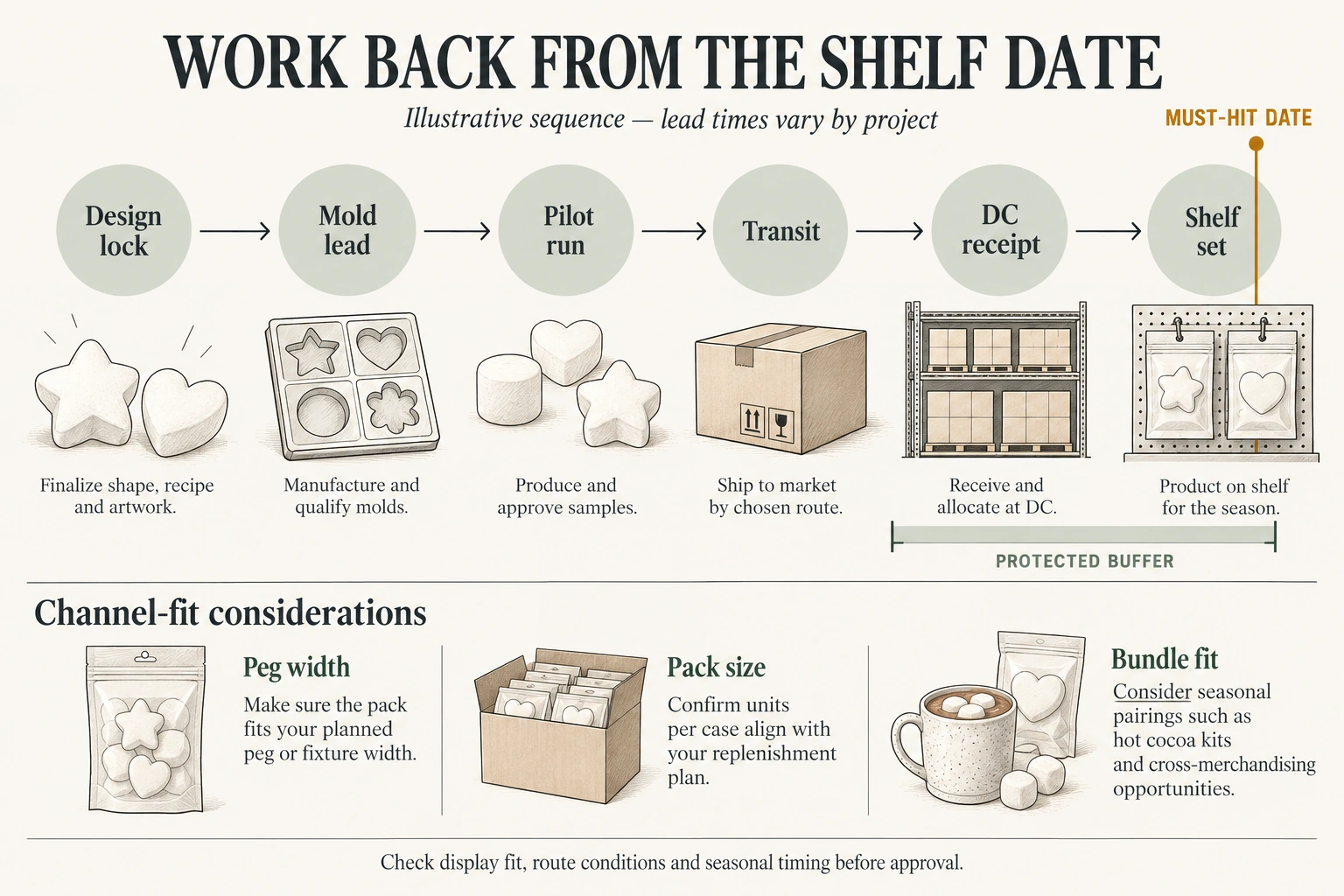
Add a channel & calendar fit module to your marshmallow competitor analysis template: map seasonal themes, display constraints, lead times, and logistics windows. Flag must-hit dates and buffers. Treat Calendar as a gate and only advance SKUs that can realistically ship and set on time.
Building a practical calendar module
From factory to shelf, marshmallows must hit precise windows: Halloween (late September set), Christmas (late November), Easter (late February/March). I configure this module to capture:
- Seasonal theme alignment: Halloween pumpkins, Christmas trees, Easter bunnies; color palettes matter for shopper recognition.
- Lead-time chain: Design lock → mold lead → pilot run → transit → DC receipt → set date.
- Display constraints: Peg vs. box shelf, gift sets, and bundle roles (e.g., hot cocoa kits).
- Logistics windows: Heat-sensitive routes may require specific transit timing or insulation.10
- Buffer planning: Add calendar buffers for port congestion or QC rework.
I learned to tie packaging specs to price ladders by channel. In one EU chain, shifting from 120 g to 100 g unlocked a €0.99 price point and improved GM without hurting perceived value because the display size looked identical. We captured this in the module as a “channel fit advantage.”
Use a simple table with go/no-go flags:
| Field | Requirement | SKU E | Gate |
|---|---|---|---|
| Theme | Halloween 2D | Pumpkin | Pass |
| Set date | 28 Sep | Ships 10 Aug | Pass |
| Display | Peg width ≤15 cm | 14 cm | Pass |
| Bundle role | Cocoa kit compatible | Yes | Pass |
| Buffer | ≥10 days | 7 days | Fail (Calendar) |
The Calendar gate is hard. If buffers are too thin, mark the SKU as “Pilot only” or “Reject” even if economics look good. The template should push only realistic candidates forward.
How do you assess supply and process risk for shaped marshmallows?
The best-looking concept can stall in production. The pain is high scrap, missed plans, and QC complaints. The answer is a supply/process risk module that converts factory realities into go/no-go and tier outputs.
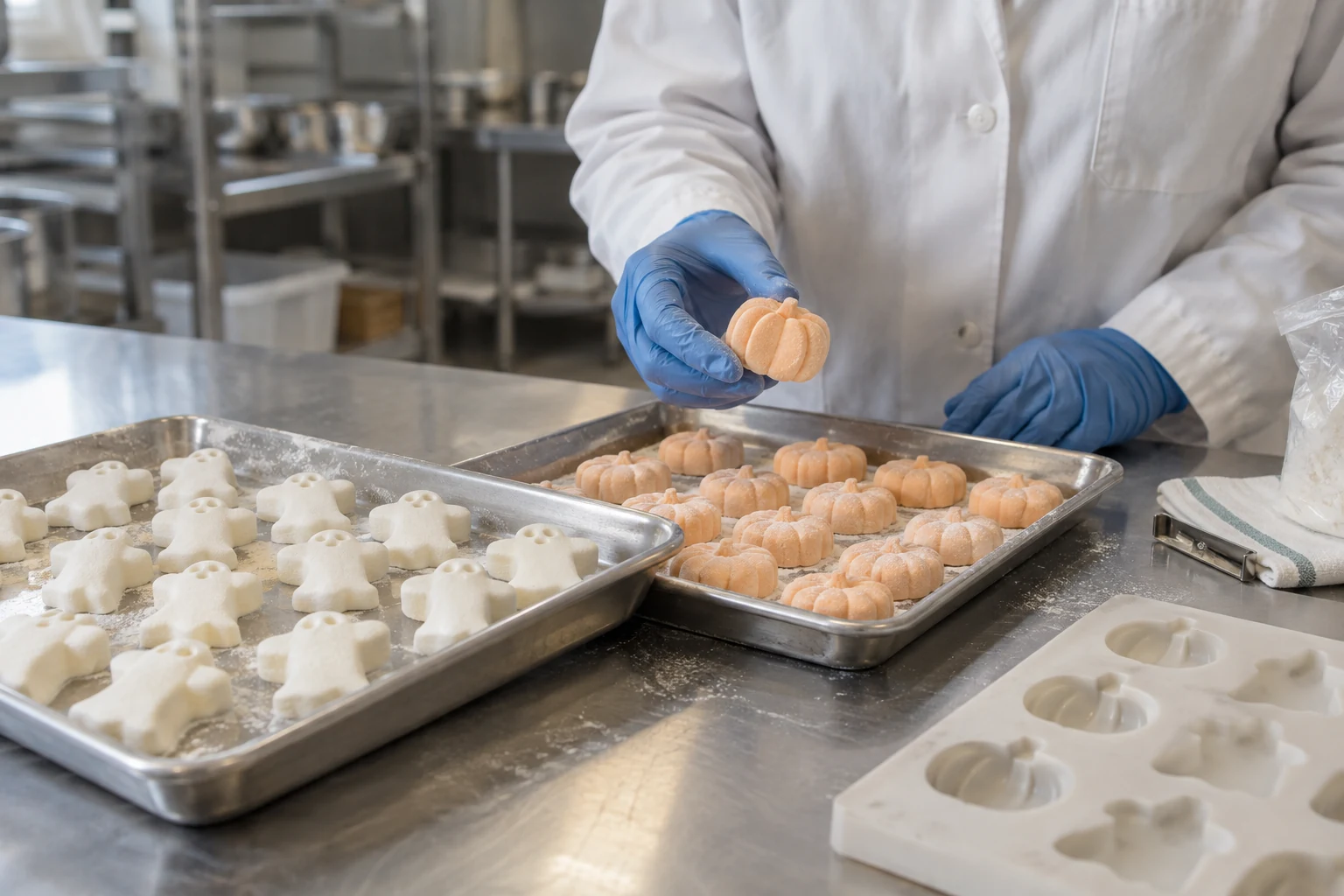
Add a supply and process risk module that scores mold changeover time, color-change downtime, dusting/coating limits, and transit stability risks. Define go/no-go and “Pilot only” scenarios. Output clear tiers: Retail-ready, Pilot, or Reject.
Turning factory realities into decisions
On our line, three process realities drive outcomes:
- Mold complexity and changeovers:
- High-detail shapes can slow demolding and raise loss by 1–2%.
- Frequent mold swaps inflate downtime; schedule sequencing can mitigate this.
- Color-change downtime:
- Multi-color SKUs require purges that cost time and scrap; darker colors exacerbate carryover.11
- A red→white change takes longer than white→red;12 we plan sequences to minimize impact.
- Dusting/coating constraints:
- Starch-only dusting can be adequate for mild climates but risks stickiness in hot/humid transit.
- Adding powdering or hybrids helps, but packaging must be compatible to avoid powder transfer issues.
I score risks with a simple rubric and tie them to action:
- Low risk: Proceed as Retail-ready.
- Medium risk: Pilot only with controlled routes or limited channels.
- High risk: Reject or redesign (e.g., simplify mold or shift colors).
An example risk panel:
- Mold changeover: Medium (2 molds, 1–2 hours)
- Color change: High (orange/black sequence)
- Dusting suitability: Medium (starch + light powder)
- Transit route: Hot corridor; insulated option available
- Recommendation: Pilot only; sequence color to white→orange→black; use insulated transit for first shipment
- Notes: Prior project loss peaked at 3.8% during black color purge; adjust batch size to reduce carryover
Tie this module back to your gates:
- If Stability or Calendar gates failed, output is “Reject.”
- If gates pass but risk is medium, output “Pilot” tier.
- Only “Retail-ready” flows through to final price comparisons and packaging beauty contests.
Remember to source notes from real runs. I never generalize beyond observed data. If another supplier claims “no loss in color switches,” I mark that “to-verify” and request pilot evidence.
Frequently Asked Questions
Why not just copy a generic candy template?
Shaped marshmallows behave differently from gummies or hard candy. Moisture, anti-sticking methods, and heat sensitivity make shelf-life and texture stability critical. A generic template underweights these risks. A dedicated marshmallow competitor analysis template gates compliance and stability first, preventing late-stage failures.
How do I normalize competitor prices for fair comparison?
Normalize by pack size, unit count, and promotion intensity before any comparison. Convert shelf price to per-unit, non-promoted equivalents. Separate product power from channel mechanics by capturing display type, promo cadence, and bundle roles. Only then run cost-and-margin models to avoid misleading “cheap vs. expensive” narratives.
What documents should I request from a factory?
Request BRC, FDA facility registration, ISO 22000/HACCP, and SMETA reports. Ask for allergen statements, colorant compliance by market, and labeling templates. Verify validity and scope with third parties if needed. Treat any missing or outdated document as a gate fail or “to-verify” until confirmed.
How do I set shelf-life requirements that match my logistics?
Define shelf-life under your actual storage and transit conditions, not ideal lab settings. If you ship through warm corridors, specify temperature/humidity ranges and test stability under those conditions. Align dusting/coating choices and packaging specs to those routes. Treat Stability as a gate.
When is a “Pilot only” tier appropriate?
Use “Pilot only” when a SKU passes Compliance and Calendar but shows medium process or route risk. Pilot in limited channels or controlled logistics to validate stability, loss rates, and sell-through. Promote to “Retail-ready” only after data confirms risk controls work.
Conclusion
A strong Marshmallow Competitor Analysis Template gates Compliance, Stability, and Calendar before it ranks anything else. Then five modules—SKU matrix, cost-and-margin model, compliance checklist, channel & calendar fit, and supply/process risk—turn comparisons into decisions with clear tiers: Retail-ready, Pilot, or Reject. If you want a working template and a factory partner who lives this framework, contact our team to co-build your next seasonal win.
"Moisture and shelf life in sugar confections", https://pubmed.ncbi.nlm.nih.gov/20112158/. Reference descriptions of marshmallows explain that these aerated sugar–gelatin confections are prone to becoming tacky under warm or humid conditions and are often dusted with starch or powdered sugar to prevent sticking. Evidence role: mechanism; source type: encyclopedia. Supports: Marshmallows are aerated sugar–gelatin confections that are hygroscopic and can become sticky with heat and humidity; dusting with starch or powdered sugar is commonly used to reduce sticking.. Scope note: Such references outline typical properties and practices but do not quantify performance under specific logistics scenarios. ↩
"E number", https://en.wikipedia.org/wiki/E_number. EU food law (e.g., Regulation (EC) No 1333/2008 and its annexes) specifies which food colours are authorised and the conditions of their use, meaning use of a non‑authorised colour for a given application would be non‑compliant. Evidence role: definition; source type: government. Supports: EU law lists authorised food colours (with E-numbers) and specifies conditions of use, so non-authorised colours or uses are restricted.. ↩
"Questions-and-Answers-Regarding-Food-Facility- ...", https://www.fda.gov/files/food/published/Questions-and-Answers-Regarding-Food-Facility-Registration-(Seventh-Edition).pdf. Industry standards such as the BRCGS Food Safety Standard and ISO 22000 are widely used to operationalize HACCP principles in food production, while U.S. facilities are legally required to register with FDA under FSMA. Evidence role: expert_consensus; source type: institution. Supports: BRCGS and ISO 22000 implement HACCP principles and are widely adopted by food manufacturers, and U.S. food facilities are required to register with the FDA.. Scope note: This establishes common practice and regulatory context but does not imply any single certificate is universally mandated in all markets. ↩
"Food Allergen Labeling and Consumer Protection Act of ...", https://www.fda.gov/food/food-allergensgluten-free-guidance-documents-regulatory-information/food-allergen-labeling-and-consumer-protection-act-2004-falcpa. Regulatory frameworks define market‑specific requirements—for example, U.S. law mandates major allergen declarations and approves colour additives for specific uses, while the EU has its own allergen‑labelling and colour‑use rules—so verification against the target market is required. Evidence role: definition; source type: government. Supports: Major allergen labeling and permitted colorant use are defined by jurisdiction (e.g., U.S. allergen laws and color approvals; EU allergen and additive rules), necessitating market-specific verification.. Scope note: This evidence is jurisdiction-specific and does not encompass all countries. ↩
"Moisture and shelf life in sugar confections", https://pubmed.ncbi.nlm.nih.gov/20112158/. Food physics studies report that sugar‑rich confections undergo temperature‑ and humidity‑dependent transitions (e.g., water activity and glass transition) that promote softening and stickiness, directly influencing shelf‑life and texture during distribution. Evidence role: mechanism; source type: research. Supports: Research on confectionery physics shows temperature- and humidity-dependent changes (water activity, glass transition) that drive softening and stickiness, affecting shelf-life and texture.. Scope note: Many studies use model systems and may not test commercial marshmallow products directly. ↩
"Can cornstarch be omitted from homemade marshmallow ...", https://www.facebook.com/groups/TheWeddingCookieTableCommunity/posts/3148732255413930/. Reference articles on marshmallows note the common practice of dusting finished pieces with starch or powdered sugar to reduce surface tack and sticking. Evidence role: general_support; source type: encyclopedia. Supports: Marshmallows are commonly dusted with starch and/or powdered sugar to reduce tackiness and sticking.. Scope note: Such references describe customary practice without quantifying effects under distribution conditions. ↩
"How to Reduce Changeover Time and Scrap Rate in ...", https://www.parsec-corp.com/blog/how-to-reduce-changeover-time-and-scrap-rate-in-manufacturing. Operations and lean‑manufacturing guidance explains that production changeovers typically incur downtime and purge‑related scrap, which lower effective yield and can impact economics. Evidence role: general_support; source type: education. Supports: Changeovers in manufacturing cause downtime and purge-related scrap, reducing yield until steady operation resumes.. Scope note: These sources confirm the principle but do not substantiate the specific 1–4% loss range for marshmallow production. ↩
"21 CFR Part 1 Subpart H -- Registration of Food Facilities", https://www.ecfr.gov/current/title-21/chapter-I/subchapter-A/part-1/subpart-H. U.S. regulations require domestic and foreign facilities that manufacture, process, pack, or hold food for consumption in the United States to register with FDA (21 CFR Part 1, Subpart H). Evidence role: definition; source type: government. Supports: U.S. law requires domestic and foreign food facilities to register with FDA.. ↩
"E number", https://en.wikipedia.org/wiki/E_number. In the EU, authorised food additives—including specific colours—are listed by E‑number with defined conditions of use in Regulation (EC) No 1333/2008 and subsequent updates, so admissibility must be checked for the intended application. Evidence role: definition; source type: government. Supports: EU regulations list authorised colours by E-number with conditions of use; compliance requires verifying admissibility.. ↩
"FSMA Final Rule on Sanitary Transportation of Human and ...", https://www.fda.gov/food/food-safety-modernization-act-fsma/fsma-final-rule-sanitary-transportation-human-and-animal-food. Under the U.S. FSMA Sanitary Transportation rule, shippers and carriers must implement temperature control or other measures as needed to keep food safe during transport, supporting the use of special routing or insulation for heat‑sensitive products. Evidence role: general_support; source type: government. Supports: Sanitary transportation regulations anticipate temperature control or other measures when necessary to protect food during transit.. Scope note: The regulation is general and does not address marshmallows specifically. ↩
"Color Change Taking Forever? Try This Purging Method", https://mdplastics.com/feeds/blog/purging-quick-color-change. Production changeover practice commonly recognises that moving from darker to lighter coloured products increases visible carry‑over risk and typically necessitates longer purge or more intensive cleaning. Evidence role: general_support; source type: education. Supports: Guidance on production changeovers notes that transitions from darker to lighter colours increase carryover visibility and require more thorough purge/cleaning.. Scope note: This evidence is general to manufacturing and not specific to marshmallow lines. ↩
"Effect of light, packaging condition and dark storage durations ...", https://pmc.ncbi.nlm.nih.gov/articles/PMC3550929/. Changeover guidelines often state that transitions from darker to lighter products require additional purge or cleaning time compared with lighter‑to‑darker changes to prevent visible residue. Evidence role: general_support; source type: education. Supports: Manufacturing practice notes that dark-to-light colour changes generally need longer purge/cleaning than light-to-dark to avoid residue.. Scope note: Practice-based guidance may vary by process, equipment, and formulation. ↩